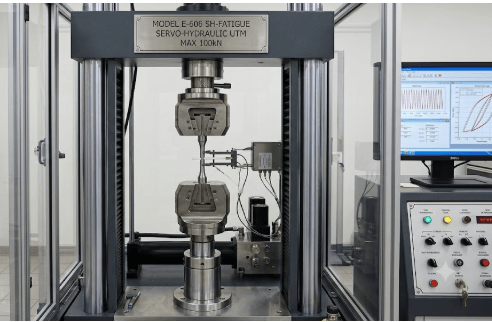
ASTM E606 provides guidelines for testing the fatigue behavior of metallic materials under controlled laboratory conditions using a strain-controlled loading mode. This test standard-
- Calculates low-cycle fatigue properties of metals.
- Assesses the relationships between strain-life (ε-N).
- Measures a cyclic stress-strain response.
- Supplies information to predict fatigue life and to design.
- Used for structural, aerospace, automotive, biomedical, and industrial metals.
- Fatigue testing for quality assurance and material qualification, in accordance with standards.
What are the Uses of ASTM E606 Testing?
ASTM E606 testing gives an idea of the response of metallic materials to repeated cyclic loading and can help to estimate the fatigue life of the material in service environments. The outcomes are used for material selection, structural design, product development, quality assurance, and failure prevention.
- ASTM E606 is used to assess the fatigue resistance of aviation structures such as aircraft, turbine blades, landing gear, and engine parts subjected to repeated cyclic loading during service. The findings help improve aircraft safety and structural reliability.
- An automotive manufacturer will conduct ASTM E606 testing on suspension parts, crankshafts, connecting rods, gears, and drive shafts to ensure they last long-term under repetitive loading.
- ASTM E606 is used to evaluate turbines, pressure vessels, piping systems, and rotating equipment subjected to cyclic thermal and mechanical stresses in the power generation industry. Fatigue Testing can help to minimize maintenance expenses and catastrophic failures.
- Biomedical manufacturers test different metallic implants, orthopedic devices, and surgical instruments to ensure they can withstand fatigue under long-term cyclic loading within the human body.
- Research laboratories compare advanced engineering applications with new alloy compositions, heat treatments, and manufacturing processes using ASTM E606.
What Materials Can Be Tested Under ASTM E606?
ASTM E606 is generally used for metallic materials such as carbon steels, stainless steels, aluminum alloys, titanium alloys, nickel-based superalloys, magnesium alloys, copper alloys, cobalt alloys, cast irons, welded metals, additive-manufactured metals, and other engineering alloys, for which fatigue performance under cyclic loading is a significant design concern.
Why is ASTM E606 Important for Fatigue Evaluation?
ASTM E606 provides engineers with a uniform standard to measure fatigue life under strain- controlled cyclic loading and provides a more accurate assessment of whether a component will survive its intended service life without failure. Fatigue data is crucial in safe engineering design, material selection, reduced maintenance costs, increased component life, and avoiding unexpected structural failure in critical applications.