
ASTM E488 Standard Test Methods for Strength of Anchors in Concrete and Masonry Elements

    What is ASTM E488? 

    ASTM E488 describes standard test methods to obtain the tensile and shear strength of post-installed or cast-in-place anchors in cracked or uncracked test members. These test methods include quasi-static, seismic, fatigue, and shock anchor loading tests and apply to anchorage devices intended to be installed at right angles to a planar surface of the test member. ASTM E488 (Standard Test Methods for Strength of Anchors in Concrete Elements) is used in the laboratory to apply tension or shearing force to anchor specimens and measure the failure mode: pullout, anchor fracture, concrete cone failure, or hardware fracture. Test programs also apply optional environmental exposures, such as freeze-thaw cycling, moisture, or temperature extremes, to evaluate anchor performance under realistic service conditions. Manufacturers and structural engineers use these results to establish criteria for anchor use in concrete construction, design data, and product specifications. 

    Read more

    Get Certified ASTM E488 Testing for Reliable Anchor Strength Verification 

    Anchors are used in a variety of applications, including structural, curtain wall, and equipment mounting, and are therefore considered safety-critical components that require testing to ensure their strength under realistic loading conditions. ASTM E488 certified testing ensures the tensile and shear strength of a post-installed or cast-in-place anchor is appropriate for the intended use application in cracked and/or uncracked concrete. This testing is carried out in IAS-accredited laboratories to assist with product approval programs, code compliance submissions, and program-specific acceptance requirements. The certified ASTM E488 testing provides manufacturers with reproducible anchor performance data and provides structural engineers with peace of mind when specifying anchor systems for applications requiring critical performance.
    What is the Scope of ASTM E488? 

    ASTM E488 includes methods for testing the tensile and shear resistance of post-installed and cast-in-place anchors in uncracked and cracked concrete test members. These test methods are applicable to anchorage devices that are fastened at right angles to a plane surface of the test member, and cover various types of loading, such as quasi-static, seismic, fatigue, and shock. The scope of ASTM E488 includes: 

    Read more

    • Material type: Cast-in-place and post-installed mechanical and adhesive anchors that are used in hardened concrete. 
    • Purpose: To generate reproducible anchor strength data to provide acceptance data, design data, and specifications. 
    • Properties evaluated: Tensile strength, shear strength, and failure mode under loading.
    • Testing Method: Controlled quasi-static, seismic, fatigue, or shock loading of anchor specimens in tension or shear.
    • Result: Maximum load, displacement, and observed failure mode of every anchor specimen. 
    • Test Limitations: These test methods are only applicable to anchors installed normal to a plane surface of the test member. 
    • Use conditions: The strength of the concrete, embedment depth, spacing, edge distance, and exposure to freeze-thaw, moisture, and/or temperature extremes influence anchor performance. 
    • Applications: Structural anchor qualification, product approval submission, curtain wall and facade anchorage, and equipment mounting design verification. 

    What are the Uses of ASTM E488 Testing?

    ASTM E488 testing helps manufacturers and laboratories to accurately measure the tensile and shear performance of an anchor in concrete. Structural engineers then apply this data to create design values and verify product suitability for a specific application. This standard-

    • Measures the pullout strength of post-installed and cast-in-place anchors.
    • Tests the shear resistance of anchors in place and installed in concrete.
    • Tests anchoring in cracked and uncracked concrete.
    • Determines anchor response to quasi-static, seismic, fatigue, and shock loading.
    • Identifies failure modes such as pullout, concrete cracking, and hardware breakage.
    • Assists with product approval and code submissions for anchorage systems. 

    What Materials Can Be Tested Under ASTM E488? 

    ASTM E488 applies to cast-in-place and post-installed mechanical and adhesive anchors made by manufacturers for installation in hardened concrete, such as expansion anchors, undercut anchors, screw anchors, and chemical adhesive anchors. The test methods accommodate anchors that technicians install in either cracked or uncracked concrete test members. Analysts verify the type of anchor, embedment depth, spacing, edge distance, and concrete strength before starting a test program, because these factors will directly affect the results of the tests.

    Why is ASTM E488 Important? 

    ASTM E488 offers standardized testing methods to provide repeatable tensile and shear strength measurements of anchors in concrete. Anchors serve as safety-critical connections in structural and non-structural applications and have widely differing capacities depending on the quality of the concrete, loading type, and loading history. The results assist the engineer in developing reliable design values for product certification and in validating that an anchorage system is safe for its duty under the loading conditions to which it is subjected to in service. 

    ASTM E488 Equipment and Sample Preparation Guide

    ASTM E488 requires a loading apparatus to apply a controlled tensile or shear load to the anchor specimen, and instrumentation to monitor load and displacement. Prior to testing, technicians prepare representative concrete test members that contain anchors in the laboratory. 

    Read more

    Sample and Specimen DetailsRepresentative cast-in-place or post-installed anchor specimens embedded in concrete test members of specified strength, either cracked or uncracked. 
    Specimen PreparationTechnicians install or cast anchors into the concrete test member at the specified embedment depth, spacing, and edge distance according to the manufacturer’s or test program’s requirements. 
    Specimen DimensionsTechnicians select concrete test member dimensions, anchor embedment depth, spacing, and edge distance based on the anchor type and the loading configuration under evaluation. 
    InstrumentationTechnicians use hydraulic or mechanical loading apparatus, load cell, displacement transducers or LVDTs, a reaction frame, and a concrete test member of specified strength and condition. 

    Testing Procedures and Requirements for ASTM E488  

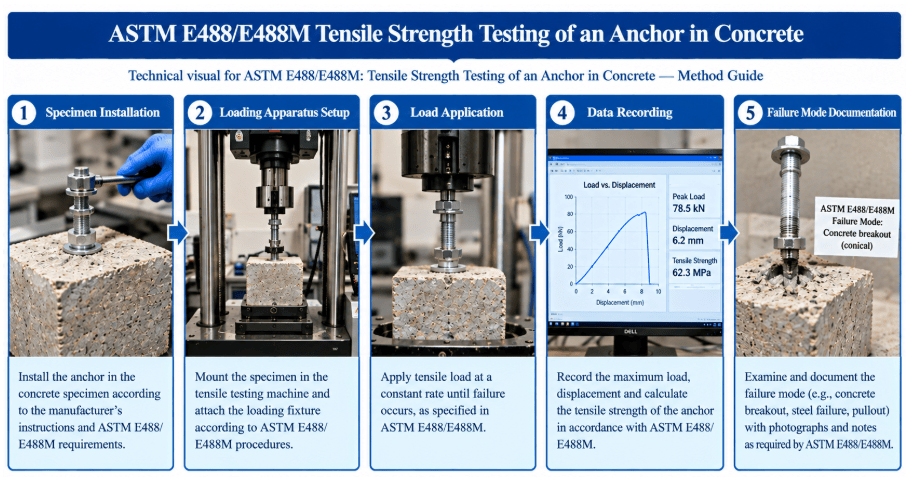
    ASTM E488 testing involves applying controlled tensile or shear load to an installed anchor specimen and measuring the load, displacement, and failure mode. Based on the test program, the technician selects the loading category (quasi-static, seismic, fatigue, or shock), and the loading sequence is completed in the laboratory. The ASTM E488 test method includes the following test procedure: 

    Read more

    Specimen Installation Technicians install or cast the anchor into the concrete test member at the specified embedment depth, spacing, and edge distance. 
    Loading Apparatus Setup Technicians mount the loading apparatus and align it to apply tensile or shear force to the anchor along the required loading axis. 
    Load Application The apparatus applies quasi-static, seismic, fatigue, or shock loading to the anchor at the specified rate until failure or a defined displacement limit occurs. 
    Data Recording Technicians record load and displacement continuously throughout the test using a load cell and displacement transducers. 
    Failure Mode Documentation Analysts document the observed failure mode, such as pullout, anchor fracture, concrete cone failure, or hardware fracture. 

    ASTM E488 Testing Process and Data Collection

    The analyst selects representative anchor specimens, verifies the strength and crack condition of the concrete test member, and then conducts tests. Then the technicians perform the installation or casting of anchors to the specified embedment depth, spacing, and edge distance. The operator installs the loading apparatus and exerts tensile or shear force as per the selected loading category. As the test continues to failure or to a predetermined displacement limit, the technicians continuously record the load and displacement data. Lastly, analysts document the observed failure mode and compile the peak load and displacement data for each specimen. 

     The image shows an anchor specimen mounted in a loading apparatus for tensile strength testing in concrete as per ASTM E488.
    ASTM E488 Tensile Strength Testing of an Anchor in Concrete

    Common Challenges and Troubleshooting

    Accurate results for ASTM E488/E488M require correct anchor installation, the correct loading alignment, and the same concrete test member quality. If the loading is misaligned, it creates unwanted bending or eccentric loading forces that introduce an error in the estimated strength. Different strengths, embedment depths, or edge distances in specimens result in different failure loads. Installation torque, embedment depth, and loading apparatus alignment must be verified before testing. Laboratories also obtain reliable results when preparing and testing all anchor specimens under the same concrete strength and crack condition. 

    ASTM E488 Analysis Results and Interpretation

    The report provides a summary of the tensile or shear strength and failure mode that technicians record for each of the anchor specimens tested. Analysts then compare these results against design values or acceptance criteria for the anchor type under evaluation.

    Read more

    • The laboratory provides the load at which each anchor specimen tested was pulled to a maximum, either in tension or shear.
    • The analyst writes down the load-displacement data observed throughout the test.
    • The laboratory records the failure mode, such as pullout, fracture of the anchor, fracture of the concrete cone, or fracture of the hardware.
    • Analysts compare results across specimens tested in cracked versus uncracked concrete.
    • The report covers the outcome of the test program for each of the loading categories: quasi-static, seismic, fatigue, and shock. 

    Link to ASTM E488

    FAQ

    ASTM E488 covers what loading conditions?
    ASTM E488/E488M are specifications for quasi-static, seismic, fatigue, and shock loading of anchors in concrete test members.
    Yes. These test methods address the performance of anchors in both cracked and uncracked concrete test members, because the condition of the cracks significantly affects anchor capacity.
    ASTM E488 is a standard that covers cast-in-place and post-installed mechanical and adhesive anchors manufactured by a manufacturer and installed by a contractor in hardened concrete as installed at right angles to a plane surface of the test member.
    Testing identifies failure modes including anchor pullout, deformation or fracture of the anchor, cracking of the surrounding concrete, and fracture of associated hardware or accessories.

    Updated on September 16, 2026

    Prakash Pandey
    About Author
    Testimonials
    Real results
    Engineers trust us with what matters most
    Start Your Testing
    Project Today
    Define your requirements and get access to
    specialized laboratories ready to deliver results
    Partners with us
    Clients
    Vendors
    Process for testing
    • STEP 01

      You share your testing requirements

    • STEP 02

      You share your sample(s)

    • STEP 03

      We deliver your test reports

    Get your testing done

    Let us known your testing requirements and we will be right back with a solution.

      Let us root for each other. Collaborate to grow, expand, and accelerate our businesses.

      Partner with us

        Contact Us

        Discover more from Matestlab Inc

        Subscribe now to keep reading and get access to the full archive.

        Continue reading