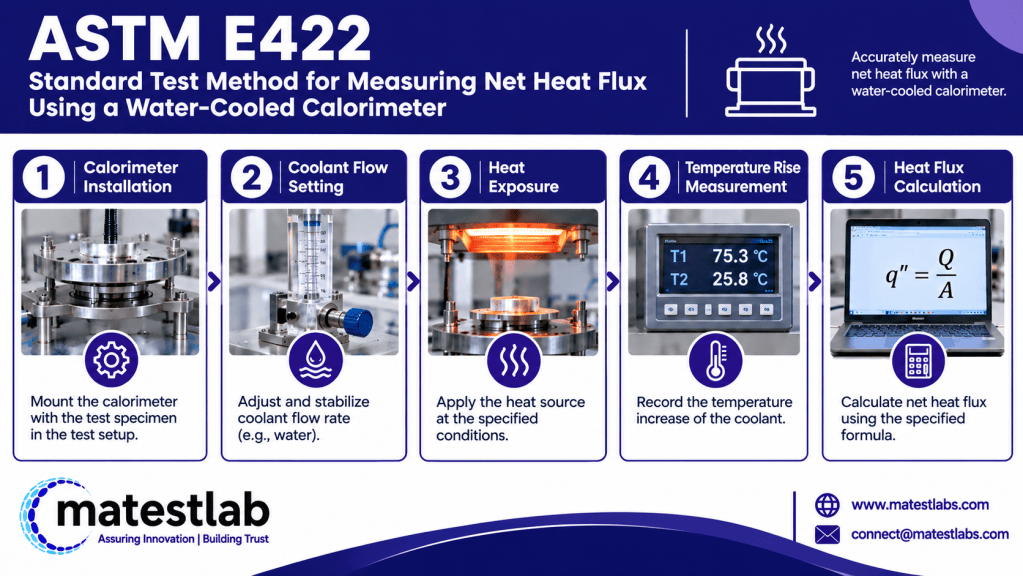
ASTM E422 is a standard test method that specifies measuring steady net heat flux to a specified water-cooled surface using a system energy balance. It measures the heat uptake by the surface of the calorimeter from the radiative, convective, or combined thermal environment. This standard specifies a uniform test method for detection of net heat flux to a water-cooled surface for the purpose of specimen evaluation of the thermal environment.
The primary purpose of ASTM E422 is to calibrate the thermal environment into which test specimens go. This test is employed in test facilities for specimen evaluation, material testing, and thermal environment control.
The scope of ASTM E422 includes
- Material type: Water-cooled calorimeter surface with a holder that matches the size, shape, and surface finish of the test specimen.
- Purpose: Calibration of the thermal environment for test specimens.
- Properties measured: Steady heat flux to a water-cooled surface.
- Method: Testing consists of flowing cooling water through the calorimeter and measuring the increase in the temperature of the water as the surface absorbs thermal energy. The net heat flux is obtained from a system energy balance.
- Result: Average heat flux over the area of the calorimeter in use.
- Test Limitations: The calorimeter has a long response time, and the thermal environment and fluid flow must be at steady state.
- Environmental conditions: When calculating energy losses, it is essential that energy losses remain small; when calculating radiative or combined flux, it is essential that the surface reflectivity of the calorimeter is measured over the wavelength region of interest.
- Applications: Calibration of thermal environments for specimen evaluation, material testing, and measurement of the distribution of net heat flux on a heated surface.
What are the Uses of ASTM E422 Testing?
ASTM E422 is used to help test facilities in determining the amount of heat absorbed by a surface. Engineers then apply that understanding to assess materials in given situations. This standard-
- Measures the net heat flux to a water-cooled surface at a constant rate.
- Adjusts the thermal environment for the test specimen.
- Supports heat flux (radiative, convective, or combined).
- Provides information about the heat flux distribution over the heated surface when multiple calorimeters are placed across the surface.
- Uses a system energy balance with a coolant temperature rise approach.
- Works under uniform net heat flux and when the surface area of the calorimeter is small.
What Materials Can Be Tested Under ASTM E422?
ASTM E422 applies to a water-cooled calorimeter, not a material sample. The test specimen should be the same size, shape, and surface finish as the calorimeter and its holder. The calorimeter is kept small and located at a uniform net heat flux. At the time of a distribution, they lay several calorimeters on the heated surface. They also measure the reflectivity of the surface of the calorimeter for radiative flux.
Why is ASTM E422 Important?
ASTM E422 provides a standard procedure for test facilities to determine the net heat flux to a water-cooled surface. A test specimen’s performance is directly related to the amount of heat received, and the lab needs to know that amount. If the size, shape, and finish of the calorimeter are the same as those of the specimen, the measured flux is assumed to be the same as that on the specimen.