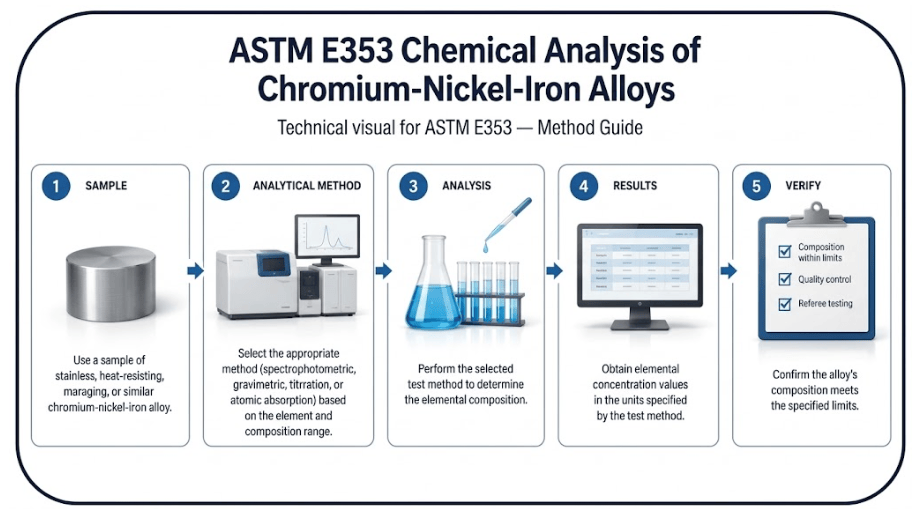
ASTM E353 describes standard test methods for the chemical analysis of stainless, heat-resistant, maraging, and other similar chromium-nickel-iron alloys. A referee method includes multiple analytical procedures in order to determine the amount of elements in a given alloy since there is no analytical procedure capable of analyzing every element in the group of chromium-nickel-iron alloys. The scope of ASTM E353 includes:
- Material type: Stainless, heat-resisting, maraging, and other similar chromium-nickel-iron alloys.
- Purpose: Referee analysis of an alloy to determine conformance to a specification that allows an alloy to meet performance requirements.
- Elements covered: A variety of elements, including manganese, aluminum, silicon, molybdenum, cobalt, chromium, nickel, titanium, tungsten, niobium, phosphorus, copper, and vanadium, are analyzed using a test method suitable for the element’s concentration levels.
- Testing method: Spectrophotometric, gravimetric, titration, or atomic absorption methods are used in accordance with the element’s concentration levels and the alloy composition.
- Results: Elemental concentration values are reported in the units specified by the individual test method used.
- Test limitations: Determination of carbon and sulfur is intentionally excluded from this standard and is given in ASTM E1019. Some composition ranges require more than one test method for full coverage.
- Applications: Compositional verification, referee testing, and quality control for chromium-nickel-iron alloys used in demanding structural and corrosive-service applications.
What are the Uses of ASTM E353?
ASTM E353 gives chemists a referee method for the verification of a chromium-nickel-iron alloy composition, which is applied by metal producers, fabricators, and end-users to check the material compliance before subjecting it to critical service. The test methods-
- Verify that an alloy element’s composition is within the limits defined by a specification.
- Support referee testing when a compositional dispute arises between a supplier and a purchaser.
- Assist metal producers in confirming quality control during alloy manufacturing.
- Help select the correct analytical technique for a given element and composition range.
- Support material certification for aerospace, automotive, construction, and power-generation applications.
Which materials can be tested under ASTM E353?
ASTM E353 applies to stainless, heat-resisting, maraging, and other similar chromium-nickel-iron alloys whose composition falls within the limits established by the standard. The method is suitable for austenitic, ferritic, and martensitic stainless steels, as well as related superalloys, used in structural, corrosion-resistant, and high-temperature applications. Before testing, a chemist should identify the expected composition of an alloy and select the specific test method suited to the element and concentration range under investigation.
Why is ASTM E353 Important?
ASTM E353 gives industries that depend on chromium-nickel-iron alloys a trusted referee method for settling questions about an alloy’s actual composition. Because these alloys serve in aerospace, automotive, construction, and power-generation applications where corrosion resistance and mechanical strength depend directly on precise composition, an inaccurate analysis can lead to a material failing in service. The standard assumes chemists performing the work are trained analysts working in a properly equipped laboratory under appropriate quality control practices, which keeps referee results consistent and defensible.