
ASTM E34 is a standard test method that provides procedures for chemically analyzing aluminum and aluminum-base alloys. The test method is for the determination of elemental composition within a certain range of concentration, including beryllium (0.3 to 100 ppm), copper (0.01 to 20.0 %), magnesium (0.002 to 12.0 %), silicon (0.05 to 20.0 %), zinc (0.003 to 12.0 %) and many other elements. The technique uses analytical methods such as atomic absorption spectrometry, inductively coupled plasma spectroscopy, and wet chemical methods to precisely analyze the chemical composition of aluminum materials. The mechanical properties, corrosion resistance, and performance of aluminum materials are closely related to their elemental composition. ASTM E34 (Standard Test Methods for Chemical Analysis of Aluminum and Aluminum-Base Alloys) specifies alloy requirements for alloy composition, impurity control, and consistent material properties for manufacturing and quality control laboratories. The test results are applicable for quality assurance, material certification, and product development in different industries.
ASTM E34 Chemical Analysis of Aluminum and Aluminum-Base Alloys
What is ASTM E34?
What is the Scope of the ASTM E34 Test Standard?
ASTM E34 is the standard that details methods for chemically analyzing aluminum and aluminum alloys. The test method includes determining major alloying elements, minor and trace elements, impurity levels, and compliance with composition standards. Specific procedures are included for various analytical techniques, and limits of composition are given for certain elements, including Be, Bi, B, Cd, Cr, Cu, Ga, Fe, Pb, Li, Mg, Mn, Ni, Si, Sn, Ti, V, Zn, and Zr. The scope of ASTM E34 includes:
- Material type: Aluminum and aluminum-base alloys (cast, wrought, and processed products).
- Purpose: Determination of elemental composition for quality control, material certification, and specification compliance.
- Property measured: Major alloying elements, minor elements, trace impurities, and composition compliance with standards.
- Method: Spectroscopic techniques (OES, AAS, ICP) and wet chemical methods.
- Result: Report elemental composition as percentages (%) and parts per million (ppm) levels.
- Test Limitations: The standard covers only aluminum and aluminum-based alloys; it does not address all safety concerns.
- Units: SI units are regarded as the standard.
- Applications: Aerospace, automotive, construction, packaging, and manufacturing industries for quality control, material verification, and product development.
What are the Uses of ASTM E34 Testing?
ASTM E34 testing is useful for manufacturers and quality control laboratories to characterize the chemical composition of aluminum and aluminum-base alloys. The test results are used for quality control, material checking, and product development. This standard is applied in several industries such as aerospace, automotive, construction, packaging, manufacturing, etc. This standard-
- Confirms compliance with alloy specifications and grades.
- Regulates the level of impurities in aluminum materials.
- Provides uniformity of material properties and performance.
- Implements quality control in production.
- Allows for material certification and acceptance.
- Enhances the reliability and safety of products.
- Supports R&D of aluminum alloys.
Which materials can be tested under ASTM E34?
ASTM E34 is used for aluminum and aluminum-based alloys. The test method is used on cast, wrought, and processed aluminum products. The method applies to alloys containing the elements in question, such as silicon, iron, copper, magnesium, manganese, zinc, titanium, chromium, and other alloying elements. Good sample preparation and handling procedures are crucial to generate reliable and representative test results.
Why is ASTM E34 Important?
ASTM E34 offers a standardized method for chemical testing of aluminum and aluminum-base alloys. The test method provides the requirements for testing to assist manufacturers in confirming the elemental composition and to make sure that the quality of the material is suitable for intended use. The standard helps to ensure consistent testing procedures and data interpretation. The chemical composition plays a direct role in the mechanical properties, corrosion resistance, and performance of the product, and accurate chemical composition analysis is essential for ensuring product quality. Industries such as aerospace, automotive, construction, and manufacturing employ ASTM E34 to ensure the composition of aluminum alloys and quality control.
ASTM E34 Equipment and Sample Preparation Guide
ASTM E34 specifies several analytical instruments and equipment needed for different analytical techniques. In the laboratories, the technicians carefully prepare representative Al samples for chemical analysis and then evaluate them. The equipment consists of analytical balances, sample preparation equipment, spectrometers (OES/AAS/ICP), wet chemistry equipment, and data acquisition equipment.
| Sample and Specimen Details | The laboratory tests aluminum and aluminum-based alloys in various forms, including cast, wrought, and processed products. The specimens must be representative of the production lot. |
| Specimen Preparation | Technicians clean, machine, or dissolve the samples depending on the selected analysis technique. They ensure the samples remain free from contamination throughout the preparation process. |
| Specimen Dimensions | The acceptable specimen size varies with the testing requirements. The method accepts either solid samples or dissolved samples depending on the chosen analytical technique. |
| Instrumentation | The equipment includes an analytical balance, sample preparation tools, spectrometers (such as OES, AAS, and ICP), a wet chemistry setup, and a data acquisition system. |
Testing Procedures and Requirements for ASTM E34
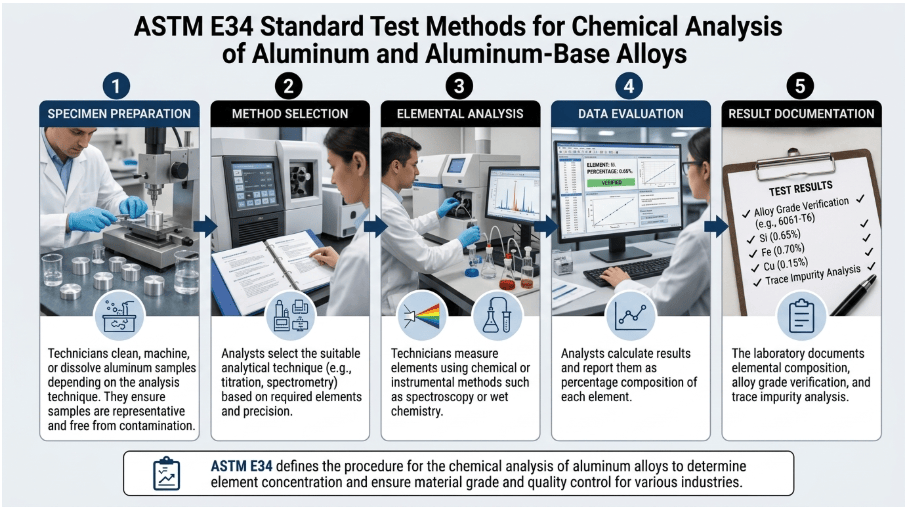
ASTM E34 testing ensures aluminum and aluminum-base alloys are tested for chemical composition according to standardized procedures. The tests are conducted in a laboratory using standardized procedures to ensure reliability and accuracy of the results. Technicians prepare specimens, choose the analytical method, conduct elemental analysis, and document the results. The ASTM E34 test method includes the following test procedure:
| Sample Preparation | Technicians clean, machine, or dissolve aluminum samples depending on the analysis technique. They ensure samples are representative and free from contamination. |
| Method Selection | Analysts select the suitable analytical technique (e.g., titration, spectrometry) based on required elements and precision. |
| Elemental Analysis | Technicians measure elements using chemical or instrumental methods such as spectroscopy or wet chemistry. |
| Data Evaluation | Analysts calculate results and report them as percentage composition of each element. |
| Result Documentation | The laboratory documents elemental composition, alloy grade verification, and trace impurity analysis. |
ASTM E34 Testing Process and Data Collection
The testing process involves preparing the aluminum sample using the desired analytical technique, then testing it. Technicians clean, machine, or dissolve the sample as needed. They choose the right analytical method for the required elements to be measured. They determine the chemical or instrumental analysis of the elements, such as spectroscopy or wet chemistry. The system quantifies the levels of particular elements and tracks the data. The results of the calculation are reported as the percentage composition of each element. Laboratories gather information for quality control, material verification, and product development.
Common Challenges and Troubleshooting
Common issues in ASTM E34 testing include poor sample preparation, contamination during testing, and incorrect calibration of analytical equipment. These problems result in incorrect elemental composition data. If samples are not prepared properly, it is possible to get non-representative results. It is possible for extraneous material to enter the system and affect the impurity analysis. When the calibration is not accurate, the concentrations will not be accurate. Problems are reduced by sample preparation, contamination prevention, and periodic calibration of analytical equipment. The use of standard procedures and maintenance of equipment ensure reliable results from experienced technicians.
ASTM D4186 Analysis Results and Interpretation
The report provides an overview of the composition of the tested aluminum or aluminum-based alloy. Displays measured results for the selected elements, the relevant units, and specimen information. The interpretation is carried out by comparing the measured values with the specification or alloy grade requirements. These results are used by quality control engineers to verify material compliance and to ensure product performance.
- The laboratory reports elemental composition as percentages (%) and parts per million (ppm) levels.
- The laboratory provides alloy grade verification and performs trace impurity analysis.
- Results indicate whether the material meets specification requirements.
- The laboratory provides quality control reports and documents testing conditions and specimen information.
- Consistent sample preparation, proper calibration, and controlled laboratory conditions help laboratories produce reliable results.
Get Certified ASTM E34 Testing for Reliable Alloy Composition Analysis
The certification helps ensure that aluminum and aluminum-base alloys are tested using a consistent chemical analysis protocol. The skills of the laboratory testers verify the elemental composition and make sure that the materials meet material specifications. Aluminum-based products benefit from ASTM E34 certified testing to help ensure quality control, material verification, and product development. The professional laboratory services guarantee that the standards are met, and it gives confidence in the test results. Engineers and quality control rely on certified testing to guarantee material integrity, performance, and safety in critical applications.
FAQ
Updated on September 14, 2026


If you are looking for a managed and trusted testing partner to achieve your research goals, feel free to schedule a meeting with us or send us a request at connect@matestlabs.com to learn more about our services. For a quick quote, call us at (302)244-7710. We are happy to serve you.
Project Today
specialized laboratories ready to deliver results