ASTM E285 Oxyacetylene Ablation Testing of Thermal Insulation Materials 

    What is ASTM E285? 

    ASTM E285 is a standard test method for screening ablative materials to determine their relative thermal insulation effectiveness when tested as a flat panel under steady hot-gas flow from an oxyacetylene burner. The test exposes a flat panel specimen to a steady flow of hot gas from an oxyacetylene burner under controlled laboratory conditions. The test outlines the temperature-resistance properties of insulation materials, ensuring their efficient application in scenarios where extreme heat is a concern. Laboratories use ASTM E285 (Standard Test Method for Oxyacetylene Ablation Testing of Thermal Insulation Materials) to assess how materials respond to heat and flames, compare materials, monitor quality control, and develop new products for aerospace and thermal protection applications. 

    Read more

    Get Certified ASTM E285 Testing for Reliable Thermal Insulation Performance 

    Ablative materials used in aerospace and thermal protection applications must withstand extreme heat and flame conditions. This test method provides helpful information to engineers attempting to understand the performance of a material as a thermal barrier when exposed to oxyacetylene flames under controlled conditions. Certified testing helps to identify the right ablative material, to design and develop new thermal protection systems, for quality control, and to compare material performance. 

    What is the Scope of ASTM E285? 

    ASTM E285 is a standard method for screening ablative materials for the relative thermal insulation effectiveness of the material as a flat panel when exposed to steady flow of hot gas from an oxyacetylene burner. This test method is used to determine the effect that a material has when exposed to heat and flames in a controlled laboratory environment, and not to assess the fire hazard and potential of a material when exposed to actual fire conditions. Results may be used as elements of a fire risk assessment. The scope of ASTM E285 includes:

    Read more

    • Material type: Ablative thermal insulation materials.
    • Testing: Screening ablative materials in order to determine the relative thermal insulation effectiveness.
    • Property measured: RTE and erosion rate.
    • Proposed Method: Place a flat panel specimen in a uniform hot gas stream from an oxyacetylene burner until it burns through.
    • Result: Relative thermal insulation effectiveness values used to compare different materials.
    • Test Limitations: The results are not predictive of material behavior in specific environments or for design applications. Using the device requires users to set up the security, health, and environmental practices appropriately.
    • Environmental conditions: Oxyacetylene gas flow in a controlled laboratory environment at ~3000°C. 
    • Applications: Production quality control of rocket insulation materials, screening of nozzle and motor liner materials, and elimination of poor materials from more advanced data generation programs. 

    What are the Uses of ASTM E285Testing?

    ASTM E285 testing helps laboratories in determining the relative thermal insulating properties of ablative materials. Engineers use the results to evaluate material performance and determine how well materials protect against heat and flame. This standard-

    • Compares the relative thermal insulation effectiveness of ablative materials by using screens.
    • Provides support for quality control of the production of thermal protection material, especially the thermal protection material of rockets 
    • Suggests materials and designs for use in the aerospace sector
    • Compares relative merit of different ablative material formulations 

    What Materials Can Be Tested Under ASTM E285? 

    The standard tests the thermal insulation of materials such as refractory ceramics, glass wool, mineral wool, and aerogel composites for high-temperature applications in spacecraft heat shields, foams, cementitious coatings, and advanced polymers in industrial furnace combustion chambers. Before beginning the testing program, an analyst should decide on the material type and test conditions. 

    Why is ASTM E285 Important? 

    Ablative materials are used for protecting structures from extreme heat in aerospace and thermal protection applications. The test method is able to screen and compare the relative thermal insulation effectiveness of various materials. Results help to choose the materials used for thermal protection systems and to remove unsuitable materials from consideration. 

    ASTM E285 Equipment and Sample Preparation Guide

    ASTM E285 uses an oxyacetylene burner system that delivers a steady flow of hot gas. Representative samples of ablative materials are prepared as flat panels for testing.

    Read more

    Sample and Specimen DetailsTechnicians use flat panel specimens of ablative thermal insulation materials. The test method is used as a screening tool to determine the relative merit of materials, particularly for rocket motor liners, nozzles, and heat shields.
    Specimen PreparationTechnicians prepare flat panel specimens according to standard requirements. They condition specimens and ensure proper thickness for testing 
    Specimen DimensionsThe test specimen is a square, flat panel with a length and width of 101.6 mm (4.000 in.), with a tolerance of +0.0, -0.71 mm (+0.000, -0.028 in.). The thickness of the specimen must be 6.35 ± 0.41 mm (0.250 ± 0.016 in.). 
    InstrumentationTechnicians use an oxyacetylene burner (nominal flame temperature approximately 3000°C), specimen holder, temperature measurement devices (thermocouples or pyrometers), gas supply cylinders, and data recording system. 

    Testing Procedures and Requirements for ASTM E285 

    This test standard imposes a continuous hot gas stream on ablative material specimens from an oxyacetylene burner. Technicians program the desired settings, and the system runs the test. The ASTM E285 test methods include the following test procedure: 

    Read more

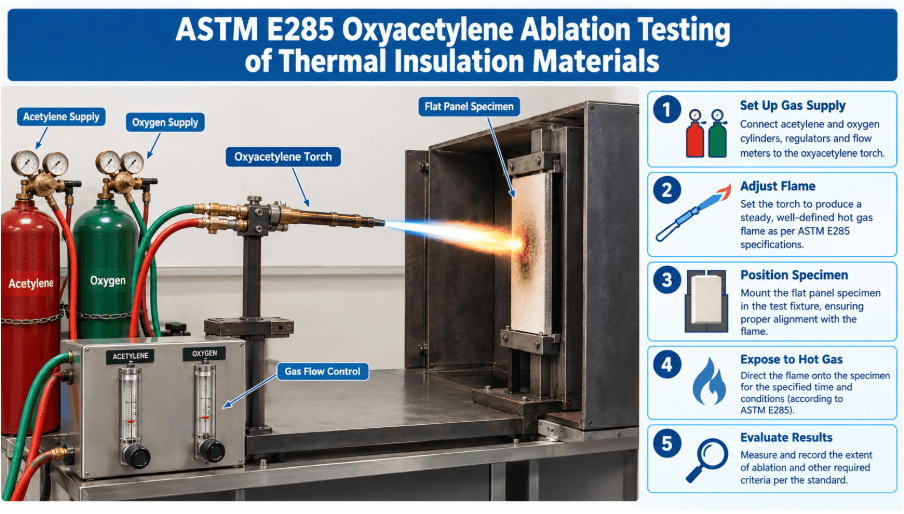
    Specimen Preparation and Mounting Technicians prepare the flat panel specimen (101.6 mm × 101.6 mm × 6.35 mm) and mount it in the test fixture at the prescribed distance from the flame. They ensure proper alignment with the oxyacetylene burner. 
    Oxyacetylene Flame Exposure Technicians ignite the oxyacetylene burner and direct hot combustion gases along the normal to the specimen surface until burn-through occurs. 
    Temperature and Erosion Measurement The system measures back-face temperature using thermocouples or pyrometers. Technicians determine the erosion rate by dividing the original specimen thickness by the burn-through time. 
    Data Analysis Technicians compute insulation index numbers by dividing the times required for back-face temperature increases of 80°C, 180°C, and 380°C by the original thickness. They also compute the insulation-to-density performance by dividing the insulation index by the panel density. 
    Result Reporting Laboratories report relative thermal insulation effectiveness, erosion rate, and test conditions in SI units. 

    ASTM E285 Testing Process and Data Collection

    The analyst chooses representative samples of the ablative material and forms flat panels. Then, the technician attaches the specimen to the test fixture and positions it with the oxyacetylene burner. The system’s function is to start up the burner and to provide a continuous flow of hot gas. Technicians measure the temperature response through the specimen thickness. They determine the rate of erosion and insulation effectiveness using their measured data. Analysts record all testing conditions and note any deviations from standard procedures. 

     The image depicts an oxyacetylene ablation test setup with a flat panel specimen being exposed to a steady flow of hot gas according to ASTM E285.
    ASTM E285 Oxyacetylene Ablation Testing of Thermal Insulation Materials

    Common Challenges and Troubleshooting

    Some challenges in the testing process include consistent flame application and control of heat exposure. Inconsistencies within the test environment and varied oxyacetylene flame intensity may produce inaccurate results. Troubleshooting steps include recalibration of the equipment, initial conditions verification, and uniform application of the flame.

    ASTM E285Analysis Results and Interpretation

    The report summarizes the ablation performance of the tested insulation material based in response to oxyacetylene flame exposure. The laboratory evaluates and compares the exposed specimens to derive the main performance criteria.

    Read more

    • The laboratory reports the erosion rate (mm/s) by dividing the original specimen thickness by the burn-through time, providing a measure of how quickly the material is consumed.
    • Analysts calculate insulation index numbers by dividing the times it takes the back face temperature to rise to 80°C, 180°C, and 380°C by the thickness of the original specimen.
    • The report will contain the percentage mass loss, depth of ablation, and surface recession measurements, and visual observations may include melting, cracking, charring, or erosion patterns.
    • The laboratory reports relative thermal insulation effectiveness of different materials, and records test conditions such as flame temperature, heat flux, and gas velocity in SI units.
    • The report compares the ablating materials and their insulation efficiency, recording the results for comparison to determine a ranking of materials and eliminate poor performers from the list, instead of giving one overall value for each material. 

    Link to ASTM E285

    FAQ

    Why is ASTM E285 important?
    ASTM E285 is significant because it specifies regulated oxyacetylene ablation test settings for determining the relative thermal insulation performance of ablative materials. The method allows for the screening and comparison of materials for thermal protection applications, while also excluding bad materials from further consideration.
    ASTM E285 is the standard test technique for screening ablative materials to establish their relative thermal insulation performance when tested as a flat panel in a constant hot gas flow from an oxyacetylene burner. It is used to monitor the quality of rocket insulation materials during production.
    ASTM E285 covers ablative thermal insulation materials utilized in aircraft, rocket motors, nozzles, motor liners, and other high-temperature thermal protection applications.
    Suyog Kamble
    About Author
    Suyog Kamble
    Suyog Kamble is an Operations Associate at MaTestLab Inc. and holds a postgraduate degree in Organic Chemistry.
    Testimonials
    Real results
    Engineers trust us with what matters most
    Start Your Testing
    Project Today
    Define your requirements and get access to
    specialized laboratories ready to deliver results
    Partners with us
    Clients
    Vendors
    Process for testing
    • STEP 01

      You share your testing requirements

    • STEP 02

      You share your sample(s)

    • STEP 03

      We deliver your test reports

    Get your testing done

    Let us known your testing requirements and we will be right back with a solution.

      Let us root for each other. Collaborate to grow, expand, and accelerate our businesses.

      Partner with us

        Contact Us

        Discover more from MaTestLab

        Subscribe now to keep reading and get access to the full archive.

        Continue reading