
ASTM E1782 Standard Test Method for Determining Vapor Pressure by Thermal Analysis

    What is ASTM E1782?

    ASTM E1782 is a standard test method for determining the vapor pressure of pure liquids or melts from boiling-point measurements using differential thermal analysis (DTA) or differential scanning calorimetry (DSC). Technicians heat a specimen at a constant rate under a constant applied pressure and record the boiling endotherm. The specimen boils at the temperature where its vapor pressure equals the applied pressure, so each applied pressure gives one point on the vapor pressure curve. The method works from 0 to 500 °C (273 to 773 K) and from 0.2 kPa to 2 MPa. This standard is important for process design and safety data because it provides vapor pressure and boiling temperature values that support hazard assessments and Safety Data Sheets. 

    Read more

    Get Certified ASTM E1782 Testing for Reliable Vapor Pressure Data

    Test data from an accredited thermal analysis laboratory provides manufacturers, regulators, and safety teams with a documented vapor pressure curve for a pure liquid or melt. A comprehensive report specifying the applied pressures, heating rate, specimen size, and pinhole size ensures that readers can reproduce, verify, and compare the measurements reliably. These documented parameters also improve transparency, consistency, and confidence in the reported results. Understanding the types and uses of differential scanning calorimetry (DSC) can further help readers explore related thermal analysis techniques and their applications. Such reliable test data supports informed material assessments, regulatory evaluations, and safety decisions while maintaining consistency across laboratory testing and quality assurance processes.

    What is the Scope of ASTM E1782?

    ASTM E1782 is a standard test method for determining the vapor pressure of pure liquids or melts from boiling point measurements made with DTA or DSC at different applied pressures; the method covers 0 to 500 °C and 0.2 kPa to 2 MPa.

    Read more

    The scope of the test method includes:

    • Test type: Vapor pressure of pure liquids or melts from boiling point measurements
    • Instruments: Differential thermal analysis (DTA) or differential scanning calorimetry (DSC) operated at different applied pressures
    • Temperature range: 273 to 773 K (0 to 500 °C)
    • Pressure range: 0.2 kPa to 2 MPa
    • Principle: A specimen heats at a constant rate under a constant applied pressure until the boiling endotherm appears, and boiling occurs where the specimen vapor pressure equals the applied pressure
    • Result: The boiling temperature at each applied pressure, which together give the vapor pressure curve
    • Related calculation: The enthalpy of vaporization, which technicians can estimate from the slope of the vapor pressure curve using Practice E2071
    • Material type: Pure liquids and melts
    • Data use: Vapor pressure and boiling temperature values for Safety Data Sheets (SDS), process design, and estimation of volatile organic content (VOC)

    What are the Uses of ASTM E1782 Testing?

    The method gives laboratories a way to measure vapor pressure, a fundamental thermophysical property of a liquid, with small specimens. The uses include

    • Supporting process design and control with vapor pressure data.
    • Establishing environmental regulations for the safe handling and transport of liquids.
    • Estimating the volatile organic content (VOC) of a material.
    • Deriving hazard assessments from vapor pressure and boiling temperature data.
    • Providing the vapor pressure and boiling temperature values that Safety Data Sheets (SDS) require.
    • Estimating the enthalpy of vaporization from the slope of the vapor pressure curve.

    What materials can be tested under ASTM E1782?

    The method applies to pure liquids and melts. A specimen can be a liquid of 1 to 5 µL or a solid of 1 to 5 mg that melts before it boils. The method works with specimens that boil between 0 and 500 °C in the range of 0.2 kPa to 2 MPa. Mixtures fall outside the method because the boiling endotherm of a mixture spreads over a range of temperatures.

    Why is ASTM E1782 Important?

    Vapor pressure is a fundamental thermophysical property of a liquid. Engineers use it to design and control processes, regulators use it to set rules for safe handling and transport, and safety teams use it to assess hazards. Vapor pressure and boiling temperature values also appear on Safety Data Sheets. ASTM E1782 gives laboratories one way to measure the property with milligram specimens in a DTA or DSC instrument. The test method falls under ASTM Committee E37 on Thermal Measurements, Subcommittee E37.01.

    ASTM E1782 Equipment and Sample Preparation Guide

    The method uses a differential thermal analysis (DTA) or DSC instrument that holds a constant applied pressure. The Technician heats a small specimen at a constant rate and records the boiling endotherm.

    Read more

    Sample and Specimen DetailsThe test sample is a pure liquid or melt. Technicians place a specimen of 1 to 5 µL of liquid, or 1 to 5 mg of solid that melts, in a container that suits the instrument.
    Specimen PreparationFor DSC, technicians seal the specimen in a hermetically sealable pan with a single pinhole in the center of the lid. For DTA, they use a capillary tube.
    Specimen DimensionsThe specimen weighs 1 to 5 mg or measures 1 to 5 µL. The pinhole in the DSC lid has a diameter of 50 to 350 µm, and 50 to 75 µm suits atmospheric pressure. For DTA, the capillary tube has an inside diameter of 2 to 4 mm and a length of 25 mm.
    InstrumentationThe Technician uses a DSC or DTA instrument that holds a constant applied pressure from 0.2 kPa to 2 MPa with a regulated vacuum or an inert gas. A heating rate of 5 K/min suits most measurements.

    Testing Procedures and Requirements for ASTM E1782

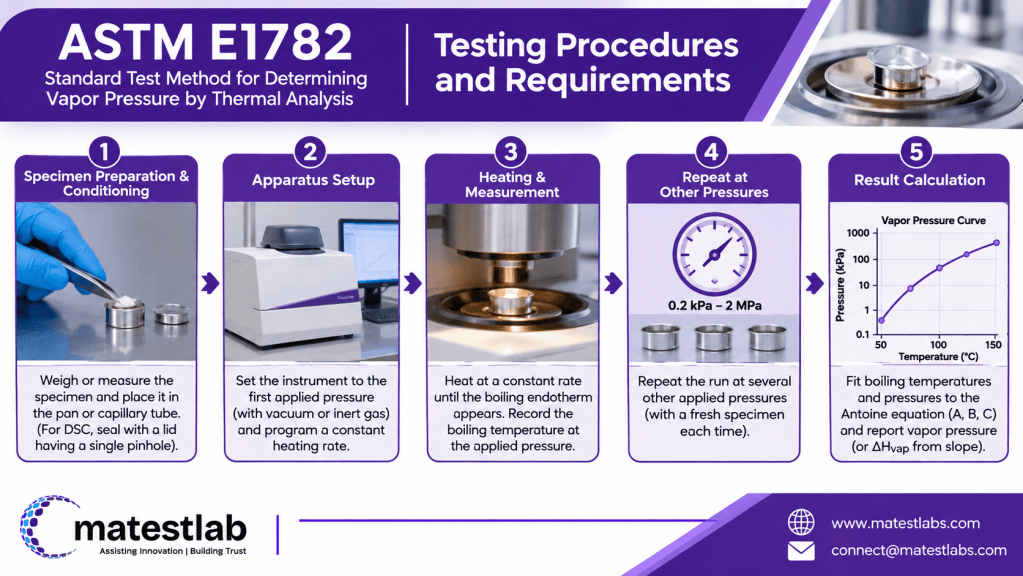
    Technicians load the specimen into the sealed pan or capillary tube, heat it at a constant rate under a constant applied pressure, and record the boiling endotherm. They repeat the measurement at other applied pressures and calculate the vapor pressure curve. ASTM E1782 testing procedure is as follows:

    Read more

    Specimen Preparation & ConditioningThe technicians weigh or measure the specimen and place it in the pan or capillary tube. For DSC, they seal the pan with a lid that has a single pinhole.
    Apparatus SetupThe operator sets the instrument to the first applied pressure with a regulated vacuum or an inert gas and sets the heating rate. The operator uses the same heating rate for all specimens in a series, because it affects the boiling endotherm.
    Heating & MeasurementThe instrument heats the specimen at a constant rate until the boiling endotherm appears. The operator records the boiling temperature at the applied pressure, because boiling occurs where the specimen vapor pressure equals the applied pressure.
    Repeat at Other PressuresThe operator repeats the heating run at several other applied pressures within the range of 0.2 kPa to 2 MPa, with a fresh specimen each time. Each run gives one more point on the vapor pressure curve.
    Result CalculationThe Technician fits the boiling temperatures and applied pressures to the Antoine equation to find the constants A, B, and C. It then reports the vapor pressure over the temperature range tested, and it can estimate the enthalpy of vaporization from the slope of the curve.

    ASTM E1782 Testing Process and Data Collection

    Technicians begin testing by placing a 1 to 5 mg specimen in a sealed pan with a pinhole lid. They set the applied pressure and heating rate, then heat the specimen until the boiling endotherm appears. They record the boiling temperature for that pressure, then repeat the run at other pressures. The laboratory records the applied pressures, the boiling temperatures, the heating rate, the specimen size, and the pinhole size. It then calculates the Antoine constants and the vapor pressure curve.

    This image shows the five-step vapor pressure procedure: a specimen sealed in a pan with a pinhole lid, heating at a set applied pressure, the boiling endotherm at each pressure, repeat runs at other pressures, and the vapor pressure curve plotted from the boiling temperatures.
    Testing procedure for determining vapor pressure by thermal analysis in accordance with ASTM E1782.

    Common Challenges and Troubleshooting

    The pinhole is the most important. If the pinhole is too big, it will allow the specimen to escape the pan before it boils and will obscure the endotherm; if it is too small, it will create a pressure inside the pan. The boiling endotherm is only sharp when the amount of vapor removed from the pan is equal to the amount being produced by the specimen; the pinhole size of the applied pressure is chosen by the technician. Pinholes are larger for lower pressures than they are for atmospheric pressure. The specimen should be a pure compound, not a mixture, as mixtures have a range of boiling points. Applied pressure must be maintained constant throughout the run, and the pressure sensor must be calibrated (Test Method E2744 for thermal analyzers).

    ASTM E1782 Analysis Results and Interpretation

    This report summarizes the vapor pressure measured for the specimen. It lists the boiling temperature at each applied pressure and the vapor pressure curve that those points give.

    Read more

    • The laboratory reports the boiling temperature at each applied pressure, because boiling occurs where the specimen vapor pressure equals the applied pressure.
    • Analysts fit the data to the Antoine equation and report the constants A, B, and C.
    • Analysts report the specimen size, the pinhole size, and the heating rate, so others can repeat the measurement.
    • Engineers estimate the enthalpy of vaporization from the slope of the vapor pressure curve.
    • Safety teams use the vapor pressure and boiling temperature values for Safety Data Sheets and hazard assessments.

    FAQ

    What does the method measure?

    The method measures the vapor pressure of pure liquids or melts from boiling point measurements made with DTA or DSC at different applied pressures.

    What temperature and pressure ranges does the method cover?

    The method covers 273 to 773 K (0 to 500 °C) and pressures from 0.2 kPa to 2 MPa.

    Why does the DSC pan have a pinhole in the lid?

    The pinhole lets the vaporized specimen escape when its vapor pressure equals the applied pressure, which produces a sharp boiling endotherm.

    Link to ASTM E1782 Standard

    Updated on November 24, 2026

    Zunaira Tehseen
    About Author
    Zunaira Tehseen is a scientific content specialist who bridges interdisciplinary research across biochemistry, molecular genetics, and materials science with technical content management. Leveraging expertise in bio-interface characterization, advanced materials evaluation, and AI-driven workflows, she curates, structures, and communicates complex technical data. At Matestlab, she leads content strategy and documentation for metallographic testing, mechanical characterization, and compliance with international standards such as ASTM and ISO, delivering precise, high-impact technical assets for industrial and scientific audiences.
    Know More
    Testimonials
    Real results
    Engineers trust us with what matters most
    Why Choose Matestlab?
    Matestlab is a unified testing services partner based in the USA. Matestlab offers raw material and product testing services through accredited, expert laboratories primarily based in the USA. Matestlab supports physical, thermal, chemical, electrical, mechanical, environmental, and characterization testing needs through its global network of 2200+ accredited testing laboratories. Matestlab's in-house materials science experts curate and design comprehensive testing programs matched to the sample material and specific testing need, with regulatory requirements and confidentiality in mind.

    If you are looking for a managed and trusted testing partner to achieve your research goals, feel free to schedule a meeting with us or send us a request at connect@matestlabs.com to learn more about our services. For a quick quote, call us at (302)244-7710. We are happy to serve you.
    Start Your Testing
    Project Today
    Define your requirements and get access to
    specialized laboratories ready to deliver results
    Partners with us
    Clients
    Vendors
    Process for testing
    • STEP 01

      You share your testing requirements

    • STEP 02

      You share your sample(s)

    • STEP 03

      We deliver your test reports

    Get your testing done

    Let us know your testing requirements and we will be right back with a solution.

      Let us root for each other. Collaborate to grow, expand, and accelerate our businesses.

      Partner with us