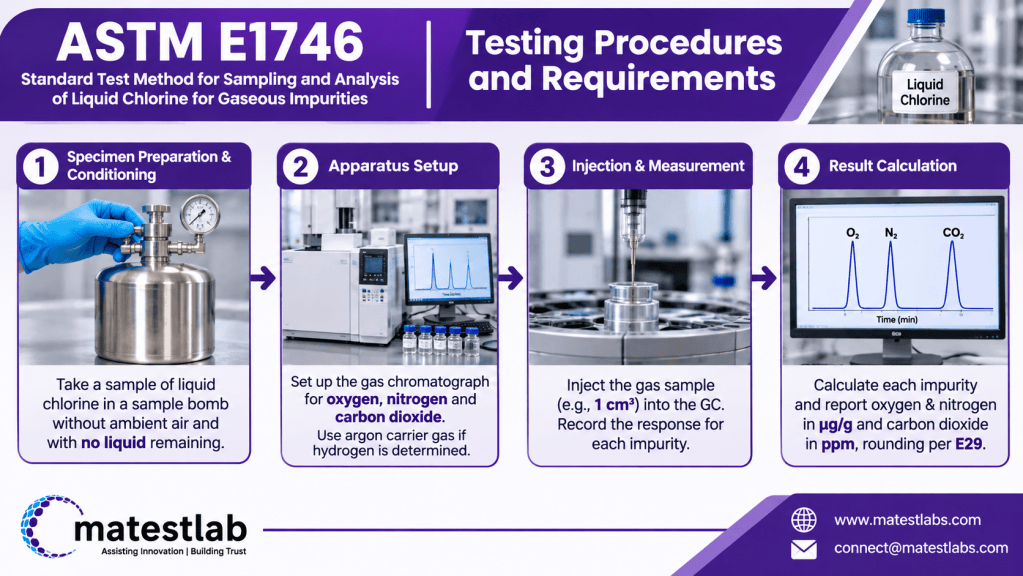
ASTM E1746 is a standard test method that covers sampling and analysis of liquid chlorine for the determination of oxygen, nitrogen, and carbon dioxide content at levels normally seen in liquid chlorine.
The scope of ASTM E1746 includes
- Material type: Liquid chlorine
- Analytes: Oxygen (200 µg/g to 400 µg/g), nitrogen (400 µg/g to 800 µg/g), and carbon dioxide (800 ppm to 1000 ppm)
- Other gases: Hydrogen and carbon monoxide are typically at or below the detection limit of the method.
- Hydrogen detection limit: 100 µg/g to 200 µg/g with a 1 cm³ gas sample and argon carrier gas, while the limits for the other components are significantly lower
- Limit data: Data were not generated to determine the lowest detection limits of the gaseous impurities
- Sampling: Designed to limit contamination by ambient air and to keep liquid out of the sample bomb
- Units: Values stated in SI units are the standard, and no other units are included
- Rounding: Results are rounded as Practice E29 describes when conformance to specifications is judged
- Safety: Users review the current Safety Data Sheets and establish their own safety, health, and environmental practices
What are the Uses of ASTM E1746 Testing?
ASTM E1746 is mainly used to measure the gaseous impurities in liquid chlorine without distorting them during sampling. The uses include
- Measuring oxygen, nitrogen, and carbon dioxide in liquid chlorine.
- Checking liquid chlorine against specifications for gaseous impurities, which grow tighter over time.
- Taking samples in a way that limits contamination by ambient air.
- Avoiding errors from liquid-vapor equilibrium by keeping liquid out of the sample bomb.
- Confirming whether hydrogen and carbon monoxide are at or below the detection limit.
What materials can be tested under ASTM E1746?
ASTM E1746 applies to liquid chlorine. The method measures the gaseous impurities that are normally present in it, namely oxygen, nitrogen, and carbon dioxide, and it notes that hydrogen and carbon monoxide are typically at or below its detection limit.
Why is ASTM E1746 Important?
It is very difficult to exclude contamination by ambient air during sampling, and the contamination caused by poor sampling can be as large as the impurity levels themselves. That would give markedly elevated results. As specifications become tighter, correct measurement of gaseous impurities becomes more important. Gaseous impurities also reach an equilibrium between the liquid and vapor phases in a sample bomb, so the result would depend on the amount of vapor space. ASTM E1746 avoids both problems by controlling how the sample is taken.