ASTM E1740 Standard Test Method for Determining the Heat Release Rate and Other Fire-Test-Response Characteristics of Wall Covering or Ceiling Covering Composites Using a Cone Calorimeter

    What is ASTM E1740?

    ASTM E1740 is a standard test method for determining the ignitability and heat release rate of wall covering or ceiling covering composites using a cone calorimeter. A composite consists of the covering, its substrate, and all laminating adhesives, coatings, and finishes. The method measures the time to sustained flaming and the heat release of specimens exposed to a prescribed heat flux, and it also gives heat release data at different heat fluxes. The apparatus and procedures come from test method E1354, and the specimen is oriented horizontally with a spark ignition source. Values stated in SI units are the standard.

    Read more

    Get Certified ASTM E1740 Testing for Reliable Wall and Ceiling Covering Fire Data

    ASTM E1740 testing gives manufacturers and buyers documented fire-response data for wall covering and ceiling covering composites. The laboratory reports the time to sustained flaming and the heat release rate under a prescribed heat flux, measured with a cone calorimeter. Results differ with heat flux and composite construction, so the laboratory also reports those conditions in full, allowing others to reconcile apparent differences between studies. Manufacturers and buyers then use the data to compare constructions as part of their heat release rate testing and flammability testing programs.

    What is the scope of the ASTM E1740 Test Standard?

    ASTM E1740 is a standard test method for determining the ignitability and heat release rate of composites consisting of a wall covering or ceiling covering, a substrate, and all laminating adhesives, coatings, and finishes. The edition used for this summary is E1740-24.

    Read more

    The scope of ASTM E1740 includes

    • Material type: Composites of a wall covering or ceiling covering, a substrate, and all laminating adhesives, coatings, and finishes
    • Properties measured: Ignitability and heat release rate
    • Apparatus: A cone calorimeter, which is a bench-scale oxygen consumption calorimeter, with the apparatus and procedures of Test Method E1354
    • Heat flux: A prescribed initial test heat flux, with heat release data also obtained at different heat fluxes
    • Specimen orientation: Horizontal, with a spark ignition source
    • Specimen size: 100 mm by 100 mm, tested at the actual thickness of the composite
    • Units: Values stated in SI units are the standard
    • Limitation: Heat release data are inappropriate if the product will not spread flame over its surface under the fire exposure conditions of interest
    • Fire hazard: The standard describes the response of materials to heat and flame under controlled conditions, but it does not by itself include all factors needed for fire hazard or fire risk assessment

    What are the Uses of ASTM E1740 Testing?

    ASTM E1740 is mainly used to describe how wall and ceiling covering composites ignite and release heat under a prescribed heat flux. The uses include

    • Determining the time to sustained flaming of a wall covering or ceiling covering composite.
    • Measuring the heat release rate of the composite under a prescribed heat flux.
    • Comparing wall coverings and constructions with quantitative heat release measurements.
    • Providing input data for fire models.
    • Obtaining heat release data at several heat fluxes for the same composite.

    What materials can be tested under ASTM E1740?

    ASTM E1740 applies to composites made of a wall covering or ceiling covering, a substrate, and all the laminating adhesives, coatings, and finishes that go with them. The composite is tested as a whole, at its actual thickness. The standard warns that the heat release data are inappropriate for a product that will not spread flame over its surface under the fire exposure of interest.

    Why is ASTM E1740 Important?

    Interior wall and ceiling coverings can influence how fast a fire grows in a room. Quantitative heat release measurements give a basis for comparing wall coverings and constructions, and they provide input to fire models. A standard cone calorimeter procedure lets laboratories measure the same composite the same way, so the time to sustained flaming and the heat release can be compared between products.

    ASTM E1740 Equipment and Sample Preparation Guide

    ASTM E1740 uses the cone calorimeter described in Test Method E1354, a bench-scale oxygen consumption calorimeter. The laboratory cuts the composite to size and tests it with the specimen horizontal under a prescribed heat flux.

    Read more

    Sample and Specimen DetailsThe specimen is a composite of a wall covering or ceiling covering, a substrate, and all laminating adhesives, coatings, and finishes. It is tested as a composite and not as separate layers.
    Specimen PreparationTechnicians cut the composite to its test size and keep its actual thickness.
    Specimen DimensionsThe test specimens are cut to an overall size of 100 mm by 100 mm and tested at the actual thickness of the composite.
    InstrumentationThe system is the cone calorimeter of Test Method E1354, a bench-scale oxygen consumption calorimeter with a radiant heater and a spark ignition source, and with measurement of the oxygen in the exhaust to find the heat release.

    Testing Procedures and Requirements for ASTM E1740

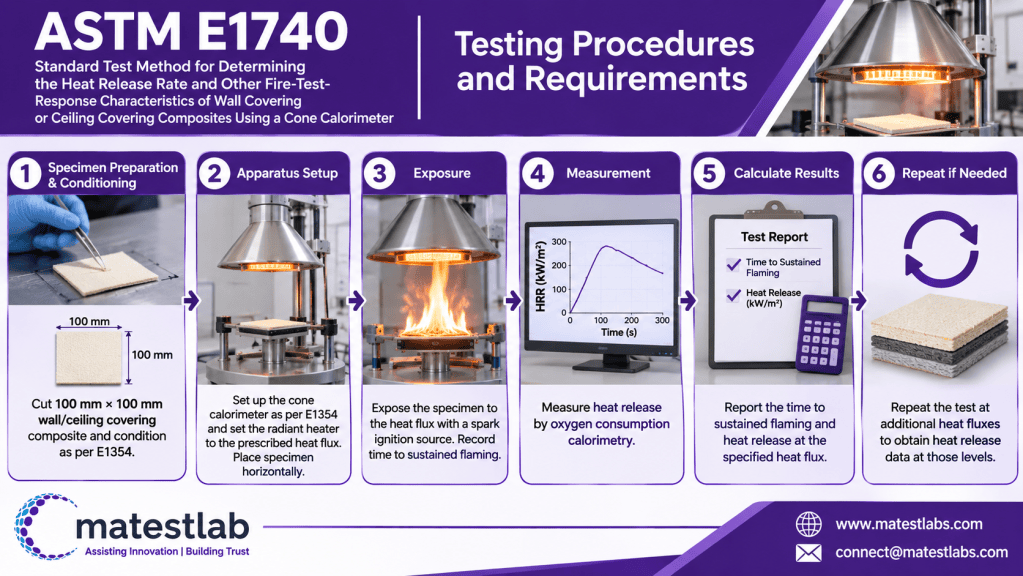
    The Technician exposes the horizontal specimen to a prescribed heat flux in the cone calorimeter and records the time to sustained flaming and the heat release. Tests at different heat fluxes give the heat release data at those fluxes. ASTM E1740 testing procedure is as follows:

    Read more

    Specimen Preparation & ConditioningTechnicians cut the wall or ceiling covering composite to 100 mm by 100 mm and keep its actual thickness. They prepare and condition the specimen as Test Method E1354 describes.
    Apparatus SetupThe operator sets up the cone calorimeter as Test Method E1354 describes and sets the radiant heater to the prescribed initial test heat flux. The specimen is placed horizontally under the heater.
    Exposure & MeasurementThe operator exposes the specimen to the heat flux with a spark ignition source in use. The system records the time to sustained flaming and the heat release by oxygen consumption calorimetry.
    Result CalculationThe laboratory reports the time to sustained flaming and the heat release for the composite, with the heat flux used. It repeats the test at other heat fluxes when heat release data at those fluxes are needed.

    ASTM E1740 Testing Process and Data Collection

    Technicians cut the composite to 100 mm by 100 mm,sets up the cone calorimeter, andplaces the specimen horizontally under the radiant heater. It exposes the specimen to the prescribed heat flux with the spark ignition source and records the time to sustained flaming and the heat release throughout the test. The results are reported with the heat flux and the construction of the composite, and tests at other heat fluxes give additional heat release data.

    This image shows the six-step ASTM E1740 cone calorimeter testing procedure for wall and ceiling covering composites, including specimen preparation and conditioning, apparatus setup, heat exposure, heat release measurement, result calculation, and repeat testing at different heat flux levels.
    ASTM E1740 Cone Calorimeter Testing of Wall Covering and Ceiling Covering Composites

    Common Challenges and Troubleshooting

    The composite must be tested as it is used, with its substrate, adhesives, coatings, and finishes, because each layer affects ignition and heat release. Products that do not spread flame over their surface give heat release data that are inappropriate for this method. The heat flux changes the results, so it must be reported with every value, and tests at several heat fluxes give a fuller picture. The cone calorimeter apparatus and procedures of Test Method E1354 must be followed closely so that results match those of other laboratories. The standard describes the response of materials to heat and flame under controlled conditions, so the results are not a complete fire hazard or fire risk assessment.

    ASTM E1740 Analysis Results and Interpretation

    This report summarizes the ignition and heat release behavior measured for a wall covering or ceiling covering composite. It lists the time to sustained flaming and the heat release with the heat flux used. Manufacturers and buyers compare the values between composites to judge their fire response.

    Read more

    • The laboratory reports the time to sustained flaming in seconds (s), the heat release rate in kilowatts per square meter (kW/m²), the total heat released in megajoules per square meter (MJ/m²), and the heat flux in kW/m². All are SI units.
    • Analysts report the heat flux used for each test, so others can repeat the measurement and compare the results.
    • The laboratory reports the construction of the composite, including the substrate, adhesives, coatings, and finishes, at its actual thickness.
    • Analysts check that the product spreads flame over its surface, because the heat release data are inappropriate when it does not.
    • Manufacturers and buyers compare the heat release data between wall coverings and constructions, and engineers use them as input to fire models.

    FAQ

    What does ASTM E1740 measure?

    ASTM E1740 measures the time to sustained flaming and the heat release rate of wall covering and ceiling covering composites exposed to a prescribed heat flux in a cone calorimeter.

    In what unit is heat release rate reported in ASTM E1740?

    The standard uses SI units. The heat release rate is reported in kW/m², the total heat released in MJ/m², and the time to sustained flaming in seconds.

    Which test method supplies the apparatus for ASTM E1740?

    The apparatus and procedures come from Test Method E1354, the cone calorimeter method.

    Link to ASTM E1740 Standard

    Updated on November 24, 2026

    Zunaira Tehseen
    About Author
    Zunaira Tehseen is a scientific content specialist who bridges interdisciplinary research across biochemistry, molecular genetics, and materials science with technical content management. Leveraging expertise in bio-interface characterization, advanced materials evaluation, and AI-driven workflows, she curates, structures, and communicates complex technical data. At Matestlab, she leads content strategy and documentation for metallographic testing, mechanical characterization, and compliance with international standards such as ASTM and ISO, delivering precise, high-impact technical assets for industrial and scientific audiences.
    Know More
    Testimonials
    Real results
    Engineers trust us with what matters most
    Why Choose Matestlab?
    Matestlab is a unified testing services partner based in the USA. Matestlab offers raw material and product testing services through accredited, expert laboratories primarily based in the USA. Matestlab supports physical, thermal, chemical, electrical, mechanical, environmental, and characterization testing needs through its global network of 2200+ accredited testing laboratories. Matestlab's in-house materials science experts curate and design comprehensive testing programs matched to the sample material and specific testing need, with regulatory requirements and confidentiality in mind.

    If you are looking for a managed and trusted testing partner to achieve your research goals, feel free to schedule a meeting with us or send us a request at connect@matestlabs.com to learn more about our services. For a quick quote, call us at (302)244-7710. We are happy to serve you.
    Start Your Testing
    Project Today
    Define your requirements and get access to
    specialized laboratories ready to deliver results
    Partners with us
    Clients
    Vendors
    Process for testing
    • STEP 01

      You share your testing requirements

    • STEP 02

      You share your sample(s)

    • STEP 03

      We deliver your test reports

    Get your testing done

    Let us know your testing requirements and we will be right back with a solution.

      Let us root for each other. Collaborate to grow, expand, and accelerate our businesses.

      Partner with us