
ASTM E1735 Standard Practice for Determining Relative Image Quality Response of Industrial Radiographic Imaging Systems from 4 to 25 MeV

    What is ASTM E1735?

    ASTM E1735 is a standard practice for determining the relative image quality response (RIQR) of industrial radiographic imaging systems exposed to X-radiation from 4 to 25 MeV. It applies to film, computed radiography (CR) imaging plates, and digital detector arrays (DDAs). Technicians expose a relative image quality indicator (RIQI) through an absorber and compare at least two radiographs to evaluate how image quality changes when one system component, such as a screen, is modified. The practice is based on equivalent penetrameter sensitivity (EPS), as described in Practice E1025. It provides a consistent method for comparing detectors, hardware, and imaging techniques to support reliable high-energy radiography assessments. Real-Time X-ray (RTX) testing is another industrial X-ray inspection method used to evaluate internal features without damaging components.

    Read more

    Get Certified ASTM E1735 Testing for Reliable Radiographic Image Quality Data

    Obtaining ASTM E1735 testing from a qualified and accredited laboratory helps manufacturers, industrial inspectors, and radiography professionals evaluate the relative image quality response of high-energy radiographic imaging systems. Testing compares film, computed radiography (CR) imaging plates, and digital detector arrays (DDAs) using X-ray energies between 4 and 25 MeV. A comprehensive assessment examines equivalent penetrameter sensitivity (EPS) to determine how changes in detectors, screens, hardware, or imaging techniques affect image quality. Detailed test reports document system configurations, exposure conditions, detector specifications, and comparative results. Matestlabs provides professional ASTM E1735 testing services to support imaging system evaluation, equipment selection, quality assurance, and reliable industrial radiographic inspection.
    What is the Scope of ASTM E1735?

    ASTM E1735 is a standard practice for determining the relative image quality response of industrial radiographic imaging systems exposed to X-radiation from 4 to 25 MeV; results compare equivalent penetrameter sensitivity between radiographs, and the practice does not apply to cobalt-60 sources or X-ray sources below 4 MeV.

    Read more

    The scope of the practice includes:

    • Practice type: Comparative assessment of image quality using the relative image quality response (RIQR)
    • Energy range: X-radiation with photon energies from 4 to 25 MeV
    • Detectors: Film, computed radiography (CR) imaging plates, and digital detector arrays (DDAs)
    • Basis: Equivalent penetrameter sensitivity (EPS) from Practice E1025
    • Test object: A relative image quality indicator (RIQI) of EPS plaques, exposed through an absorber material
    • Comparison: At least two radiographs or radiographic processes
    • Variables: Any single component of the X-ray system, such as screens, hardware, or technique
    • Special configurations: Users may design a non-standard RIQI and absorber configuration, which a drawing similar to Fig. 1 must control
    • Limits: The practice does not apply to cobalt-60 sources or X-ray sources below 4 MeV, and Practice E746 covers lower energies

    What are the Uses of This Practice?

    The practice gives radiography users a way to compare imaging systems and techniques with the same test object. The uses include:

    • Determines the relative image quality response of a film, CR imaging plate, or DDA at 4 to 25 MeV.
    • Shows how image quality changes when technicians change one component, such as a screen.
    • Compares hardware and techniques that affect image quality.
    • Supports the choice of an imaging system for high-energy radiography.
    • Works with Practice E1025 through the equivalent penetrameter sensitivity concept.

    What systems can be tested under ASTM E1735?

    The practice applies to industrial radiographic imaging systems that use X-ray sources from 4 to 25 MeV. The detector can be film, a CR imaging plate, or a DDA. The practice compares systems and factors, such as hardware and techniques, and it does not qualify the performance of a specific radiographic technique. It does not apply to cobalt-60 sources or to X-ray sources below 4 MeV.

    Why is ASTM E1735 important?

    High-energy radiography often needs a choice among screens, detectors, and techniques, and each choice changes how small a feature the image can show. The practice turns that choice into a comparison with a common test object, so users can see which configuration performs better. Because the test object is the same for every system, the comparison does not depend on a particular part. 

    ASTM E1735 Equipment and Sample Preparation Guide

    The practice needs a high-energy X-ray source, a detector, a relative image quality indicator, and an absorber plate. Technicians expose the RIQI through the absorber and change only one component of the system between exposures.

    Read more

    Sample and Specimen DetailsThe test object is a relative image quality indicator (RIQI) made of equivalent penetrameter sensitivity (EPS) plaques positioned on an absorber plate. The absorber stands in for the material the X-rays pass through.
    Specimen PreparationThe technician places the RIQI on the absorber and sets up the X-ray source and the detector, which can be film, a CR imaging plate, or a DDA. The technician changes only one component between exposures, such as a screen.
    Specimen DimensionsThe RIQI uses plaques of different thicknesses, and each plaque carries an array of identical holes. The plaques sit on an absorber plate of a specified material and thickness, and a drawing similar to Fig. 1 controls the RIQI and absorber configuration. For lower energies, the sister practice E746 uses four plaques with thicknesses of 0.38, 0.25, 0.20, and 0.13 mm, and each array has 30 identical holes.
    InstrumentationThe laboratory uses a 4 to 25 MeV X-ray source, the detector under test with its screens, film processing or CR and DDA readout equipment, and software or a densitometer to evaluate the radiographs by optical density or pixel value.

    Testing Procedures and Requirements for ASTM E1735

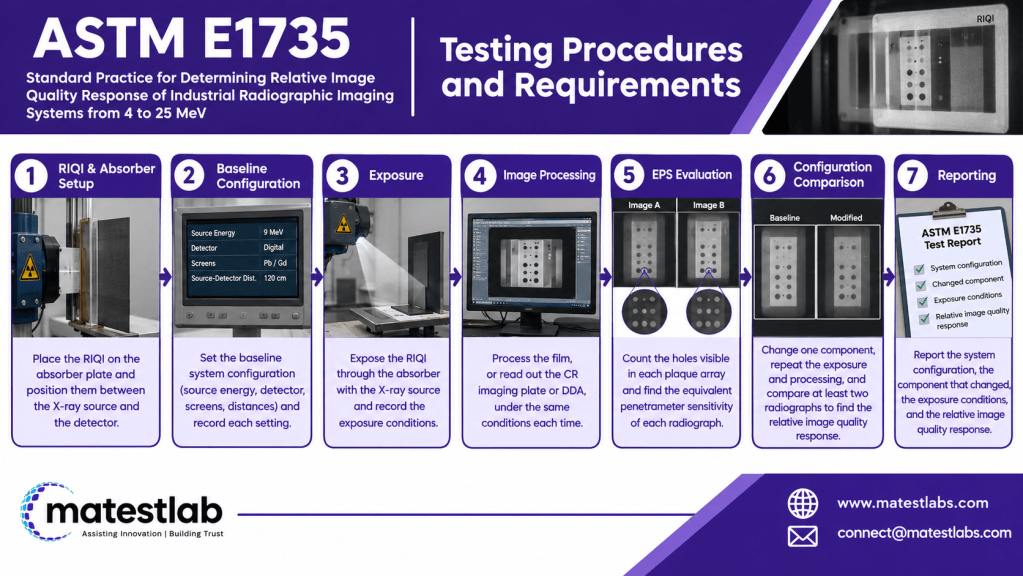
    The Technician exposes the RIQI through the absorber with a baseline system configuration, changes one component, and exposes it again. The analysts compare the visible holes in the radiographs to find the relative image quality response. ASTM E1735 testing procedure is as follows

    Read more

    RIQI & Absorber SetupTechnicians place the RIQI on the absorber plate and position it between the X-ray source and the detector.
    Baseline ConfigurationTechnicians set up the baseline system, with the source energy, detector, screens, and distances that they want to describe, and record each setting.
    ExposureTechnicians expose the RIQI through the absorber with the X-ray source and record the exposure conditions.
    Image ProcessingTechnicians process the film, or read out the CR imaging plate or the DDA, under the same conditions each time.
    EPS EvaluationAnalysts count the holes that they can see in each plaque array and find the equivalent penetrameter sensitivity of each radiograph.
    Configuration ComparisonTechnicians change one component, repeat the exposure and processing, and compare at least two radiographs to find the relative image quality response.
    ReportingThe laboratory reports the system configuration, the component that changed, the exposure conditions, and the relative image quality response.

    ASTM E1735 Testing Process and Data Collection

    Technicians begin testing by placing the RIQI on the absorber and setting up the baseline imaging system. They expose the RIQI at 4 to 25 MeV, process or read out the image, and record the settings. They then change one component, such as a screen, and repeat the exposure. The analysts count the visible holes in each plaque array of both radiographs and find the equivalent penetrameter sensitivity for each. The laboratory compares the two results to report the relative image quality response.

    The image shows the ASTM E1735 testing procedure, including RIQI and absorber setup, baseline configuration, radiographic exposure, image processing, EPS evaluation, configuration comparison, and reporting of relative image quality response.
    ASTM E1735 Testing Procedures for Determining the Relative Image Quality Response of Industrial Radiographic Imaging Systems from 4 to 25 MeV.

    Common Challenges and Troubleshooting

    The most common error is to alter more than one variable during the exposures, since this does not reveal which variable is responsible for the difference. One piece at a time is replaced, and each setting is noted by the technician. It is also important that they are exposed and processed in a similar way, as this is possible to mask the effect of the component under test. In the case of CR imaging plates and DDAs, the pixel value serves the function of the optical density instead of what it does for film. The RIQI and the absorber are also maintained constant during each exposure. There must be strict radiation safety controls for high-energy radiography.

    ASTM E1735 Analysis Results and Interpretation

    This report summarizes how different radiographic imaging systems perform when exposed to high-energy X-rays between 4 and 25 MeV.

    Read more

    • The laboratory reports the relative image quality response by comparing equivalent penetrameter sensitivity (EPS) between radiographs obtained under different system configurations.
    • Technicians document the RIQI and absorber configuration, detector type, exposure conditions, X-ray energy, and imaging parameters to support accurate review and reproducibility.
    • Analysts examine the visible holes in each plaque array and compare the results to identify changes in image quality.
    • Engineers interpret the findings to determine how changes in screens, detectors, hardware, or imaging techniques affect radiographic performance.
    • Manufacturers and radiography professionals use these results to compare imaging systems, evaluate detector performance, and support equipment selection and quality assurance.

    Link to ASTM E1735 Standard

    FAQ

    What does ASTM E1735 cover?
    The practice covers a way of comparing the image quality response of industrial radiographic imaging systems exposed to X-radiation from 4 to 25 MeV.
    No. Early editions covered film, but the 2019 revision covers film, CR imaging plates, and DDAs, and it became a practice at that time.
    No. The practice is not for cobalt-60 sources or X-ray sources below 4 MeV. Practice E746 covers lower energies.
    It is the concept from Practice E1025 that the RIQI plaques use. It describes image quality through the holes that a radiograph shows.

    Updated on November 24, 2026

    Laraib Hashmi
    About Author
    Laraib Hashmi is an aspiring research enthusiast and science content professional with a strong interdisciplinary skill set, holding a postgraduate degree in Applied Microbiology from KIIT Bhubaneshwar, Odisha.
    Know More
    Testimonials
    Real results
    Engineers trust us with what matters most
    Why Choose Matestlab?
    Matestlab is a unified testing services partner based in the USA. Matestlab offers raw material and product testing services through accredited, expert laboratories primarily based in the USA. Matestlab supports physical, thermal, chemical, electrical, mechanical, environmental, and characterization testing needs through its global network of 2200+ accredited testing laboratories. Matestlab's in-house materials science experts curate and design comprehensive testing programs matched to the sample material and specific testing need, with regulatory requirements and confidentiality in mind.

    If you are looking for a managed and trusted testing partner to achieve your research goals, feel free to schedule a meeting with us or send us a request at connect@matestlabs.com to learn more about our services. For a quick quote, call us at (302)244-7710. We are happy to serve you.
    Start Your Testing
    Project Today
    Define your requirements and get access to
    specialized laboratories ready to deliver results
    Partners with us
    Clients
    Vendors
    Process for testing
    • STEP 01

      You share your testing requirements

    • STEP 02

      You share your sample(s)

    • STEP 03

      We deliver your test reports

    Get your testing done

    Let us know your testing requirements and we will be right back with a solution.

      Let us root for each other. Collaborate to grow, expand, and accelerate our businesses.

      Partner with us