
ASTM E1623 Determination of Fire and Thermal Parameters of Materials, Products, and Systems Using an Intermediate Scale Calorimeter (ICAL)

    What is ASTM E1623?

    ASTM E1623 is a standard test method for determining fire and thermal parameters of materials, products, and assemblies using an intermediate scale calorimeter (ICAL); it exposes a vertical specimen with a face area of 1 m² to a controlled radiant heat flux from a gas-fired panel. The method determines heat release rate by oxygen consumption calorimetry and also measures ignitability, mass loss rate, visible smoke development, and gas release under well-ventilated conditions. The heat flux stays constant and ranges from 0 to 50 kW/m². This standard is important for fire safety engineering because it tests assemblies at their end-use thickness and configuration, which in turn supports material selection, design, and fire modeling. 

    Read more

    Get Certified ASTM E1623 Testing for Reliable Fire Performance Data

    Obtaining ASTM E1623 testing from an accredited fire testing laboratory helps manufacturers, engineers, and product developers demonstrate the fire performance of materials, products, and assemblies. Professional testing evaluates specimens in their end-use thickness and configuration under controlled radiant heat exposure. The assessment provides reliable data on heat release rate, ignition time, mass loss rate, smoke development, and gas release. A comprehensive test report documents specimen details, applied heat flux, ignition method, test conditions, measured parameters, and observed physical changes. Matestlabs offers professional ASTM E1623 testing services to support material evaluation, product development, fire safety engineering, regulatory documentation, and computer-based fire modeling requirements.
    What is the Scope of ASTM E1623?

    ASTM E1623 is a standard test method for determining fire and thermal parameters of materials, products, and assemblies with an intermediate-scale calorimeter; results include heat release rate, ignitability, mass loss rate, visible smoke development, and gas release, and SI units are standard.

    Read more

    The scope of the test method includes:

    • Test type: Fire-test-response method that uses an intermediate scale calorimeter (ICAL)
    • Exposure: Constant radiant heat flux of 0 to 50 kW/m² on a vertical specimen, with or without an external ignitor
    • Heat release: Determined by oxygen consumption calorimetry from the oxygen concentration and flow rate in the exhaust duct
    • Smoke: Quantified by the obscuration of light by the combustion product stream in the exhaust duct
    • Ignition: Hot wires ignite the combustible vapors during ignition and heat release tests, and line burners replace them for flame spread parameters
    • Measured characteristics: Ignitability, heat release rates, mass loss rates, visible smoke development, and gas release under well-ventilated conditions
    • Model inputs: Effective heat of combustion, surface temperature, ignition temperature, and emissivity for computer fire models
    • Specimens: Materials, products, and assemblies tested in thicknesses and configurations that represent actual end use
    • Units: SI values are standard
    • Limits: The standard does not by itself include all factors needed for fire hazard or fire risk assessment

    What are the Uses of This Test Method?

    The method gives manufacturers, designers, and researchers a way to measure how materials and assemblies respond to radiant heat. The uses include:

    • Determines the heat release rate of materials, products, and assemblies.
    • Measures the time to ignition, the mass loss rate, and smoke and gas production.
    • Assesses the heat release rate of a wall assembly at its end-use thickness.
    • Provides effective heat of combustion, surface temperature, ignition temperature, and emissivity as inputs for computer fire models.
    • Supports flame spread studies when technicians use line burners in place of hot wire igniters.
    • Supports evaluation, design, and research and development of materials, products, and assemblies.

    What Materials Can Be Tested Under ASTM E1623?

    The method applies to materials, products, and assemblies, such as wall assemblies, that technicians can test at their end-use thickness. A specimen includes the representative joints and other details when they are part of normal design. The method also applies to end-use products that do not have a flat surface, and technicians adjust the heat flux to the value wanted at the average distance of the surface from the radiant panel. Results have limited validity if the specimen melts enough to overflow the drip tray or if explosive spalling occurs.

    Why is ASTM E1623 Important?

    Fire behavior depends on thickness, layering, and joints, so a small coupon does not always show how a whole assembly burns. The method tests assemblies in their end-use configuration and measures heat release through oxygen consumption, providing engineers with data for fire modeling. These evaluations complement broader fire resistance testing used to assess the performance of construction materials and assemblies. The standard also emphasizes that results apply only to the exposure conditions used during testing.

    ASTM E1623 Equipment and Sample Preparation Guide

    The method uses an intermediate scale calorimeter with a gas-fired radiant panel and an exhaust system that measures oxygen, flow, and smoke. Technicians mount the specimen vertically and expose it to a constant heat flux.

    Read more

    Sample and Specimen DetailsThe test sample is a material, product, or assembly, such as a wall assembly, tested at its end-use thickness. When joints or other details are part of normal design, the specimen includes them.
    Specimen PreparationThe technician prepares the specimen in a configuration that represents actual end-product use and mounts it vertically facing the radiant panel. For a surface that is not flat, the technician adjusts the heat flux to the value wanted at the average distance of the surface from the radiant panel.
    Specimen DimensionsThe specimen has a face area of 1 m² and stays vertical during the test. Technicians test it at the thickness and configuration of the end-use product.
    InstrumentationThe laboratory uses an intermediate scale calorimeter with a gas-fired radiant panel, hot wire ignitors or line burners, a drip tray, and an exhaust duct with oxygen concentration and flow measurement. It also uses a light obscuration system for smoke and a way to measure the mass loss of the specimen.

    Testing Procedures and Requirements for ASTM E1623

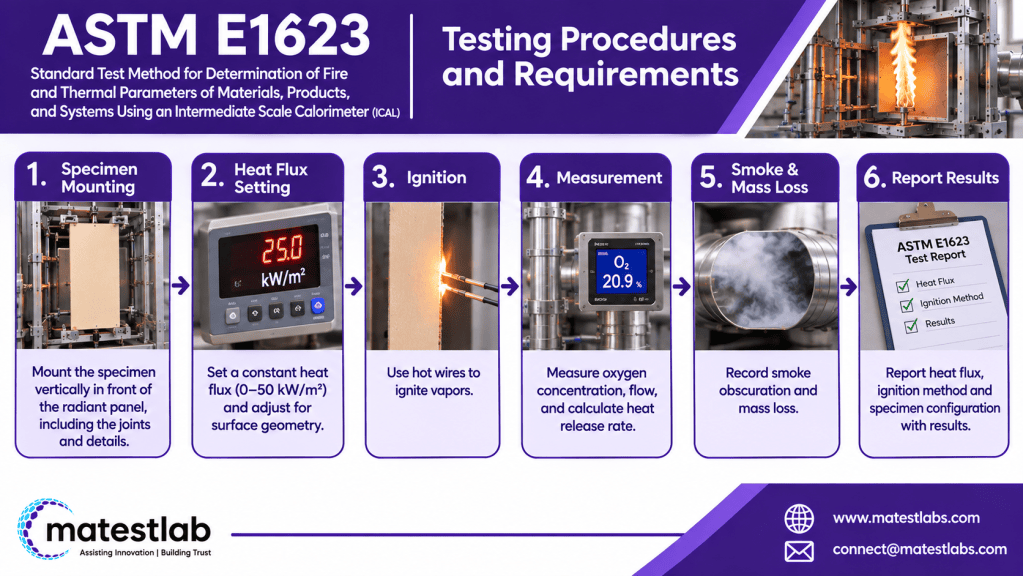
    The Technician mounts the specimen vertically, sets the radiant heat flux, ignites the vapors with hot wires, and measures oxygen, flow, smoke, and mass loss while the specimen burns. It then calculates the fire parameters from the data. ASTM E1623 testing procedure is as follows:

    Read more

    Specimen MountingTechnicians mount the specimen vertically in front of the radiant panel and include the joints and details that are part of normal design.
    Heat Flux SettingTechnicians set a constant heat flux in the range of 0 to 50 kW/m² and adjust it for a non-flat surface at the average distance from the radiant panel. Measurements at heat flux below 10 kW/m² need special considerations.
    IgnitionTechnicians use hot wires to ignite the combustible vapors from the specimen during ignition and heat release tests. For flame spread parameters, they use line burners instead.
    Heat Release MeasurementTechnicians measure the oxygen concentration and flow rate in the exhaust duct and calculate the heat release rate by oxygen consumption calorimetry.
    Smoke & Mass Loss MeasurementTechnicians measure the obscuration of light in the exhaust duct to quantify smoke development, and they record the mass loss of the specimen to find the mass loss rate.
    Specimen Behavior ObservationTechnicians record whether the specimen sags, deforms, or delaminates, whether it melts into the drip tray, and whether explosive spalling occurs, because these behaviors limit how far they can trust the results.
    ReportingThe Technician reports the heat flux, the ignition method, and the specimen configuration with the results, because the results are valid only for the exposure conditions of the test.

    ASTM E1623 Testing Process and Data Collection

    The technicians start testing by mounting the specimen in its end-use configuration and mounting it vertically. They adjust the heat flux, start the exposure, and start the hot wire to ignite the vapors. During the test, all instruments monitor the oxygen concentration, the exhaust flow rate, the light obscuration, and the mass of the specimen. The technicians also record ignition, flaming, and any sagging, melting, or spalling. Based on the recorded data, the laboratory calculates heat release rate, time to ignition, mass loss rate, and smoke development.

     The image shows the ASTM E1623 testing procedure, including specimen mounting, heat flux setting, ignition, heat release measurement, smoke analysis, mass loss measurement, and test result reporting using an intermediate-scale calorimeter.
    ASTM E1623 Testing Procedures for Determining Fire and Thermal Parameters of Materials, Products, and Systems Using an Intermediate Scale Calorimeter (ICAL)

    Common Challenges and Troubleshooting

    Specimen behavior causes most of the trouble. A specimen that melts enough to overflow the drip tray, or one that suffers explosive spalling, gives results of limited validity. Specimens that sag, deform, or delaminate also need careful interpretation, so technicians report what they see. Heat release measurements at low heat flux, below 10 kW/m², need special considerations. A non-flat surface changes the heat flux the surface receives, so technicians adjust the setting for the average distance from the radiant panel. Results hold only for the exposure conditions of the test, so a change in heat flux or configuration can change the outcome. Fire testing is also hazardous, and laboratories use safeguards for personnel and property.

    ASTM E1623 Analysis Results and Interpretation

    This report summarizes how the material or assembly responded to controlled radiant heat exposure. It presents the heat release rate, ignition time, mass loss rate, smoke development, and gas release measurements.

    Read more

    • The laboratory reports the heat release rate calculated through oxygen consumption calorimetry and records the smoke development and mass loss for each specimen tested.
    • Technicians document the specimen configuration, applied heat flux, ignition method, exposure conditions, and test duration to support accurate review and reproducibility.
    • Analysts examine the recorded data and specimen behavior, noting flaming, deformation, sagging, delamination, melting, or explosive spalling.
    • Engineers interpret the results to understand fire performance under the specific test conditions and identify relevant inputs for computer fire models.
    • Manufacturers and designers use these findings to compare materials, evaluate product performance, and support fire safety engineering decisions.

    Link to ASTM E1623 Standard

    FAQ

    What does the method cover?
    The method covers the measurement of heat release rate and other fire and thermal parameters of materials, products, and assemblies with an intermediate scale calorimeter.
    The method exposes a vertical specimen to a constant heat flux in the range of 0 to 50 kW/m².
    The method uses oxygen consumption calorimetry, which measures the oxygen concentration and flow rate in the exhaust duct.
    No. The standard measures the response of a specimen to heat and flame under controlled conditions, and it does not by itself include all factors needed for fire hazard or fire risk assessment.

    Updated on November 12, 2026

    Laraib Hashmi
    About Author
    Laraib Hashmi is an aspiring research enthusiast and science content professional with a strong interdisciplinary skill set, holding a postgraduate degree in Applied Microbiology from KIIT Bhubaneshwar, Odisha.
    Know More
    Testimonials
    Real results
    Engineers trust us with what matters most
    Why Choose Matestlab?
    Matestlab is a unified testing services partner based in the USA. Matestlab offers raw material and product testing services through accredited, expert laboratories primarily based in the USA. Matestlab supports physical, thermal, chemical, electrical, mechanical, environmental, and characterization testing needs through its global network of 2200+ accredited testing laboratories. Matestlab's in-house materials science experts curate and design comprehensive testing programs matched to the sample material and specific testing need, with regulatory requirements and confidentiality in mind.

    If you are looking for a managed and trusted testing partner to achieve your research goals, feel free to schedule a meeting with us or send us a request at connect@matestlabs.com to learn more about our services. For a quick quote, call us at (302)244-7710. We are happy to serve you.
    Start Your Testing
    Project Today
    Define your requirements and get access to
    specialized laboratories ready to deliver results
    Partners with us
    Clients
    Vendors
    Process for testing
    • STEP 01

      You share your testing requirements

    • STEP 02

      You share your sample(s)

    • STEP 03

      We deliver your test reports

    Get your testing done

    Let us know your testing requirements and we will be right back with a solution.

      Let us root for each other. Collaborate to grow, expand, and accelerate our businesses.

      Partner with us