
ASTM E1461 Thermal Diffusivity by the Flash Method

    What is ASTM E1461?

    ASTM E1461 describes a standard test method for thermal diffusivity by the flash method for solid materials. The process measures how quickly thermal energy transfers through a sample when an energy pulse is applied to one surface. The method applies a brief energy pulse to one surface of the specimen and measures the temperature change on the other surface. ASTM E1461 describes thermal transport behavior and supports material development, quality control, and thermal design in laboratories. It can be used to assess homogeneous and isotropic materials, and some nonhomogeneous materials. From the measured thermal diffusivity, engineers can gain insight into heat-transfer behavior, and if density and specific heat are known, they can calculate thermal conductivity.

    Read more

    Get Certified ASTM E1461 Testing for Reliable Thermal Diffusivity

    Thermal diffusivity influences how quickly a material responds to temperature changes. Therefore, measuring this property helps engineers assess materials for thermal cycling, heat transfer, and temperature-control applications. Thermal diffusivity is determined using a procedure consistent with ASTM E1461 (Standard Test Method for Thermal Diffusivity by the Flash Method), a flash-method procedure. These results may be used for material comparison, thermal design, quality control, and the development of materials with desired thermal performance properties.
    What is the Scope of the ASTM E1461 Test Standard?

    This standard covers the flash method for determining thermal diffusivity. It is a process that records the temperature response from a specimen that receives a brief thermal energy pulse. The ASTM E1461 standard-

    Read more

    • Measures the thermal diffusivity of solid materials.
    • Measures temperature by flash.
    • Records the temperature change on the back of a sample.
    • Applies to a range of solid materials.
    • Facilitates the characterization of thermal properties.
    • Supports comparing the thermal behavior of materials.
    • Supplies data that can be used to calculate thermal conductivity if other properties are known.

    What are the Uses of ASTM E1461 Testing?

    ASTM E1461 testing can assess the rate at which thermal energy moves through a material. The results are used by engineers to compare thermal behavior and to test materials for temperature-sensitive applications. This standard-

    • It determines the thermal diffusivity.
    • Supports Thermal Material Characterization.
    • Helps compare different material compositions.
    • Assists in thermal design and thermal engineering analysis.
    • It assists in thermal processing evaluation.
    • It helps with quality control and material development.
    • Provides information, together with the information from density and specific heat data, for the determination of thermal conductivity.

    Which materials can be tested under ASTM E1461?

    ASTM E1461 is applicable to a broad spectrum of solid materials that can be formed into appropriate specimens and that generate thermal responses that can be measured. These materials may include metals, ceramics, carbons, composites, polymers, and other solid materials. The test conditions should be chosen based on the thermal stability of the material, the geometry of the specimens, the surface condition, and the expected thermal diffusivity of the material.

    Why is ASTM E1461 Important?

    ASTM E1461 is a standard method of measuring thermal diffusivity by the rapid flash method. Knowing the thermal diffusivity of a material at consistent temperatures helps the engineer understand its heat-transfer and response characteristics. The results can also be used for material selection, thermal design, process development, and comparison of the thermal performance of various materials.

    ASTM E1461 Equipment and Sample Preparation Guide

    ASTM E1461 calls for a flash thermal diffusivity instrument that can deliver a short energy pulse and measure the temperature response. Laboratories prepare specimens to the appropriate size and surface condition for the particular test configuration.

    Read more

    Sample and Specimen DetailsLaboratories test solid material samples that have dimensions appropriate for the flash method and the equipment being used.
    Specimen PreparationThe surfaces of the specimens are machined, cleaned, and prepared according to the relevant procedure and instrument specifications.
    Specimen DimensionsSpecimen thickness and diameter depend on the material, test temperature, and equipment configuration.
    InstrumentationThe test uses a flash energy source, a temperature detector, a specimen holder, a temperature-control system, a data acquisition system, and a thermal diffusivity analyzer.

    Testing Procedures and Requirements for ASTM E1461

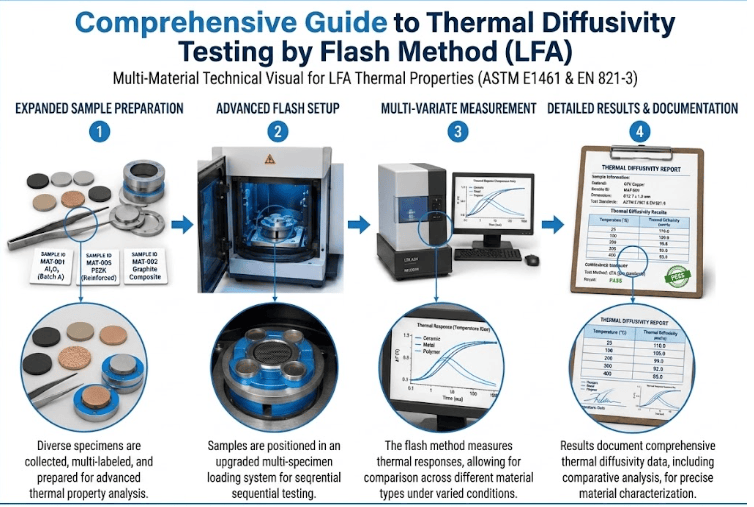
    This test method uses a short thermal energy pulse to heat the front surface of a specimen. Then, thermal energy passes through the material, and the temperature increase is measured on the other surface. ASTM E1461 test procedure is as follows-

    Read more

    Specimen PreparationTechnicians prepare the specimen to the required size and shape and ensure that its surface is suitable for the selected flash measurement setup.
    Energy PulseTechnicians apply a brief energy pulse to the specimen surface using the instrument.
    Temperature MeasurementTechnicians measure the temperature response on the opposite surface as heat passes through the specimen.
    Thermal Diffusivity CalculationAnalysts use the temperature-time response and specimen thickness to determine the thermal diffusivity.
    Result ReportingLaboratories report the thermal diffusivity along with test temperature, specimen data, and pertinent test conditions.

    ASTM E1461 Testing Process and Data Collection

    Analysts prepare representative specimens for analysis using the flash method. Next, the dimensions of the specimen are measured, and the sample is placed in the thermal diffusivity instrument. The instrument then sends a brief energy pulse to the front surface of the specimen, and the detector measures the temperature response on the back surface. The temperature-time curve is recorded by the system for analysis. Finally, thermal diffusivity is calculated from the measured response and specimen thickness. For thermal behavior over a temperature range, measurements can be carried out in the laboratory at a specified temperature.

    This image shows a solid material specimen positioned in a flash thermal diffusivity analyzer for ASTM E1461 testing.
    ASTM E1461 Flash Method Thermal Diffusivity Testing

    Common Challenges and Troubleshooting

    Consistent specimen size, proper surface preparation, stable temperature conditions, and accurate temperature measurement are essential for proper ASTM E1461 performance. Surface irregularities and/or inappropriate specimen thickness can affect the measured thermal response. Technicians should check specimen size and instrument calibration before testing. Additionally, correct specimen energy-pulse conditions allow laboratories to acquire reliable thermal diffusivity measurements.

    ASTM E1461 Analysis Results and Interpretation

    Thermal diffusivity of the tested material under the specified test conditions and temperature is summarized. The measured diffusivity is reported along with the specimen information.

    Read more

    • ASTM E1461 provides thermal diffusivity data rather than an overall thermal-performance value.
    • Thermal Diffusivity is often expressed as mm2/s or m2/s.
    • Laboratories report the test temperature, as thermal diffusivity can vary with temperature.
    • Results are reported along with specimen thickness and test conditions applicable to the tests.
    • When density and specific heat capacity are known, thermal conductivity can be calculated.
    • Laboratories can achieve consistent results with controlled thermal conditions and specimen preparation.

    Link to ASTM E1461

    Updated on August 24, 2026

    Gokula Srinivasan Selvam
    About Author
    Gokula Srinivasan Selvam is a Material Testing Associate at Matestlab Inc. and holds a postgraduate degree in Ceramic Engineering from IIT (BHU), Varanasi. His academic background and professional experience are centered on advanced ceramic materials, their processing, characterization, and performance evaluation.
    Know More
    Testimonials
    Real results
    Engineers trust us with what matters most
    Why Choose Matestlab?
    Matestlab is a unified testing services partner based in the USA. Matestlab offers raw material and product testing services through accredited, expert laboratories primarily based in the USA. Matestlab supports physical, thermal, chemical, electrical, mechanical, environmental, and characterization testing needs through its global network of 2200+ accredited testing laboratories. Matestlab's in-house materials science experts curate and design comprehensive testing programs matched to the sample material and specific testing need, with regulatory requirements and confidentiality in mind.

    If you are looking for a managed and trusted testing partner to achieve your research goals, feel free to schedule a meeting with us or send us a request at connect@matestlabs.com to learn more about our services. For a quick quote, call us at (302)244-7710. We are happy to serve you.
    Start Your Testing
    Project Today
    Define your requirements and get access to
    specialized laboratories ready to deliver results
    Partners with us
    Clients
    Vendors
    Process for testing
    • STEP 01

      You share your testing requirements

    • STEP 02

      You share your sample(s)

    • STEP 03

      We deliver your test reports

    Get your testing done

    Let us know your testing requirements and we will be right back with a solution.

      Let us root for each other. Collaborate to grow, expand, and accelerate our businesses.

      Partner with us