ASTM E1409 Standard Test Method for Determination of Oxygen and Nitrogen in Titanium and Titanium Alloys by Inert Gas Fusion

    What is ASTM E1409?

    ASTM E1409 is a standard test method for the determination of oxygen and nitrogen in titanium and titanium alloys using inert gas fusion. The prepared metal sample is heated at a high temperature in a graphite crucible whilst inside a controlled atmosphere of inert gas. Oxygen is converted to carbon monoxide and nitrogen is liberated. The analyzer uses infrared or thermal conductivity to detect oxygen and thermal conductivity to detect nitrogen. The oxygen and nitrogen are reported as a percentage by mass. This test can be used for testing titanium samples and quality control. It provides information on the chemical composition, which can be used to indicate the purity of the material. It can also be used to specify or assess titanium alloys.

    Read more

    Get Reliable ASTM E1409 Testing for Accurate Oxygen and Nitrogen Assessment

    The ASTM E1409 test method provides an accurate measurement of the oxygen and nitrogen levels in both Titanium and Titanium Alloys. This allows producers of Titanium to ensure that their product is of high quality and meets the required specifications. By following correct sample preparation and instrument calibration procedures, errors can be minimized. In addition, reliable testing gives manufacturers a standard basis for quality control and material evaluation. 

    What is the Scope of ASTM E1409?

    ASTM E1409 is a standard test method for the determination of oxygen and nitrogen in titanium and titanium alloys by the inert gas fusion method. The method measures the quantity of oxygen and nitrogen by high-temperature fusion in a graphite crucible with a carrier gas flow of inert gas. This method provides a standardized method of quantifying oxygen and nitrogen mass fractions in titanium, aiding quality control and specification of titanium.

    Read more

    The scope of ASTM E1409 includes:

    • Material type: Titanium and titanium alloys.
    • Purpose: To determine the oxygen and nitrogen content in metal samples.
    • Properties evaluated: Oxygen content from 0.01% to 0.5% and nitrogen content from 0.003% to 0.11%.
    • Testing method: Inert gas fusion and IR or thermal conductivity oxygen and thermal conductivity nitrogen detection.
    • Result: Content of oxygen and nitrogen expressed as a percentage by mass.
    • Test limitations: Oxygen and nitrogen are detected within these ranges. Low-purity flux can affect recovery of oxygen.
    • Methodology: This test should be performed under controlled laboratory conditions using well-calibrated equipment, reference material, and careful sample preparation.
    • Application: Used in titanium laboratories and manufacturing for quality control, specification checking, and evaluation of titanium alloy composition. 

    What are the Uses of ASTM E1409 Testing?

    The main purposes of ASTM E1409 are to determine the oxygen and nitrogen content in order to provide quality control on titanium alloys and to provide a consistent means for analyzing chemical composition. It provides useful information for specification testing and material evaluation.

    • Determines oxygen and nitrogen content in titanium and titanium alloys.
    • Supports titanium alloy quality control.
    • Helps assess chemical composition.
    • Checks conformity with specified oxygen and nitrogen limits.
    • Supports material evaluation and specification checking.

    What Materials Can Be Tested Under ASTM E1409?

    ASTM E1409 method outlines how technicians determine the amount of oxygen and nitrogen contained within titanium and titanium alloys. Manufacturers use this testing method to determine how much oxygen and nitrogen are contained within their metal samples. The samples are prepared and weighed by the technicians performing the testing. Each sample is placed into a graphite crucible with nickel flux; the sample is then heated using the analyzer with an inert gas flow to determine how much oxygen and nitrogen are contained within the sample.

    Why is ASTM E1409 Important?

    ASTM E1409 is an important standard test method to determine oxygen and nitrogen content within titanium and titanium alloys. Oxygen and nitrogen content are part of the chemical composition requirements for titanium materials. This test helps to ensure quality control and specification by providing data that can be used to assess oxygen and nitrogen levels. It also provides a set of analytical methodologies for laboratories to follow to give comparable results.

    ASTM E1409 Equipment and Sample Preparation Guide

    Determining the oxygen and nitrogen content of titanium and titanium alloys is an important chemical parameter. These can be determined using a high-temperature fusion and gas detection method. These results are used by Titanium manufacturers and QC labs to determine the chemical makeup of materials.

    Read more

    Sample and specimenTechnicians choose samples made of titanium or titanium alloys that represent the material being tested for oxygen and nitrogen analysis. The sample needs to be an example of the material being evaluated to ensure the results of the analysis are accurate.
    Sample preparationTechnicians clean the metal sample to remove any surface impurities. They use a file, an abrasive tool, or a proper chemical method to get the specimen ready. After that, they wash the sample with acetone. Let it dry in the air before measuring its weight.
    Sample dimensionsTechnicians make a test portion that weighs between 0.100 grams and 0.150 grams. The process does not set exact size limits for length, width, or thickness. The sample prepared must have material to carry out the chemical analysis properly.
    InstrumentationTechnicians use an automated inert gas fusion analyzer, graphite crucibles, and high-purity nickel flux to measure the levels of oxygen and nitrogen. The system has a high-temperature furnace, an inert gas source, gas cleaning equipment, and proper detection tools. Technicians also use a balance, clean tweezers, crucible tongs, and standard materials for preparing the sample and calibrating the machine.

    ASTM E1409 Testing Procedure and Requirements

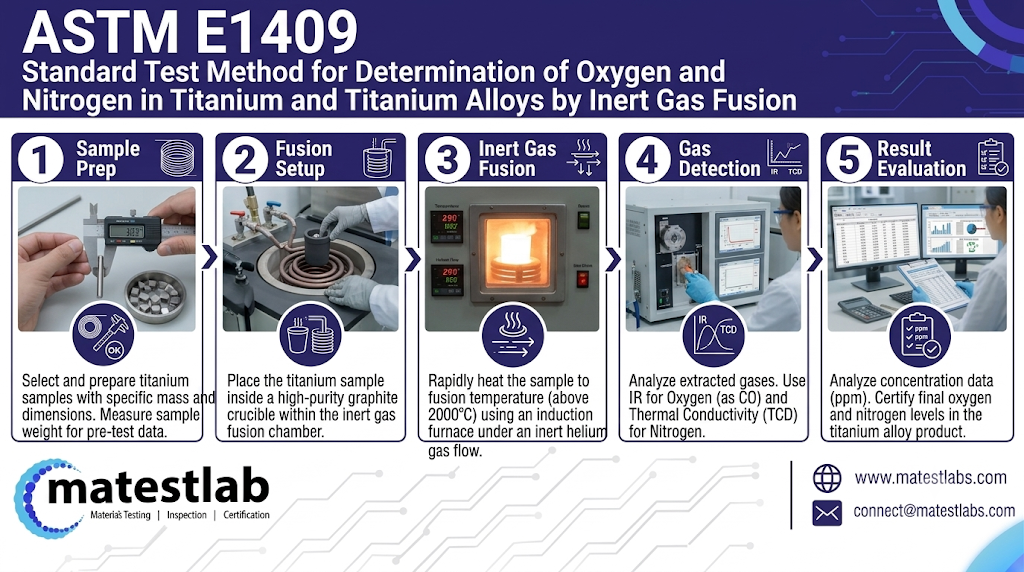
    ASTM E1409 helps determine oxygen and nitrogen content in titanium materials, which provides useful information about chemical composition and supports material specifications. The analysis combines high-temperature fusion, controlled gas extraction, and instrumental detection to quantify both elements. Technicians use the detector response and calibrated reference materials to report the final oxygen and nitrogen values.

    Read more

    Testing StepProcedure
    Specimen preparationA representative sample of titanium should be prepared, removing any surface contamination. A suitable quantity of sample should be weighed.
    Reagent requirementsHigh-purity nickel flux, inert gases, acetone, and any other reagents will be used, using high-purity graphite crucibles and optional graphite powder.
    Nickel flux preparationA high-purity nickel flux should be used. As required, the flux could be purified. The suitability of the flux can be determined by carrying out a blank.
    Sample cleaningSurface contamination is removed by either physical or chemical means. The sample is then rinsed with acetone and left to dry.
    Instrument preparationAssemble the analyzer according to the manufacturer’s instructions. Check for any gas leaks around the furnace, filters, and analyzer.
    Instrument calibrationCalibrate the analyzer using certified titanium or titanium alloys. Confirm that the instrument is responding correctly by comparing the results with those of the certified reference materials.
    Sample loadingPlace between 0.100 g and 0.150 g of titanium sample into the analyzer with nickel flux.
    High-temperature fusionThe analyzer heats the sample and nickel flux inside the graphite crucible. The sample releases oxygen and nitrogen.
    Oxygen detectionThe oxygen reacts with carbon to form carbon monoxide. Depending on the design of the analyzer, this is reacted to produce carbon dioxide. The gases are then analyzed using an infrared or thermal conductivity detection system.
    Nitrogen detectionDuring fusion, the analyzer releases nitrogen gas. The inert gas flow carries this to the thermal conductivity detector.
    Result calculationThe analyzer compares the response from the detector with those of the reference materials. The mass fraction of oxygen and nitrogen is calculated based on the mass of the sample, calibration information, and blank subtraction.

    ASTM E1409 Testing Process and Data Collection

    The oxygen and nitrogen content in Titanium can be determined using an inert gas fusion technique. Weigh the sample before preparing the metal and mixing it with the nickel flux. The sample is placed inside the graphite crucible before heating with Inert gas. Oxygen combines with carbon, creating carbon monoxide, and nitrogen is produced as a gas. The instrument uses Infrared detection for oxygen and thermal conductivity detection for nitrogen. The signal from each detector is compared to standards to give a percentage result for each element.

    The image shows the measurement of oxygen and nitrogen content in titanium and titanium alloys according to ASTM E1409.
    Titanium and titanium alloy samples analyzed to determine oxygen and nitrogen content by inert gas fusion according to ASTM E1409.

    Common Challenges and Troubleshooting

    Technicians have trouble understanding how much oxygen and nitrogen are present in titanium samples. Surface contaminants cause high oxygen readings in the sample. Incorrect preparation of the sample and overheating due to mechanical cleaning of the sample may affect the results. Impure nickel flux absorbs the released oxygen and produces incorrect readings. Gas leakage, irregular blank values, and incorrect instrument calibration affect the test results. Technicians carefully prepare their samples, check the purity of their flux, and follow the correct procedures. The instruments are well maintained and regularly checked for correct calibration.

    ASTM E1409 Analysis Results and Interpretation

    This test provides information on the oxygen and nitrogen content of titanium and titanium alloys, using ASTM E1409. This is presented as a percentage of the total sample mass.

    Read more

    • The oxygen and nitrogen content of the sample is determined using the detector signal, sample mass, calibration data, and blank correction.
    • Oxygen can be present in the sample between 0.01% and 0.5% (mass), and nitrogen can range from 0.003% to 0.11% (mass).
    • These values allow manufacturers to determine their chemical composition.
    • The purity of nickel flux and any surface contamination can have an effect on the oxygen in the sample. Technicians ensure that they prepare the sample correctly and use high-quality flux.
    • Manufacturers compare the oxygen and nitrogen values with the relevant specifications for their titanium alloys.

    Link to ASTM E1409

    FAQ

    What does ASTM E1409 determine?
    ASTM E1409 determines the oxygen and nitrogen content of titanium and titanium alloys through inert gas fusion.
    The method applies to titanium and titanium alloys.
    Oxygen and nitrogen content form part of the chemical composition requirements for titanium materials. Manufacturers check these values against material specifications.
    Surface contamination, low-purity nickel flux, sample overheating, and incorrect instrument calibration affect the test results.

    Updated on November 12, 2026

    Zunaira Tehseen
    About Author
    Zunaira Tehseen is a scientific content specialist who bridges interdisciplinary research across biochemistry, molecular genetics, and materials science with technical content management. Leveraging expertise in bio-interface characterization, advanced materials evaluation, and AI-driven workflows, she curates, structures, and communicates complex technical data. At Matestlab, she leads content strategy and documentation for metallographic testing, mechanical characterization, and compliance with international standards such as ASTM and ISO, delivering precise, high-impact technical assets for industrial and scientific audiences.
    Know More
    Testimonials
    Real results
    Engineers trust us with what matters most
    Why Choose Matestlab?
    Matestlab is a unified testing services partner based in the USA. Matestlab offers raw material and product testing services through accredited, expert laboratories primarily based in the USA. Matestlab supports physical, thermal, chemical, electrical, mechanical, environmental, and characterization testing needs through its global network of 2200+ accredited testing laboratories. Matestlab's in-house materials science experts curate and design comprehensive testing programs matched to the sample material and specific testing need, with regulatory requirements and confidentiality in mind.

    If you are looking for a managed and trusted testing partner to achieve your research goals, feel free to schedule a meeting with us or send us a request at connect@matestlabs.com to learn more about our services. For a quick quote, call us at (302)244-7710. We are happy to serve you.
    Start Your Testing
    Project Today
    Define your requirements and get access to
    specialized laboratories ready to deliver results
    Partners with us
    Clients
    Vendors
    Process for testing
    • STEP 01

      You share your testing requirements

    • STEP 02

      You share your sample(s)

    • STEP 03

      We deliver your test reports

    Get your testing done

    Let us know your testing requirements and we will be right back with a solution.

      Let us root for each other. Collaborate to grow, expand, and accelerate our businesses.

      Partner with us