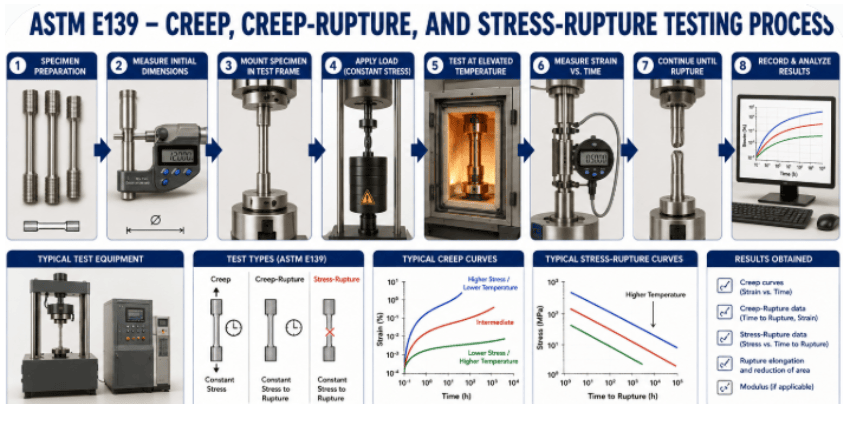
ASTM E139 applies to the creep, creep-rupture, and stress-rupture testing of metallic materials under specified conditions of stress, load, temperature, and time. The methods give information on time-dependent deformation and the ability of metallic materials to withstand sustained loading. The scope of ASTM E139 includes:
- Material Type: Metallic materials and applicable alloys evaluated for creep or rupture behavior.
- Property Measured: Creep deformation, creep rate, rupture time, and other appropriate creep or rupture properties.
- The method: Testing consists of applying a sustained load or stress to a metallic specimen, keeping the temperature constant, and then observing the specimen over time.
- Result: Results include strain, deformation, creep rate, stress, temperature, and time to rupture (as applicable).
- Test Limitations: Results depend on the test conditions/circumstances described and on the material, specimen dimensions, applied stress, test duration, and temperature.
- Environmental Conditions: Temperature and applicable test-environment conditions are controlled, as they can affect the creep and rupture behavior.
- Applications: High-temperature material evaluation, engineering design, material selection, alloy development, quality control, and long-term evaluation.
What are the uses of ASTM E139 testing?
ASTM E139 testing provides engineers and technical staff with an indicator of the response of metallic materials to sustained stress for a prolonged period of time. The test indicates information on time-dependent deformation, creep rates, and rupture characteristics under given conditions of temperature and loading. These results are used by technicians and analysts to gain insight into long-term material performance and for engineering decision-making. The data can also be useful for comparing materials and assessing their performance for critical service conditions. The test helps to:
- Creep Evaluation: Measures the deformation of a metal material as a function of time when subjected to a constant stress.
- Rupture Assessment: Determines the properties and times-to-failure of rupture under given conditions.
- Material Comparison: A comparison of the creep and rupture behavior of the appropriate metallic material/ alloys.
- Material Selection: Helps in choosing materials for sustained-load and elevated-temperature applications.
- Engineering Design: Supplies mechanical-performance information for appropriate engineering uses.
- Quality Control: Assists with checking the uniformity of materials and their effectiveness.
- Materials Development: Helps develop and test metallic materials and alloys.
Which Materials Can Be Tested According to ASTM E139?
ASTM E139 applies to metallic materials for which the creep, creep-rupture, or stress-rupture properties are needed. The method is especially valuable when engineers want to comprehend the behavior of metals subjected to sustained loading for extended periods of time at controlled temperatures. Techs can make representative specimens from production materials, metallic alloys, and materials in development. The specimens selected must satisfy the required dimensions, condition, and test configuration for the selected type of test. The method applies to:
- Material Type: Metallic materials evaluated for time-dependent deformation and rupture behavior.
- Metallic Alloys: Supports creep and rupture evaluation of applicable alloy grades.
- High-Temperature Materials: Allows evaluation of metals intended for elevated-temperature service.
- Production Materials: Supports testing of representative specimens from manufacturing or production batches.
- Development Materials: Helps engineers evaluate new or modified metallic materials for long-term performance.
Why Is ASTM E139 Testing Important?
This process of progressive deformation over time is referred to as creep and can occur in metallic materials under sustained stress, especially at high temperatures. Repeated exposure may lead to bursting. ASTM E139 is a standard method for assessing these behaviors in a controlled setting. The results are useful for the analysis of high-temperature and sustained-stress material performance, comparative analysis of metallic materials, material selection, and evaluation of all the alloys for their application to sustained stress at high temperature.