ASTM E1232 Standard Test Method for Temperature Limit of Flammability of Chemicals 

    What is ASTM E1232?

    ASTM E1232 is a standard test method to provide a common, precise method for laboratory determination of stability profiles of chemical formulations. The protocol focuses on characterizing critical temperature ranges where chemical mixtures, under specific conditions, begin to decompose faster than they are heated. It is a major measurement parameter used by chemical industries worldwide to create reliable processing envelopes, ensure safe shipping instructions, and determine operational constraints for reactive chemical systems in modern processing industries. Commercial analytical laboratories systematically apply ASTM E1232 (Standard Test Method for Temperature-Staged Isothermal Kinetics of Thermally Unstable Materials) to measure accurate kinetic parameters and induction times under well-controlled, isolated laboratory conditions that meet global regulatory compliance requirements. Evaluating thermal stability helps researchers understand how materials respond to controlled heating and identify changes associated with thermal breakdown

    Read more

    Get Certified ASTM E1232 Certification Testing for Thermally Unstable Materials

    Manufacturers use ASTM E1232 certification testing to validate their chemical products’ thermal hazard profiles and reaction kinetics before entering large-scale commercial distribution. This third-party certified testing data ensures complete compliance with international maritime shipping safety and environmental protection laws. This formal validation process allows chemical suppliers to validate temperature ranges, avoid potentially fatal thermal runaway reactions, and ensure a validated, secure safety status in the global supply chain.

    What is the Scope of ASTM E1232?

    ASTM E1232 is a standard test method that includes accurate laboratory measurement of the reaction parameters (kinetic) and heat induction periods (thermal) of potentially unstable chemical materials. Describes precisely the testing method to be followed for determining the behavior of the sample through a series of isothermally maintained temperature ranges with specific thermal analysis equipment. This intensive practice makes it possible to achieve the highest degree of reproducibility when evaluating complex formulations in which self-heating phenomena occur locally under normal industrial processing, warehousing, or trans-shipping conditions. The framework sets uniform baselines for sample mass, instrumentation calibration, and heat flow monitoring to ensure high fidelity in data extraction.

    Read more

    The scope of ASTM E1232 includes:

    • Materials:  Thermally unstable materials, chemical intermediates, and reactive mixtures.
    • Purpose: Estimation of reaction kinetics and auto-heating induction time to avoid thermal runaways.
    • Properties Measured: Activation energy, pre-exponential factors, and isothermal induction periods.  
    • Methods: Accurate heat flow monitoring and temperature-staged isothermal calorimetry.
    • Results:  Kinetic models that represent the decomposition of chemicals over time – quantitative.
    • Test Limitation: Sensitive to the initial state of the sample purity, sample weight, and the containment configurations in the vessel.
    • Environmental Conditions: Performed in gas-purged, hermetically sealed analytical chambers with temperature control.
    • Applications: Scaling of chemical processes, classification of dangerous goods transportation, design of safe storage.

    What are the Uses of ASTM E1232 Testing? 

    This standardized thermal safety test is commonly used in the chemical manufacturing, defense, and pharmaceutical industries to assess the risk of runaway reactions. It provides empirical kinetic information for making predictive thermal models of bulk storage tanks and full-scale factory reactors. This standard,

    • Enables the process engineer to ensure safe maximum allowable process temperature in industrial manufacturing.
    • Helps logistics managers to define refrigeration parameters for international transport.
    • Sets verifiable boundaries of thermal safety to reduce the catastrophic hazard of facility explosion.
    • Gives reproducible kinetic information for the shelf-life stability of novel chemical formulations.

    What material can be tested under ASTM E1232?

    This critical thermal hazard test standard is specifically developed for thermal testing of a wide range of thermally unstable materials, reactive chemical intermediates, organic peroxides, self-reactive materials, specialty pharmaceutical formulations, etc. The method is safe and will allow for the inclusion of more complex chemical compounds that may spontaneously decompose over a period of time when exposed to sustained warm temperatures. It analyzes both liquid and solid raw materials, special polymer initiators, volatile energetic mixtures, as well as complex process mixtures which require comprehensive thermodynamic characterization to ensure safe blending, packaging, handling, and long-term bulk storage in automated chemical production facilities.

    Why is ASTM E1232 Important?

    ASTM E1232 is particularly significant because it provides the exact mathematical information needed to avoid catastrophic thermal runaway reactions in modern chemical manufacturing facilities. This protocol is different from basic scanning tests, which only determine a general initial time to the decomposition point when the sample is heated quickly and at a high rate, and the scanning method is used only to determine the precise time to explosion for constant real-world heating. This is a very realistic simulation to avoid unexpected fires in warehouses and explosions of dangerous goods on ships, which can slowly self-heat over days or weeks. It offers an unparalleled and universally accepted safety structure for evaluating chemical stability and for ensuring their safe use in plant operations and adherence to international, stringent dangerous goods transport regulations that protect operational personnel.

    ASTM E1232 Equipment and Sample Preparation Guide

    This advanced thermal hazard evaluation requires a highly specialized laboratory environment, including precision differential scanning calorimeters or dedicated micro-calorimetry units. Volatile decomposition products should not escape from the samples into the surrounding atmosphere and affect the heat generation curves used to calculate the operating parameters during processing, so the reactive samples must be isolated in special hermetic pans under pressure.

    Read more

    Sample and Specimen DetailsEngineers isolate representative sub-samples of raw reactive formulations while avoiding premature heat exposure. 
    Specimen PreparationLab technicians seal the volatile material into specialized high-pressure corrosion-resistant hermetic test crucibles.
    Specimen DimensionsTesting operators weigh the precise specimen mass down to sub-milligram levels to prevent explosive sample overloading.
    InstrumentationAnalysts configure the heat-flux sensors and automated gas-purge systems to maintain isothermal environments.

    Testing Procedures and Requirements for ASTM E1232

    The testing sequence requires a careful step-by-step control of instrument temperature stages and realistic reaction times. Analysts must perform each step carefully to collect clean heat-generation data while avoiding uncontrolled vessel failures. The test is conducted in the following steps:

    Read more

    Instrument PurgingTechnicians flush the specimen chamber with high-purity inert nitrogen gas to eliminate background oxidative reactions.
    Rapid Pre-HeatingOperators rapidly ramp the instrument temperature to the first designated isothermal testing stage boundary.
    Isothermal HoldOperators maintain the selected target temperature with absolute precision to capture sample induction periods.
    Exotherm TrackingTechnicians record the exact timeline and magnitude of any exothermic heat-flow signatures.
    Temperature StagingAnalysts repeat the complete sequence at multiple distinct temperature increments using fresh sample pans.
    Kinetic ModelingAnalysts process the combined multi-stage induction timelines to mathematically plot the final material stability curve.

    ASTM E1232 Testing Process and Data Collection

    The entire thermal characterization process depends on highly sensitive systems that can record small changes in heat energy over long periods. Laboratory technicians monitor baseline drift, chamber pressures, and localized energy releases throughout each successive temperature plateau. The exact duration between the initial isothermal stabilization and the maximum exothermic reaction point is recorded absolutely accurately. The time-to-exotherm matrix is an empirical representation used to build extensive equations to define material longevity.

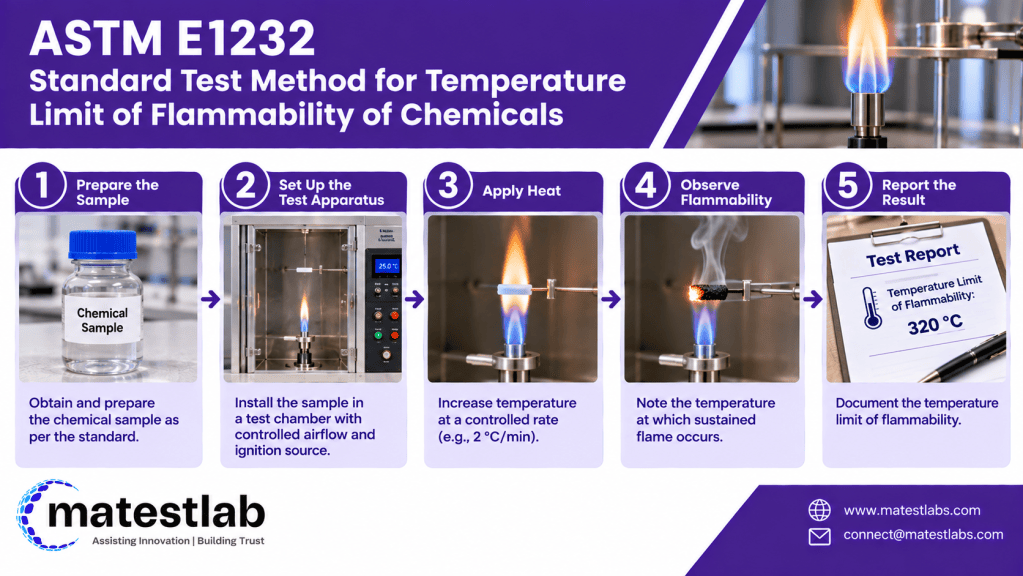
     The image shows the ASTM E1232 workflow, including preparation of chemical sample, setting up the test apparatus with controlled airflow and an ignition source, gradually increasing the temperature under controlled conditions, observing and recording the temperature at which a sustained flame occurs, and documenting the temperature limit of flammability in the final report.
    ASTM E1232 Determination of  Temperature Limit of Flammability of Chemicals 

    Common Challenges and Troubleshooting

    One of the great difficulties in implementing this standard of testing is the great volatility of the samples and the complete stability of the base measurements in prolonged isothermal periods. A leak, or a container that is overfilled, in a test container will corrupt the kinetic data at once. Only gold-plated or special stainless-steel hermetic crucibles can be used in troubleshooting, and there must be strict weight checks after testing. Technicians must perform empty-cell baselines regularly to fully remove parasitic instrument signal noise.

    ASTM E1232Analysis Results and Interpretation

    After the isothermal staging tests, the obtained raw heat flow curves are carefully analyzed for the decomposition behavior. The advanced kinetic curves are compared to the global processing limits to qualify safe operating ranges.

    Read more

    • Operators determine the exact induction times from the inflection points of the heat generation curves in the laboratory.
    • Quality assurance engineers use Arrhenius plotting software to determine the ACTIVATION ENERGY of decomposition.
    • Chemical operators compare the calculated stability data with maximum safe handling limits for the manufacturer.
    • Technical technicians archive complete thermodynamic files for traceability for compliance audits with dangerous goods.

    Link to ASTM E1232 

    FAQ

    How do I submit a sample or request an ASTM E1232 quote?
    You can request a quote by providing your safety data sheet, estimated decomposition onset temperatures, sample compatibility details, and shipping criteria through our secure portal.
    We utilize high-pressure differential scanning calorimeters, automated micro-calorimetry units, specialized gold-sealed hermetic crucibles, and advanced kinetic modeling software following the temperature-staged isothermal method.
    Yes, our specialized thermal hazard testing facilities maintain full ISO 17025 accreditation, ensuring absolute calibration accuracy, complete traceability, and strict compliance for all explosive hazard characterizations.
    We support global chemical enterprises by providing comprehensive dangerous goods shipping compliance guidelines, managing temporary import customs paperwork, and delivering certified electronic data packages securely worldwide.

    Updated on November 9, 2026

    Laraib Hashmi
    About Author
    Laraib Hashmi is an aspiring research enthusiast and science content professional with a strong interdisciplinary skill set, holding a postgraduate degree in Applied Microbiology from KIIT Bhubaneshwar, Odisha.
    Know More
    Testimonials
    Real results
    Engineers trust us with what matters most
    Why Choose Matestlab?
    Matestlab is a unified testing services partner based in the USA. Matestlab offers raw material and product testing services through accredited, expert laboratories primarily based in the USA. Matestlab supports physical, thermal, chemical, electrical, mechanical, environmental, and characterization testing needs through its global network of 2200+ accredited testing laboratories. Matestlab's in-house materials science experts curate and design comprehensive testing programs matched to the sample material and specific testing need, with regulatory requirements and confidentiality in mind.

    If you are looking for a managed and trusted testing partner to achieve your research goals, feel free to schedule a meeting with us or send us a request at connect@matestlabs.com to learn more about our services. For a quick quote, call us at (302)244-7710. We are happy to serve you.
    Start Your Testing
    Project Today
    Define your requirements and get access to
    specialized laboratories ready to deliver results
    Partners with us
    Clients
    Vendors
    Process for testing
    • STEP 01

      You share your testing requirements

    • STEP 02

      You share your sample(s)

    • STEP 03

      We deliver your test reports

    Get your testing done

    Let us know your testing requirements and we will be right back with a solution.

      Let us root for each other. Collaborate to grow, expand, and accelerate our businesses.

      Partner with us