ASTM E1228 Standard Test Method for Assay of Peroxy Esters-Catalyzed Iodometric Procedure

    What is ASTM E1228?

    ASTM E1228 is a standard test method that provides a precise, validated analytical method for assessing specific organic peroxides widely used in modern chemical manufacturing. This detailed technical methodology provides consistent testing criteria to quantify the amount of active compound, directly supporting chemical stability, safe long-term storage, and effective shelf-life management for high-purity industrial chemical shipments worldwide. The ASTM E1228 (Standard Test Method for Assay of Peroxy Esters—Catalyzed Iodometric Procedure) is used throughout commercial chemical laboratories to precisely determine the chemical formulation parameters and active oxygen contents before the peroxy compound is finally released to the market and distributed to industries throughout the world.

    Read more

    Certified ASTM E1228  Testing for Organic Peroxides and Chemical Intermediates

    Organic peroxide manufacturers rely on ASTM E1228 testing to officially validate their organic peroxide formulations and confirm exact chemical purity before shipment to industrial consumers. Obtaining this certified test data ensures compliance with international quality management systems and safety regulations for dangerous materials. This stringent validation process enables the chemical supplier to ensure the activity of the components, minimize handling risks, and provide market credibility without doubt in the worldwide manufacturing industry.

    What is the Scope of ASTM E1228?

    ASTM E1228 is a standard test method for the peroxy ester class of organic peroxides and is an in-depth laboratory test. It offers a very detailed analytical protocol that is used to accurately measure the active oxygen in a particular chemical titration process, utilizing a special catalyzed chemical reaction procedure. This is a standard that guarantees the best consistency and high repeatability of the evaluation of complex chemical compounds, which are used in the quality control of industrial manufacturing processes in different industrial sectors, as critical processing agents. The testing framework reduces laboratory routine testing human error by providing standardized guidelines for the preparation of solutions, chemical calibration, and titration endpoints.

    Read more

    The scope of ASTM E1228 includes:

    • Materials:  Organic peroxides of the peroxy ester type.
    • Applications: Testing peroxy esters for suitability for commercial use.
    • Measured Properties: Percentage of active oxygen and overall chemical assay values.
    • Methods/Reagents: Potassium iodide solution, Potassium permanganate solution, Hydrochloric acid solution, sodium hydroxide solution.
    • Result: Quantitative determination of the concentration and purity of peroxy ester.
    • Test Limitation: Only applicable for peroxy esters; other peroxides must be tested using a different method.
    • Environmental Conditions: Controlled temperature water bath and light-controlled reaction environments.
    • Applications: Quality control in manufacturing, safety compliance, and polymer synthesis research.

    What are the Uses of ASTM E1228 Testing? 

    It is a widely used analytical test in the chemical manufacturing industry for confirmation of specifications for commercial products and batch consistency. It gives a reliable indicator of the quality of the chemical input into polymer production before the polymer is produced in large quantities. This standard,

    • Confirms the purity of polymerization reaction initiators used by chemical engineers.
    • Helps quality control teams to qualify raw material shipments from international suppliers.
    • Sets safety limits based on the precise measurement of active oxygen levels.
    • Supplies analytical information that can be reproduced for research and development of chemical products.

    What material can be tested under ASTM E1228?

    This important chemical testing guideline is specifically for analysis of organic peroxides that are all of the peroxy ester type. Specialty chemical compounds encompass a variety of commercially important formulations that are used as high-efficiency polymer initiators, chemical intermediates, and reaction catalysts. The method is suitable for peroxy esters in any commercial form as long as they can be dissolved in the appropriate laboratory solvents without causing thermal decomposition or explosive reactions to occur. These include Liquid peroxy esters, Technical-grade peroxide mixtures, and special formulations that must be carefully tested for active oxygen (AO) to ensure safe use in industry.

    Why is ASTM E1228 Important?

    ASTM E1228 is significant as it provides a true and standardized method to track the active oxygen level in chemically unstable peroxy esters. These organic peroxides are catalysts and polymerization initiators, and any variation in their assay value can make a significant difference in the rate of chemical reactions or affect industrial safety. Knowing the exact purity of the polymer helps to avoid incomplete curing and unsafe thermal reactions in the manufacturing process within the factory. This will give workers a reliable and universally accepted way to measure, ensuring high-quality plastic and polymer production, and enabling global suppliers to offer validated materials to buyers with trust and without contention.

    ASTM E1228 Equipment and Sample Preparation Guide

    This particular chemical analysis can only be performed in a carefully controlled laboratory with precision analytical equipment and reagent-grade chemicals. The preparation step requires careful consideration of details because the organic peroxides are sensitive to heat and can react with the environment, and the correct temperature control is needed for proper analysis, as well as precise mass measurement and correct glassware configuration for complete safety of the laboratory during the process. Trained laboratory staff must carefully coordinate sample handling to prevent contamination and safeguard the chemical integrity of the sample.

    Read more

    Sample and Specimen DetailsAnalysts obtain representative samples of peroxy esters while maintaining appropriate low-temperature storage protocols to prevent premature degradation. 
    Specimen PreparationTechnicians dissolve measured portions of the peroxy ester sample using specified reagent-grade solvents under a ventilated fume hood.
    Specimen DimensionsOperators weigh the precise sample mass using analytical balances calibrated to the nearest tenth of a milligram. 
    InstrumentationEngineers calibrate automated burets, iodine flasks, and regulated water baths to guarantee highly reproducible titration results.

    Testing Procedures and Requirements for ASTM E1228

    The entire chemical analysis is based upon a carefully controlled series of steps in order to achieve complete reaction efficiency and accurate titration endpoints. Each step needs to be performed with a specific time requirement, a specific temperature under room conditions, and a precise amount of reagents to achieve the reproducible results required to meet global standardization requirements. The test is conducted in the following steps:

    Read more

    Sample WeighingTechnicians weigh a precise quantity of the peroxy ester sample into a clean iodine flask.
    Solvent AdditionTechnicians introduce the designated solvent mixture to dissolve the sample completely without agitation.
    Catalyst and Reagent IntroductionOperators add the specified catalyst along with potassium iodide solution to initiate the reduction reaction.
    Controlled IncubationOperators place the flask in a temperature-controlled water bath for a designated reaction period.
    Iodometric TitrationTechnicians titrate the liberated iodine with standardized sodium thiosulfate solution until the endpoint is approached.
    Endpoint VerificationAnalysts add starch indicator and titrate carefully until the distinct blue color completely disappears.

    ASTM E1228 Testing Process and Data Collection

    The whole process of chemical testing relies on careful recording of data at key points in the iodometric titration sequence. Technicians are constantly checking sample weight, volumes of reagent added, and the color change that occurs when the solution mixture is combined. The amount of sodium thiosulfate titrant used in the sample titration and blank baseline titration is measured with high accuracy. The resulting empirical values are precisely recorded in the central data systems to obtain the correct percentage per the final peroxy ester assay.

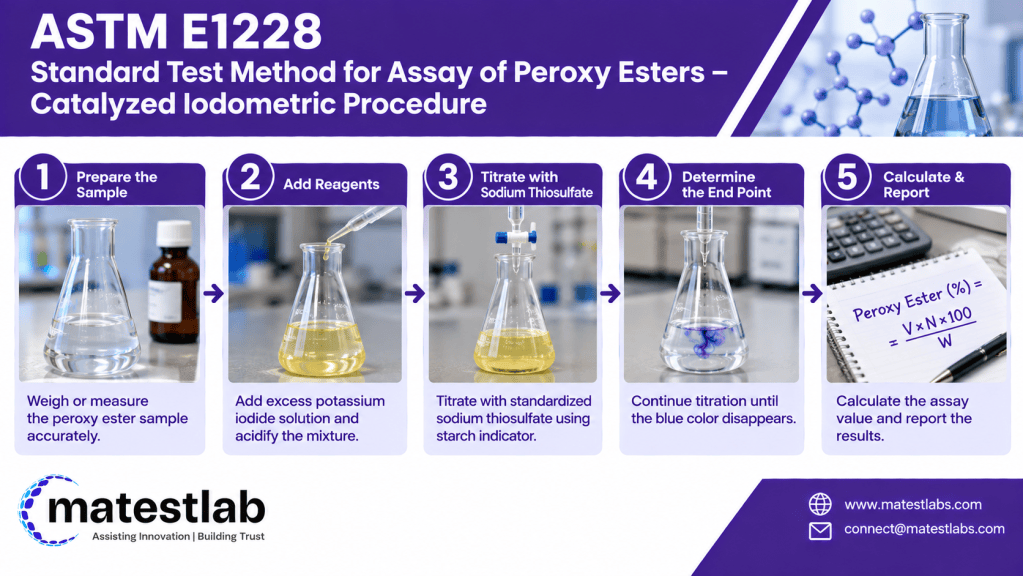
     The image shows the ASTM E1228 workflow covering accurately weighing the peroxy ester sample, adding excess potassium iodide solution and acidifying the mixture to release iodine, titrating the liberated iodine with standardized sodium thiosulfate using a starch indicator, continuing titration until the blue color disappears, and calculating and reporting the peroxy ester content.
    ASTM E1228 Determination of Peroxy Esters-Catalyzed Iodometric Procedure

    Common Challenges and Troubleshooting

    One of the main problems in this testing process is that the iodide ions may self-oxidize or decompose before the titration is completed. Inaccurate readings of active oxygen will result if ambient room temperature changes considerably or if the solution is subjected to excessive sunlight. During the reaction phase, chilled water baths and dark storage conditions must be used absolutely during the troubleshooting phase. It is also the responsibility of the laboratory staff to ensure the freshness and stability of all chemical reagents used regularly.

    ASTM E1228 Analysis Results and Interpretation

    ASTM E1228 analysis and interpretation involves completion of a physical titration series; the analysis of primary data points that are gathered with standardized mathematical formulas to establish the accurate compound purity rate. All these analytical calculations are comprehensive calculations that are performed in a way that takes both sample weights and blank volume corrections into account to provide a total metric accuracy for all the chemical batches evaluated under review.

    Read more

    • Analysts compute the percentage of active oxygen based on the net volume of titrant consumed.
    • Technicians compare the calculated assay values against the manufacturer’s certified specifications.
    • Operators document any variances observed during blank titrations to correct potential background errors.
    • Engineers round off the final assay percentages in strict accordance with standard rounding practices.

    Link to ASTM E1228

    FAQ

    How do I submit a sample or request an ASTM E1228 quote?
    You can request a quote by submitting your compound’s safety data sheet, concentration ranges, sample quantities, and safety handling requirements through our secure client intake portal.
    We utilize calibrated analytical balances, temperature-controlled water baths, specialized iodine flasks, and standardized sodium thiosulfate titrants following the catalyzed iodometric procedure.
    Yes, our analytical laboratories are fully accredited to ISO 17025 standards, ensuring complete compliance with international quality controls for testing organic peroxides.
    We support global manufacturers by providing compliant hazardous materials shipping guidelines, international customs documentation, and secure electronic delivery of certified testing reports.

    Updated on November 9, 2026

    Laraib Hashmi
    About Author
    Laraib Hashmi is an aspiring research enthusiast and science content professional with a strong interdisciplinary skill set, holding a postgraduate degree in Applied Microbiology from KIIT Bhubaneshwar, Odisha.
    Know More
    Testimonials
    Real results
    Engineers trust us with what matters most
    Why Choose Matestlab?
    Matestlab is a unified testing services partner based in the USA. Matestlab offers raw material and product testing services through accredited, expert laboratories primarily based in the USA. Matestlab supports physical, thermal, chemical, electrical, mechanical, environmental, and characterization testing needs through its global network of 2200+ accredited testing laboratories. Matestlab's in-house materials science experts curate and design comprehensive testing programs matched to the sample material and specific testing need, with regulatory requirements and confidentiality in mind.

    If you are looking for a managed and trusted testing partner to achieve your research goals, feel free to schedule a meeting with us or send us a request at connect@matestlabs.com to learn more about our services. For a quick quote, call us at (302)244-7710. We are happy to serve you.
    Start Your Testing
    Project Today
    Define your requirements and get access to
    specialized laboratories ready to deliver results
    Partners with us
    Clients
    Vendors
    Process for testing
    • STEP 01

      You share your testing requirements

    • STEP 02

      You share your sample(s)

    • STEP 03

      We deliver your test reports

    Get your testing done

    Let us know your testing requirements and we will be right back with a solution.

      Let us root for each other. Collaborate to grow, expand, and accelerate our businesses.

      Partner with us