ASTM E1178 Standard Test Methods for Analysis of Acrylonitrile

    What is ASTM E1178?

    ASTM E1178 is a set of standard test methods that establish precise laboratory procedures for determining the baseline purity of industrial-grade chemical intermediates. The standard clearly outlines methods for isolating and assaying specific harmful contaminants, trace contaminants, and active inhibitors in chemical liquid matrices to prevent corrosion of structural materials, ensure safe production, and maintain stability during bulk transportation throughout the global shipping system. Modern analytical facilities use ASTM E1178 (Standard Test Methods for Analysis of Acrylonitrile) to verify final product quality and ensure manufacturing consistency worldwide during standard industrial laboratory audits to meet strict technical benchmarks.

    Read more

    Certified ASTM E1178 Testing for Industrial Chemical Batches

    Commercial chemical shipments undergo ASTM E1178 certification testing to ensure they are extremely pure and free of hazardous or unwanted side components. Third-party certified testing reports ensure full compliance with international chemical safety laws, reduce liability within the international supply chain, and safeguard downstream processing systems. This formal validation process gives the industrial chemical supplier the ability to verify precise purity levels, ensure full regulatory compliance, and confidently achieve certified quality status in international markets.

    What is the Scope of ASTM E1178?

    ASTM E1178 standard test methods provide analytical methods for laboratories to measure the full chemical profile, visual appearance characteristics, and impurity distributions of industrial-grade acrylonitrile. The full standard provides detailed chemical analysis information that can be used to isolate and quantify various components, including color variation parameters, fractions of hydrogen cyanide, concentrations of p-methoxyphenol inhibitors, and water content in sample batches. Chemical analysis helps laboratories identify and quantify impurities in industrial chemical samples and verify that measured concentrations meet applicable specifications. The detailed scheme provides uniform titration curves, rules, and distillation procedures and reduces manual errors in routine production processes.

    Read more

    The scope of ASTM E1178 includes:

    • Materials: Liquid acrylonitrile monomer formulations and chemical intermediates.
    • Purpose: Determine chemical composition and impurity limits in commercial supply chains.
    • Properties Measured: Color levels, hydrogen cyanide concentration, the inhibitor value for p-methoxyphenol (MEHQ), and moisture content percentage.
    • Methods: Spectrophotometric color matching, Silver nitrate titration systems, Karl Fischer volumetric analysis.
    • Result: Certified quantitative assay percentages that provide information on chemical component mass distributions.
    • Test Limitation: The test was developed specifically for acrylonitrile and cannot be used for other organic nitriles.
    • Environmental Conditions: Laboratory fume hoods, with controlled ambient temperature.
    • Applications: Quality audits for plastics manufacturing, investigation of synthetic textile fibers, and safety controls for nitrile rubber processing.

    What are the Uses of ASTM E1178 Testing? 

    The protocol is a specialized chemical evaluation method widely used throughout the industrial petrochemical industry to confirm product specifications before chemical processing. Provides the exact empirical data required to prevent chemical polymerization before the product reaches its destination by bulk shipping. This standard,

    • Verifies the concentration of stabilizer molecules in raw materials by process engineers.
    • Helps quality control teams determine trace quantities of moisture that can lead to equipment corrosion.
    • Sets forth clear limits of safety for highly toxic hydrogen cyanide contamination in products.
    • Offers reproducible analytical reference standards for continuing research and development of industrial polymers.

    What material can be tested under ASTM E1178?

    This highly specific chemical testing system targets commercial-grade acrylonitrile liquid monomers and related technical chemical intermediates. The analytical method is optimized for high-purity liquid samples for the synthesis of advanced acrylic fibers, high-durability modacrylic textiles, special nitrile rubbers, and robust acrylonitrile butadiene styrene (ABS) engineering plastics. The testing protocol calls for samples to be in a stable liquid state, allowing for safe dissolution, titration, and characterization of the compound without the possibility of hazardous exothermic polymerization reactions or the potential for an impact on the safety parameters defined in international hazardous materials regulations.

    Why is ASTM E1178 Important?

    The significance of ASTM E1178 cannot be overstated, as it creates a consistent and worldwide quality standard for a large volume of consumer products that rely heavily on a critical building block chemical. Acrylonitrile is inherently unstable and reactive, so the amount of inhibitor used, such as p-methoxyphenol, must be carefully controlled to prevent dangerous spontaneous polymerization in large bulk cargo containers. This standard establishes clear, repeatable laboratory procedures to monitor these inhibitors and provides a method for detecting toxic contaminants such as hydrogen cyanide, while safeguarding chemical facility workers, maintaining building integrity in international transportation, and avoiding expensive manufacturing defects in the automotive, textile, and electronics sectors.

    ASTM E1178 Equipment and Sample Preparation Guide

    The performance of this specialized analytical evaluation requires a strictly controlled laboratory environment with precision glass apparatus, chemical fume hoods, and very sensitive spectrophotometric measurement systems. Throughout the preparation, extreme care must be taken to prevent contamination of the sample from outside sources such as moisture or the ambient heat source.

    Read more

    Sample and Specimen DetailsEngineers isolate representative liquid fractions from bulk industrial storage tanks utilizing airtight, amber glass containment bottles securely.
    Specimen PreparationTechnicians filter the liquid sample matrices meticulously under a ventilated hood to remove suspended micro-particles before testing.
    Specimen DimensionsOperators weigh the precise sample volume using calibrated volumetric pipets accurate to within hundredths of a milliliter.
    InstrumentationEngineers calibrate the electronic colorimeters, automatic burets, and digital Karl Fischer titration vessels to guarantee complete reproducibility.

    Testing Procedures and Requirements for ASTM E1178

    The analytical sequence requires close monitoring of chemical reagent additions, reaction times, and digital instrument calibrations. To isolate clean contaminant metrics, technicians need to perform each procedure step carefully to prevent chemical degradation or unsafe exposure to vapors within the workspace. The test is conducted in the following steps:

    Read more

    Color AssessmentTechnicians compare the raw liquid sample against standard platinum-cobalt scales using a calibrated spectrophotometer.
    Cyanide ExtractionOperators introduce specified alkaline reagents to separate the trace hydrogen cyanide fractions from the main matrix.
    Reagent TitrationOperators titrate the extracted mixture with standardized silver nitrate solution until reaching the exact potentiometric endpoint.
    Inhibitor MeasurementTechnicians quantify the p-methoxyphenol concentrations utilizing ultraviolet spectroscopy methods at designated wavelengths.
    Moisture AnalysisAnalysts inject a clean sample aliquot into a Karl Fischer titration cell to measure water mass.
    Data RecordingAnalysts log the absolute reagent consumption volumes to calculate final parts-per-million contamination levels.

    ASTM E1178 Testing Process and Data Collection

    The chemical characterization process relies on quick, accurate data collection and careful visual examination of chemical endpoints. During each testing phase, laboratory technicians continuously monitor electronic detector outputs, baseline stability, and titrant levels. The system automatically records all volumes of chemical titrants used in both active sample evaluations and blank tests into digital systems with high accuracy. Specific software automatically compiles the collected empirical data to calculate final purity safely.

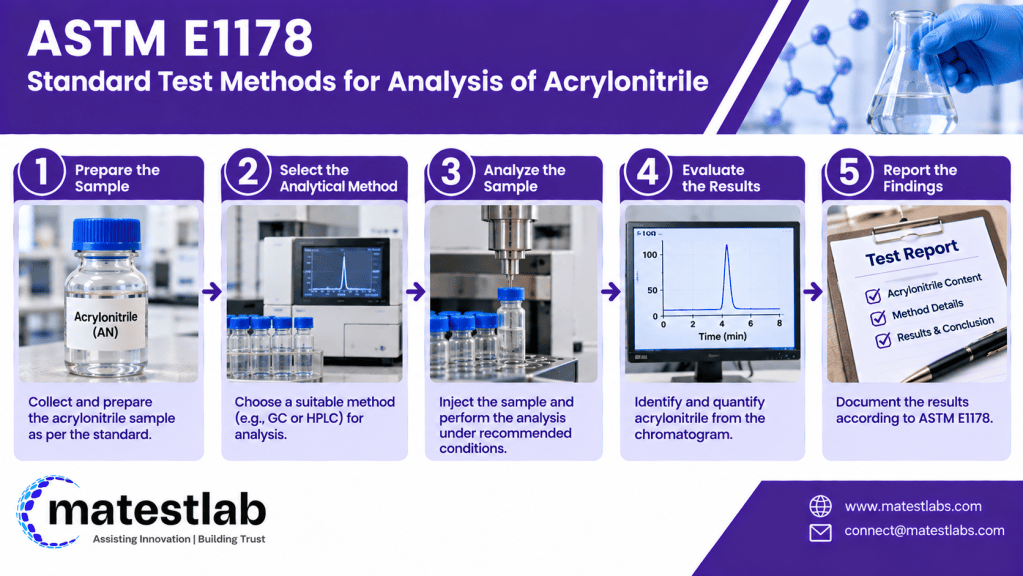
     The image shows ASTM E1178 workflow covering collecting and preparing the acrylonitrile sample, selecting a suitable analytical technique such as gas chromatography (GC) or high-performance liquid chromatography (HPLC), injecting and analyzing the sample under specified conditions, evaluating chromatograms to identify and quantify acrylonitrile, and documenting the analytical findings in the final test report.
    ASTM E1178 Test Methods for Analysis of Acrylonitrile

    Common Challenges and Troubleshooting

    One of the main difficulties in implementing this testing standard would be to avoid losing the volatiles of the target material or absorbing water from the atmosphere during handling. Allowing even a brief exposure to moisture will result in the final water determination results being completely different from the actual results. Airtight syringe injection techniques must be used, and the drying desiccants must be fresh in the equipment when troubleshooting is done. In addition, technicians need to take regular blank baseline runs to remove background chemical noise.

    ASTM E1178 Analysis Results and Interpretation

    The report summarizes the analytical results used to characterize the tested material’s composition and relevant quality properties. Analysts interpret measured concentrations and observations against applicable specification limits, customer requirements, or reference criteria; results alone do not establish safety or regulatory compliance.

    Read more

    • Laboratory scientists report hydrogen cyanide (HCN) concentration in acrylonitrile in µg/g, equivalent to ppm by mass. Analysts compare the measured concentration with the applicable specification or customer limit.
    • Quality assurance engineers report p-methoxyphenol (MEHQ) concentration and evaluate whether it falls within the specified range for the material. MEHQ serves as a polymerization inhibitor during acrylonitrile storage and shipment.
    • Chemical analysts record the measured color using the platinum-cobalt (Pt-Co) scale and report the corresponding value. They compare the result with the specified color limit rather than interpreting it as a general measure of clarity.
    • Technicians retain the analytical records and supporting instrument data required for traceability, including relevant calibration and quality-control records. Laboratory reports identify the test methods used and any deviations that could affect result interpretation.

    Link to ASTM E1178

    FAQ

    How do I submit a sample or request an ASTM E1178 quote?
    You can request a quote by submitting your material safety data sheets, expected impurity levels, sample counts, and handling protocols through our secure intake portal.
    We utilize automated Karl Fischer titrators, UV-Vis spectrophotometers, precision micro-burets, and calibrated platinum-cobalt color measurement systems following the official ASTM standard procedures.
    Yes, our analytical laboratories maintain full ISO 17025 accreditation, ensuring absolute calibration accuracy, complete traceability, and strict regulatory compliance for all dangerous chemical evaluations.
    We support global petrochemical manufacturers by providing compliant hazardous materials shipping guidance, managing complex customs documentation, and delivering certified electronic data packages securely worldwide.

    Updated on November 9, 2026

    Zunaira Tehseen
    About Author
    Zunaira Tehseen is a scientific content specialist who bridges interdisciplinary research across biochemistry, molecular genetics, and materials science with technical content management. Leveraging expertise in bio-interface characterization, advanced materials evaluation, and AI-driven workflows, she curates, structures, and communicates complex technical data. At Matestlab, she leads content strategy and documentation for metallographic testing, mechanical characterization, and compliance with international standards such as ASTM and ISO, delivering precise, high-impact technical assets for industrial and scientific audiences.
    Know More
    Testimonials
    Real results
    Engineers trust us with what matters most
    Why Choose Matestlab?
    Matestlab is a unified testing services partner based in the USA. Matestlab offers raw material and product testing services through accredited, expert laboratories primarily based in the USA. Matestlab supports physical, thermal, chemical, electrical, mechanical, environmental, and characterization testing needs through its global network of 2200+ accredited testing laboratories. Matestlab's in-house materials science experts curate and design comprehensive testing programs matched to the sample material and specific testing need, with regulatory requirements and confidentiality in mind.

    If you are looking for a managed and trusted testing partner to achieve your research goals, feel free to schedule a meeting with us or send us a request at connect@matestlabs.com to learn more about our services. For a quick quote, call us at (302)244-7710. We are happy to serve you.
    Start Your Testing
    Project Today
    Define your requirements and get access to
    specialized laboratories ready to deliver results
    Partners with us
    Clients
    Vendors
    Process for testing
    • STEP 01

      You share your testing requirements

    • STEP 02

      You share your sample(s)

    • STEP 03

      We deliver your test reports

    Get your testing done

    Let us know your testing requirements and we will be right back with a solution.

      Let us root for each other. Collaborate to grow, expand, and accelerate our businesses.

      Partner with us