ASTM E1169 Standard Practice for Conducting Ruggedness Tests

    What is ASTM E1169? 

    ASTM E1169 describes a standard practice for conducting ruggedness tests on specific test methods. This practice identifies factors that strongly influence a particular test method’s measurement and estimates the degree of control laboratories need during routine testing. ASTM E1169 (Standard Practice for Conducting Ruggedness Tests) specifies statistically designed experiments with two levels for each factor and experimentally changes all factor levels simultaneously to analyze the individual effect of each factor on the measured result. Analysts conduct a set of runs, each using a specific combination of factor values, then examine the data to rank the most important factors. ASTM Subcommittee E11.20 maintains this practice, and Guide E1488 identifies ruggedness testing as part of the validation phase of developing a standard test method.

    Read more

    Get Certified ASTM E1169 Testing for Rigorous Method Validation 

    Certification confirms that the test method’s ruggedness evaluation meets the requirements of ASTM E1169, including the proper two-level factorial design and statistical evaluation. Analysts use the results to improve a test method before an interlaboratory study and as part of the validation phase of developing a standard test method. ASTM E1169 also offers statistically designed methods that enable laboratories to consider multiple factors in a more efficient manner than performing separate experiments on each factor.

    What is the Scope of ASTM E1169? 

    STM E1169 covers conducting ruggedness tests to identify the factors that strongly influence a test method’s measurements. It conducts a statistical design of experiments with two levels of each factor to assess the effects of the factors. The standard sets out a uniform practice to assess the importance of each factor and the level of control required by the laboratory, for both Plackett-Burman and fractional factorial screening designs. It is employed in industries for test method validation, development of standards, and optimization of laboratory processes. 

    Read more

    • Material type: Uniform test material that represents the specific test method under evaluation.
    • Purpose: Identification of factors that strongly influence test measurements and estimation of the control required for those factors.
    • Properties evaluated: Measured test results from a specific test method. 
    • Testing Method: The testing method involves selecting factors that are pertinent to the experiment, setting two levels for each of these factors, performing the desired experimental trials, and computing the effects of these factors on the results. 
    • Result: Estimated effects of individual factors on the measured test result. 
    • Test Limitations: ASTM E1169 does not determine optimum test-method conditions and limits its experimental designs to two levels per factor. 
    • Use conditions: Analysts usually perform ruggedness testing in one laboratory using a single material, and the experiment is designed to primarily test the effect of the changes in the selected factors. 
    • Applications: Test-method development, validation, factor-control evaluation, and preparation for interlaboratory study.

    What are the Uses of ASTM E1169 Testing?

    ASTM E1169 provides a statistical method for laboratories to assess the effects of test method variables on test results. Analysts use the output to determine which factors require tighter control and to identify potential weaknesses before broader testing. This standard-

    • Recognizes factors in the test that significantly affect the outcome of the test.
    • Designs a statistically planned experiment to evaluate several factors.
    • Decides the degree of control of important factors required.
    • Helps with the validation stage of a standard test method.
    • Supports laboratories in determining a deficiency prior to an interlaboratory study.
    • Efficiently solves a problem that would otherwise be solved individually by testing each factor.
    • Helps analysts identify potential interactions among the factors that might need further testing.

    What Materials Can Be Tested Under ASTM E1169? 

    ASTM E1169 does not specify one particular material because the practice is designed to test the ruggedness of a test method, rather than the performance of a particular material. Laboratories typically use standard material that represents the test method under investigation. Analysts select the material based on the requirements of the underlying test method and maintain consistent material conditions throughout the experimental runs. 

    Why is ASTM E1169 Important? 

    ASTM E1169 is significant because laboratories allow variables of the test method to vary; they affect the results obtained from the test. Ruggedness testing enables analysts to highlight factors that might have an influence and decide which factors need more control. Laboratories evaluate multiple factors simultaneously through a statistically designed experiment instead of conducting separate experiments for every factor. From the results, analysts correct the test method and then prepare it for interlaboratory testing. 

    ASTM E1169 Equipment and Sample Preparation Guide

    ASTM E1169 requires statistically designed experiments and uniform test material.  Laboratories use the equipment, test materials, and measurement systems required by the underlying test method. Analysts also monitor and document the factors they select at a specific level for each experimental trial. Other referenced ASTM documents include ASTM E456, E1325, E1488, E2282, and E2082.

    Read more

    Sample and Specimen DetailsTechnicians use uniform material so that they measure the effects of changing only the factors.  This uniformity allows them to measure the effects of changing only the factors. 
    Specimen PreparationThey conduct the ruggedness test within a single laboratory on uniform material to isolate factor effects from laboratory-to-laboratory variability. 
    Parameter Specifications Technicians assign two carefully selected values—a plausible upper (high) and lower (low) limit—to each selected factor based on normal operational fluctuations, omitting physical dimensional measurements. 
    InstrumentationLaboratories use the instruments and measurement equipment required by the underlying test method, together with suitable systems for controlling and recording the selected factors and test results. 

    Testing Procedures and Requirements for ASTM E1169  

    The technicians determine the factors that influence the test result and select two suitable levels for each factor. The analysts then combine the factors as per the experimental design, run the experiments in random order, and analyze the measurements. ASTM E1169 contains a simple 8-run design, and interaction effects require further investigation.

    Read more

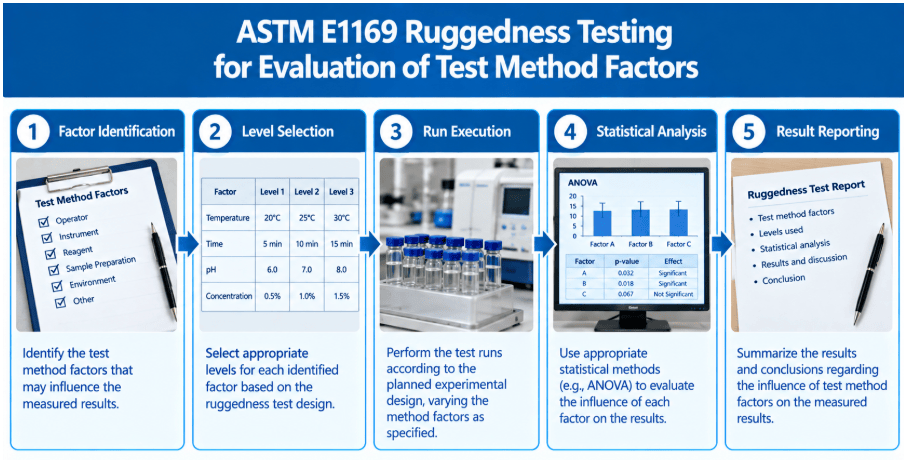
    Factor Identification Technicians identify relevant factors such as temperature, time, specimen size, and operator technique that are features of the test method or laboratory environment known to vary across laboratories. 
    Level Selection Technicians select two levels for each factor and choose moderate separations between high and low settings. These levels typically represent the extreme values that a factor may encounter under normal testing conditions. 
    Run Execution Technicians execute runs arranged in a random order with prescribed settings of each factor under study. They apply the basic eight-run design or other appropriate experimental designs to determine the effects of each factor on the measured results.
    Statistical Analysis Analysts perform statistical analysis to determine the effect of factors on the test method results. They calculate the subsequent effect of those changes upon the test results and identify which factors strongly influence measurements. 
    Result Reporting Laboratories report factor effects that assist in determining the degree of control required of factors described in the test method. They document the experimental design used and the analysis they performed. 

    ASTM E1169 Testing Process and Data Collection

    The testing procedure begins with the analyst’s identification of the test method and the selection of factors that could affect the measurements made during the process. The next step is to assign two levels to each factor and to set up the experimental design. Technicians then take the planned runs in a random sequence, keeping the conditions of the underlying test method. Analysts record the test results after completing the runs, and then calculate the main effects of the factors and determine which variables require closer control.

     The image shows a statistically designed ruggedness test to evaluate the influence of test method factors on measured results according to ASTM E1169
    ASTM E1169 Ruggedness Testing for Evaluation of Test Method Factors

    Common Challenges and Troubleshooting

    Incorrect factor selection, inconsistent material preparation, unsuitable factor levels, and poor control of the underlying test method affect ruggedness-test results. Analysts select factors likely to vary within the range of test method use and choose moderate high and low values. They use the randomization procedure to minimize the effect of uncontrolled variation on the experimental runs. Interaction effects cause difficulties in interpretation if the effect of one factor varies depending upon the level of another factor. When analysts suspect important interactions, they conduct additional testing rather than relying only on the basic design. 

    ASTM E1169 Analysis Results and Interpretation

    The laboratory report summarises the ranked factor effects identified through the ruggedness test design. ASTM E1169 specifies the factors that affect the results of a test method, rather than material-performance rating in general.

    Read more

    • The laboratory reports the calculated effect size for each factor evaluated across its two assigned levels.
    • The analyst recognizes design factors and levels tested and the number of runs performed.
    • The statistician documents the results of the half normal plot and correlates the ranked effects with the factors that are most likely to need tight control.
    • The engineer takes into account possible interaction effects, level separation, and randomization of runs when analyzing ruggedness results.
    • Standards committees use the identified critical factors to set appropriate control tolerances within the written test method. 

    Link to ASTM E1169 

    FAQ

    What types of experimental designs does ASTM E1169 use?
    The practice is restricted to experimental designs with two levels per factor. The designs require the simultaneous variation of all the factor levels, thus enabling the determination of the effects of each of the factors on the measured results.
    The purpose of a ruggedness test is to identify factors that exert a strong influence on the measurements obtained by a particular test method. It is also to estimate the degree of control needed for those factors.
    Conduct ruggedness testing before an interlaboratory (round robin) study to correct any deficiencies in the test method, and include it in the validation phase of developing a standard test method, as described in Guide E1488.

    Updated on September 16, 2026

    Gokula Srinivasan Selvam
    About Author
    Gokula Srinivasan Selvam is a Material Testing Associate at Matestlab Inc. and holds a postgraduate degree in Ceramic Engineering from IIT (BHU), Varanasi. His academic background and professional experience are centered on advanced ceramic materials, their processing, characterization, and performance evaluation.
    Know More
    Testimonials
    Real results
    Engineers trust us with what matters most
    Start Your Testing
    Project Today
    Define your requirements and get access to
    specialized laboratories ready to deliver results
    Partners with us
    Clients
    Vendors
    Process for testing
    • STEP 01

      You share your testing requirements

    • STEP 02

      You share your sample(s)

    • STEP 03

      We deliver your test reports

    Get your testing done

    Let us know your testing requirements and we will be right back with a solution.

      Let us root for each other. Collaborate to grow, expand, and accelerate our businesses.

      Partner with us

        Discover more from Matestlab

        Subscribe now to keep reading and get access to the full archive.

        Continue reading