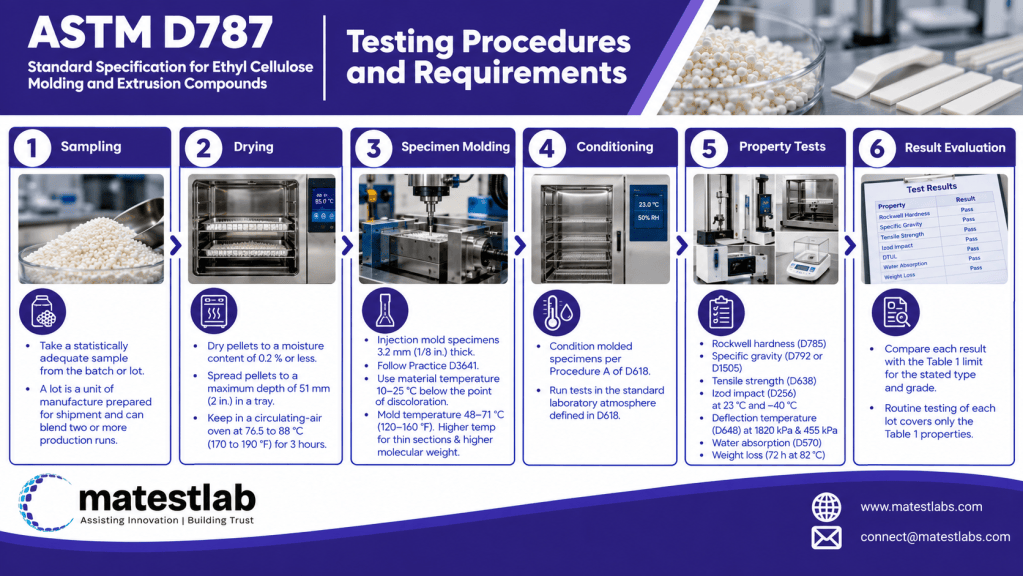
ASTM D787 covers requirements for plasticized ethyl cellulose thermoplastic compounds suitable for injection molding and extrusion. It does not include special materials compounded for special applications. Technicians determine conformance with the tests that the specification lists.
The scope of ASTM D787 includes:
- Material type: Plasticized ethyl cellulose thermoplastic molding and extrusion compounds
- Types and grades: Two types and eleven grades, with Type I for general purpose and Type II for improved impact resistance, especially at low temperatures
- Form: Pellets, unless otherwise specified
- Properties: Specific gravity, Rockwell hardness, tensile strength, Izod impact strength, deflection temperature, water absorption, and weight loss on heating
- Specimen basis: Injection molded specimens 3.2 mm (1/8 in.) thick
- Sampling: Statistically adequate, with a lot defined as a unit of manufacture prepared for shipment
- Routine testing: Limited to the properties in Table 1
- Units: SI units are standard, and the English values are for information only
- ISO equivalent: None known
What are the Uses of ASTM D787 Testing?
ASTM D787 helps compound suppliers, molders, extruders, and buyers specify and accept ethyl cellulose compounds. Buyers call out a material by the specification number, the type, and the grade, for example, D787 Type I, Grade 1. This standard:
- Classifies ethyl cellulose molding and extrusion compounds into two types and eleven grades.
- Sets minimum and maximum property limits for each grade in Table 1.
- Defines the material requirements for pellets, uniformity, contamination, and color.
- Specifies how technicians dry, mold, and condition the test specimens.
- Names the test methods that determine each property.
- Supports acceptance of a batch or lot against the grade the purchase order names.
- Gives buyers a common call-out for ordering a compound by type and grade.
What Materials Can Be Tested Under ASTM D787?
ASTM D787 applies to plasticized ethyl cellulose thermoplastic compounds in pellet form that suit injection molding and extrusion. The compounds may contain colorants in the nominal amounts that producers ordinarily use, and only materials that meet the specified properties fall under the standard. The color and transparency or opacity of molded items must match samples that the manufacturer submits within commercial match tolerances. Special materials compounded for special applications fall outside the specification.
Why is ASTM D787 Important?
Ethyl cellulose compounds vary widely in strength, hardness, and impact resistance, so purchases need a clear grade. ASTM D787 sets those properties for eleven grades, from Grade 1 with a minimum tensile strength of 44.8 MPa to Grade 11 with a minimum Izod impact strength of 320.3 J/m at 23 °C. The specification also sets limits on water absorption and weight loss on heating, which describe how the compound handles moisture and heat. Common test methods and specimen preparation let different laboratories report comparable values.