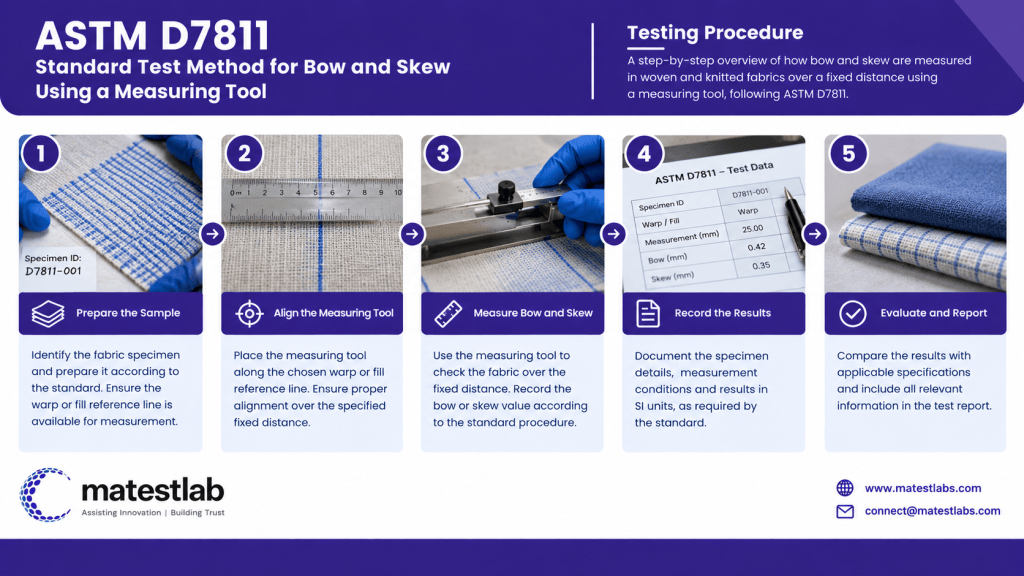
ASTM D7811 is a standard test practice that defines where analysts can apply this test method and where they need another approach. First, the method determines the bow and skew of woven and knitted fabrics over a fixed distance, using a measuring tool. Next, it supports small specimens and cut parts, provided that a warp or fill reference line, or both, helps align the tool. In addition, the standard states all values in SI units, and it notes that no known ISO equivalent exists. Consequently, the summary below shows how ASTM D7811 fits typical textile evaluations.
- Material type: Woven and knitted fabrics. The method applies to both constructions and can be used on fabric specimens or cut parts. The standard lists bow, double bow, double hooked bow, double reverse bow, hooked bow, and skew among its relevant terms, so analysts can describe the distortion pattern precisely.
- Purpose: Determine bow and skew over a fixed distance. The technician measures the greatest distance between a straightedge and a marked filling yarn, knitted course, printed line, or design line, parallel to the selvage. The resulting data supports research and development, quality control, acceptance and rejection under specifications, and special purposes.
- Property evaluated: Bow and skew, which describe distortion in yarn alignment. The standard explains that manufacturing, dyeing, tentering, finishing, or other operations can induce these defects when tension spreads unevenly across the fabric width. Furthermore, bow and skew may cause sewing problems in fabrics and draping problems in finished products.
- Method: A measuring tool aligned with a warp or fill reference line. The technician places a straightedge across the fabric between the two points where the marked line meets the selvages or edges. The technician then measures the greatest distance between the straightedge and that marked line.
- Typical test surface: Small fabric specimens or cut parts that carry a reference line. The analyst lays the specimen on a flat surface of sufficient area to hold it. The reference line must be available, because it helps the analyst align the tool accurately.
- Limitations: Requires a warp or fill reference line, and results may not compare with Test Method D3882 results. D3882 covers fabric in rolls, so its results may differ from those of this method. In addition, the data applies to the material under the conditions of this particular test and is not necessarily the same as data from other environments.
- Applications: Research and development, quality control, and acceptance or rejection under specifications. The standard also considers the method satisfactory for acceptance testing of commercial shipments. Moreover, bow and skew look more displeasing in colored, patterned fabrics such as plaids and horizontal stripes, so producers of those fabrics often apply the method closely.
What are the Uses of ASTM D7811 Testing?
Textile producers and buyers use this method at several stages of the fabric supply chain. For example, it provides objective data when visual inspection cannot settle a dispute about fabric distortion. The following uses show where the method adds the most value:
- Generates data for research and development of fabrics and finishing processes.
- Supports quality control during fabric manufacturing and finishing.
- Guides acceptance and rejection decisions under purchase specifications.
- Serves as a satisfactory method for acceptance testing of commercial shipments.
- Evaluates small specimens and cut parts when roll-based testing is not practical.
- Helps identify distortion that arises during manufacturing, dyeing, tentering, or finishing.
Why is ASTM D7811 Important?
Bow and skew affect how a fabric looks, cuts, and sews into finished products. This method also provides a common way for mills and buyers to quantify distortion, and the information can be used for development, quality control, acceptance, and rejection of goods based on specifications. Furthermore, the standard notes that many other operations, such as finishing, can result in uneven tension across the fabric width and bow or skew. Therefore, measurement can help identify the process that caused the distortion. Bow and skew look more displeasing in colored, patterned fabrics, such as plaids and stripes, than in solids. Therefore, accurate measurement protects the appearance and satisfaction of the product and customer.