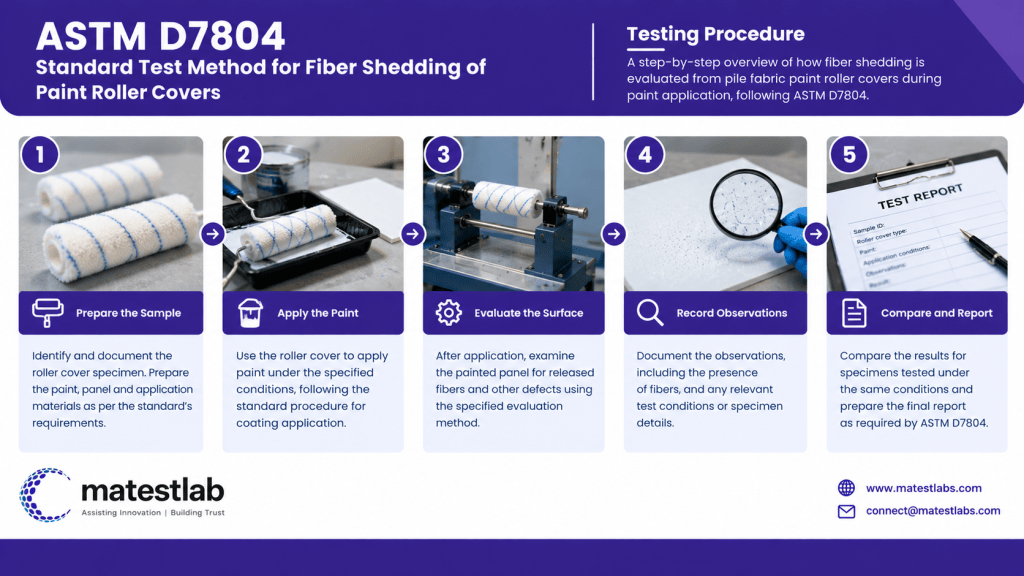
ASTM D7804 Standard Test Method for Fiber Shedding of Paint Roller Covers
What is ASTM D7804?
ASTM D7804 is a standard test method for evaluating fiber shedding from paint roller covers during paint application. It describes a procedure for applying paint to sealed test paper, allowing the paint film to dry, and counting the fibers released onto the surface. The results help manufacturers assess how fiber shedding may affect the appearance of a finished coating and compare the performance of different roller covers. Because the application and panel evaluation involve subjective judgment, the method limits comparisons to testing within one facility, using one operator for each set of applications. Manufacturers can use this method to support quality control and evaluate paint roller cover performance.
Get Reliable ASTM D7804 Testing for Paint Roller Fiber Shedding
This test method provides manufacturers and laboratories with a standardized way to evaluate releasable fibers transferred from paint roller covers to painted surfaces. As a result, manufacturers and suppliers can assess roller cover performance and maintain coating application quality. The method supports comparative evaluation of fiber shedding during paint application. Consistent testing and clear documentation help manufacturers evaluate roller cover quality. In addition, textile material testing helps manufacturers assess the physical properties, dimensional stability, and durability of fabrics used in different applications.
What is the Scope of ASTM D7804 Testing?
ASTM D7804 is a standard test method for evaluating releasable fibers transferred from paint roller covers to painted surfaces. It helps determine fiber shedding during paint application and assess its effect on the finished coating. The method supports comparative evaluation and quality control of pile fabric paint roller covers.
Material type: Pile fabric paint roller covers. The standard applies only to this cover type, and the test uses three identical covers of one design, each 9 in. (228.6 mm) long on a 1.5 in. (38.1 mm) diameter core. Identical covers allow the analyst to average the results and describe the shedding behavior of that design.
Purpose: Determine the amount of releasable fibers that transfer from a roller cover to a painted surface. The method focuses on fibers that leave the cover and land in the paint film, because those fibers affect the final appearance. Fibers released during painting can lead to an aesthetically unacceptable finish, which is why the standard measures this transfer.
Property evaluated: Fiber shedding, counted as lint fibers in the dried paint film. The analyst counts only lint fibers across the entire painted surface and records the result as a number of fibers. The final value equals the average of the three results from the three covers.
Method: Painting sealed test paper with a loaded roller cover, then counting the fibers under 5× magnification. The technician loads the cover with paint and rolls it out on the test paper in the stroke pattern that the standard shows. After the paint film dries, the analyst circles and counts each lint fiber with a lighted magnifying glass and fluorescent light.
Typical test surface: Sealed test paper secured to a flat vertical surface. The paper minimizes paint absorption, which allows a paint film to form. The technician secures two sections, each 28 in. (711.2 mm) wide and 20 in. (508 mm) long, to create a 28 by 40 in. test surface.
Limitations: Subjective evaluation, best suited to comparative testing within one facility and with one operator. Because the application and the panel evaluation depend on the operator, results from different facilities may not agree. In addition, results may vary when the laboratory uses different paint types, so the report should identify the paint by type, product number, and color.
Applications: Quality control, product comparison, and supplier evaluation of roller covers. Manufacturers can use the fiber count to monitor shedding and to compare roller fabrics or designs under uniform conditions. Buyers can apply the same comparison to supplier covers, provided that the same facility, operator, and paint generate the data.
What are the Uses of ASTM D7804 Testing?
Roller cover manufacturers, laboratories, and buyers use this method wherever lint affects the quality of a painted finish. For instance, it gives them an objective fiber count when a visual impression alone cannot settle a quality question. The following uses show where the method adds the most value:
Monitors fiber shedding to keep roller cover production consistent.
Compares new roller fabrics or designs against existing products under uniform conditions.
Supports quality control programs that aim to reduce lint in painted finishes.
Assists procurement teams in checking supplier claims before purchase.
Guides the investigation of production issues that may increase shedding.
Provides comparable data for roller covers that a single facility tests.
Why is ASTM D7804 Important?
Lint on a painted surface ruins the smooth finish that the paint is meant to provide. The standard states that fibers released during painting can lead to an aesthetically unacceptable finish. The test method gives manufacturers a repeatable way to count those fibers, and it requires a controlled environment, three identical covers, and the same paint for each cover, so the comparison stays fair. Moreover, the count reflects how a cover behaves when it paints a real test surface rather than how it looks on the shelf. Consequently, producers can improve roller cover quality, and buyers can choose products that leave a cleaner finish.
ASTM D7804 Equipment and Sample Preparation Guide
First, the technician selects three identical paint roller covers, each measuring 9 in. (228.6 mm) long on a 1.5 in. (38.1 mm) diameter core. Next, the analyst prepares a commercially available semi-gloss or gloss paint, identifies it by type, product number, and color, and mixes it to a uniform consistency. In addition, the laboratory secures sections of sealed test paper that minimize paint absorption and allow a proper paint film to form. Then, the technician wipes the tray, the paper, and the surrounding area with a tack cloth to remove dust and lint. Finally, the team conducts every test in a controlled environment. The table below summarizes the sample and equipment requirements of the standard.
Technicians select three identical pile fabric paint roller covers for each test set. Identical covers allow a fair average of the fiber counts. The analyst also identifies the test paint by type, product number, and color because results may vary by paint.
Specimen Preparation
Technicians pour fresh paint into a clean, dry tray, and the paint depth equals the pile height of the cover. For example, a 1/2 in. (12.7 mm) pile cover needs 1/2 in. (12.7 mm) of paint. Fresh paint prevents fibers from an earlier test from contaminating the result.
Specimen Dimensions
Analysts secure two sections of sealed test paper, each 28 in. (711.2 mm) wide and 20 in. (508 mm) long, to a flat vertical surface. Together, the sections form a 28 by 40 in. test surface. The paper has a minimum thickness of 10 mil and a basis weight of 50 lb/Mft² (250 g/m 2), which limits paint absorption.
Instrumentation
Technicians use a paint roller frame and a paint tray that suits the cover, a tack cloth to remove dust and lint, and a lighted magnifying glass with 5× magnification. Each tool controls a source of error, namely contamination before painting and missed fibers after painting.
What Are the ASTM D7804 Testing Procedure and Requirements?
First, the technician prepares a clean tray, a clean test surface, and fresh paint. Next, the technician loads the roller cover and rolls it out on the sealed test paper in the pattern shown in the standard. Afterward, the laboratory repeats the same steps on the two remaining covers, using fresh paint and a new tray each time. Once the paint film dries, the analyst counts the lint fibers under magnification. Finally, the analyst averages the three results. The table below lists each step in the order that the standard describes.
Technicians conduct the test in a controlled environment and wipe the tray, the paper surface, and the surrounding area with a tack cloth. The technician then secures the two paper sections to a flat vertical surface. Clean surfaces keep outside lint out of the paint film.
Paint and roller preparation
Analysts pour fresh paint into the tray at a depth equal to the pile height and place the cover on the frame. Paint that fibers have already touched must not be used, because it would inflate the count.
Loading the roller cover
Technicians load the cover with twenty back-and-forth strokes, ten of which go into the paint tray well. The technician then finishes with four back-and-forth strokes, two of which even out the paint on the tray ramp. The cover may need hand rotation to load uniformly.
Roll-out
Technicians roll the cover out on the sealed test paper in the stroke pattern that the standard illustrates. A fixed pattern gives every cover the same paint application.
Repeat on remaining covers.
Technicians repeat the procedure on the two other identical covers with fresh paint and a new tray. This repetition produces three results for averaging.
Fiber counting and reporting
After the paint film dries, the analyst places the panel on a flat horizontal surface in a well-lighted area and wipes it with a clean tack cloth. The analyst then circles and counts each lint fiber across the entire painted surface with a 5× magnifying glass and fluorescent light. Finally, the analyst records the number of fibers and averages the three results.
ASTM D7804 Testing Process and Data Collection
During testing, the laboratory records the paint type, product number, and color, the roller cover identification, and the fiber count for each of the three covers. The analyst circles each lint fiber that appears in the dried paint film, so no fiber gets counted twice. Because the standard records results as a number of fibers, the report stays easy to read and compare. Afterward, the laboratory averages the three counts to obtain the final result. In addition, a complete test report gives buyers and quality teams the evidence they need to compare roller covers with confidence.
Step-by-step workflow for fiber shedding testing of paint roller covers, from loading and rolling out the paint to counting the fibers
Common Challenges and Troubleshooting in Fiber Shedding Testing
Several practical issues can affect fiber counts. For example, dust or lint on the tray, the paper, or the surrounding area can contaminate the paint film, so the technician must wipe these surfaces with a tack cloth. Similarly, reused paint or an old tray can carry fibers from an earlier test; therefore, the laboratory must use fresh paint and a new tray for each cover. Because the counting is subjective, different operators may reach different numbers, so one operator should evaluate each set. Finally, different paint types can change the results, and consequently the analyst should keep the paint identical when comparing covers.
ASTM D7804 Analysis Results and Interpretation
The results show how many lint fibers a roller cover leaves behind in a dried paint film. Analysts count these fibers across the entire painted surface and record the total for each cover. Moreover, they average the three results to obtain one value for the covers under evaluation. The bullets below explain how to read ASTM D7804 results in practice.
Analysts count the lint fibers circled in the dried paint film for each cover. This count represents the number of fibers released by that cover during painting.
Analysts calculate the final result by averaging the fiber counts from three identical covers. This average reduces the effect of an unusually high or low count from a single panel.
Technicians record the paint type, product number, and color along with the fiber counts. The analyst compares results only when the same facility, operator, and paint produce them.
Analysts avoid direct comparisons between results from different facilities because paint application and panel evaluation involve subjective judgment. Comparisons are most reliable when one laboratory performs the tests under consistent conditions.
Analysts consider the precision statement, which is based on a 2006 interlaboratory study involving seven laboratories and two types of paint roller covers. However, the standard limits comparisons to results generated within the same facility.
Analysts use the fiber counts to assess the potential for lint to affect the appearance of the painted surface. Manufacturers use these results to identify covers that may need improvement, while buyers use them to compare products.
FAQs
What does ASTM D7804 measure?
It determines the amount of releasable fibers that a paint roller cover transfers to a surface being painted. The analyst reports the result as a number of fibers.
Which roller covers does this method cover?
The method applies to pile fabric paint roller covers. The test uses three identical covers, and the analyst averages their results.
Can different laboratories compare their results?
Not reliably. The application and the panel evaluation are subjective, so the standard recommends comparative testing within one facility with one operator for each set of applications.
What tools does the analyst need to count the fibers?
The analyst needs a tack cloth and a lighted magnifying glass with 5× magnification. The analyst also uses fluorescent light and circles each lint fiber in the dried paint film.
Why does the paint type matter?
Results may vary when different paints are used. For that reason, the report identifies the paint by type, product number, and color.
Zunaira Tehseen is a scientific content specialist who bridges interdisciplinary research across biochemistry, molecular genetics, and materials science with technical content management. Leveraging expertise in bio-interface characterization, advanced materials evaluation, and AI-driven workflows, she curates, structures, and communicates complex technical data. At Matestlab, she leads content strategy and documentation for metallographic testing, mechanical characterization, and compliance with international standards such as ASTM and ISO, delivering precise, high-impact technical assets for industrial and scientific audiences. Know More
Testimonials
Real results
Engineers trust us with what matters most
“We had a great experience working with this company for our ASTM E84 testing. They were the first company to respond to our inquiry within just a few minutes of submitting it. From start to finish, the communication was excellent, and the entire process was swift, straightforward, and hassle-free.”
Ivars FancyWalls
United States
“Very good communication, testing associates were very patient with delays on our end. Reasonable turnaround time for results and nicely detailed report. Analysts were also quick to answer any follow-up questions. Happy with results.”
Skye Henderson
United States
“Matestlab connected us with an accredited lab within days, cutting weeks off our product validation timeline.”
Rebecca Kozodoy-Pins
United States
Why Choose Matestlab?
Matestlab is a unified testing services partner based in the USA. Matestlab offers raw material and product testing services through accredited, expert laboratories primarily based in the USA. Matestlab supports physical, thermal, chemical, electrical, mechanical, environmental, and characterization testing needs through its global network of 2200+ accredited testing laboratories. Matestlab's in-house materials science experts curate and design comprehensive testing programs matched to the sample material and specific testing need, with regulatory requirements and confidentiality in mind.
If you are looking for a managed and trusted testing partner to achieve your research goals, feel free to schedule a meeting with us or send us a request at connect@matestlabs.com to learn more about our services. For a quick quote, call us at (302)244-7710. We are happy to serve you.
Start Your Testing Project Today
Define your requirements and get access to specialized laboratories ready to deliver results