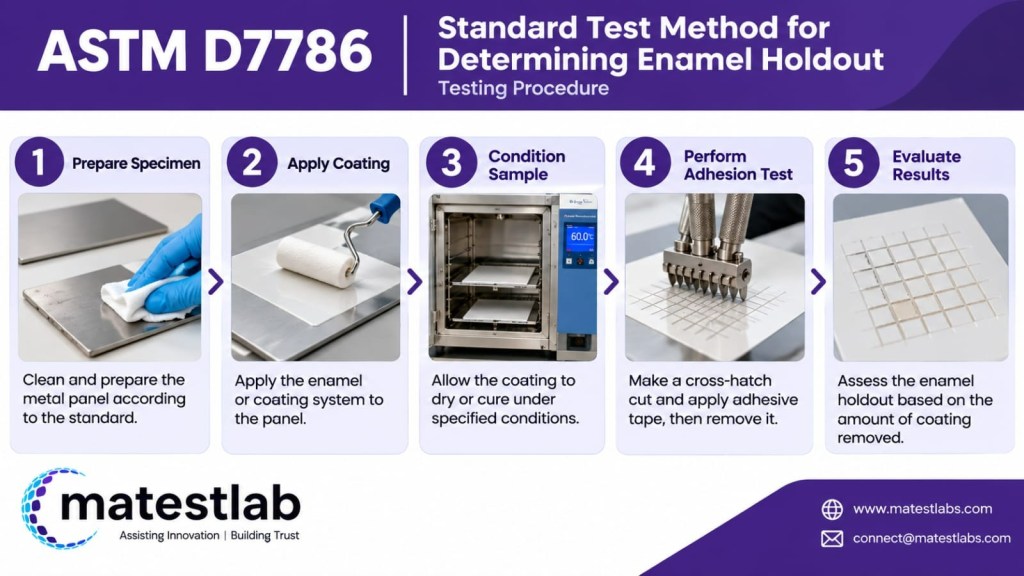
ASTM D7786 is a standard test method that helps to evaluate enamel holdout of primers and topcoats. The method involves applying a standard topcoat onto a primer. The gloss values of the topcoat applied over the primer are compared to those of the standard topcoat applied to a smooth, non-porous surface. The method can be used to compare different topcoats or other paints as a first coat.
The scope of ASTM D7786 includes:
- Material type: Primers, standard topcoats, and other paints.
- Purpose: To evaluate the ability of the primer/topcoat to allow a topcoat to achieve high gloss values.
- Properties evaluated: Gloss values, difference between the primed topcoat and standard topcoat.
- Testing method: Coatings are applied to both the sample and standard surfaces. They are then allowed to dry, and the gloss is measured.
- Result: There will be a difference in the gloss values. The smaller this difference, the better the enamel holds out.
- Test limitations: The outcome will depend on the choice of coating system, preparation of the surface, application conditions, and measurement of the samples. It will not independently determine how durable the coatings will be in the long term.
- Methodology: Technicians will prepare the coated and standard surfaces and apply the standard topcoat. The gloss will then be measured in accordance with the standard.
- Applications: The method helps to formulate paints, select primers and topcoats. Also, it evaluates the quality of coatings.
What are the Uses of ASTM D7786 Testing?
ASTM D7786 is used by paint manufacturers and raw material suppliers to determine the enamel holdout of the coating system. In addition, the test measures the gloss buildup on the primed substrate compared to a smooth, non-porous control substrate. The results can be used by coating professionals to help them understand compatibility of primer and topcoat materials. The Standard method:
- Helps to determine how much effect the primer has on the gloss of a standard topcoat.
- Determines the enamel holdout by comparing the gloss values of the test and control substrates.
- Helps to compare two different topcoats when applied over the same primer.
- Evaluates coating systems that contain paints other than primer as a base coat.
- Helps to analyze interactions between primer/topcoat and coating formulations.
- Provides comparative data during coating development and quality analysis.
Why is ASTM D7786 Important?
ASTM D7786 enables coating professionals to determine how well a primer will allow the topcoat to achieve the desired level of gloss. Primers can absorb some of the topcoat, causing issues with the overall finish. The test method helps technicians to compare the gloss value of the primed topcoat to that of a reference topcoat on a smooth, non-porous substrate. The lower the difference between primed and reference, the better the enamels hold out. Paint manufacturers utilize the results to compare different coating combinations during development and quality control. However, enamel holdout is only one part of coating performance, and other relevant properties should also be tested separately to assess how durable, adherent, or exposure-resistant coatings are.
How is Enamel Holdout determined in ASTM D7786?
Enamel holdout is calculated by comparing the gloss of the standard topcoat with the gloss of the topcoat applied directly onto a smooth, non-porous surface. The technician applies both coating systems and allows them to dry. The analyst will then compare the gloss of the topcoat. A small difference between the two will indicate good enamel holdout. Whereas a large difference will indicate the primer has had a greater effect on the gloss. This method is a relative test.
Can ASTM D7786 be used to compare various topcoats?
Yes, ASTM D7786 can be used to assess the enamel holdout of the various topcoats. Technicians keep the primer constant and compare the gloss results from the various coating systems. Thus, it helps the paint manufacturer understand how the topcoats are interacting with the specific primer. The technician ensures that all preparation, application, drying, and testing conditions have been kept consistent. The results should be analyzed with respect to the chosen coating system and should not be seen as a generalized ranking of topcoats.