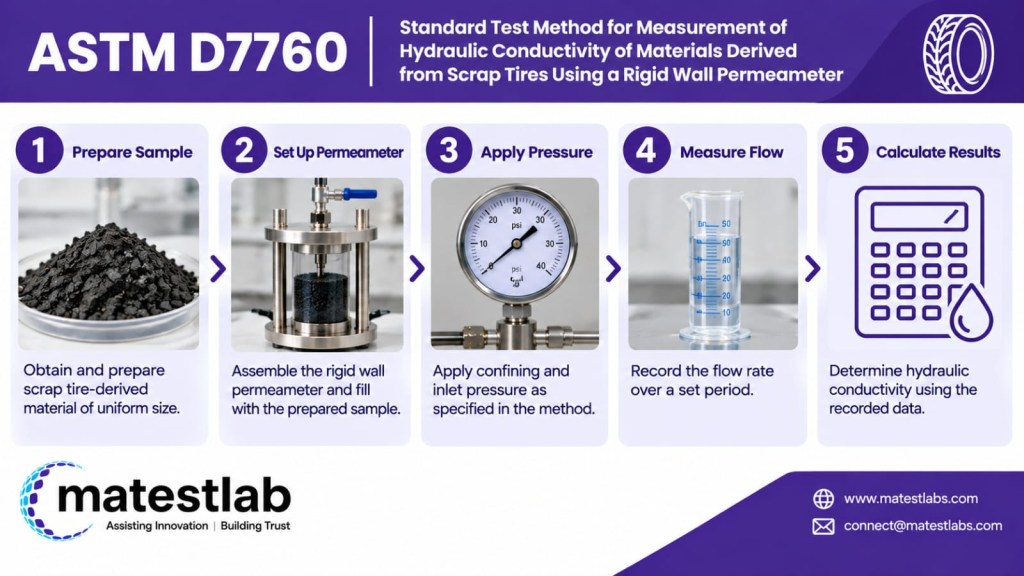
ASTM D7760 is a standard test method that determines the hydraulic conductivity of water-saturated materials sourced from scrap tires. In addition, the method can be applied to tire chips, shreds, and derived aggregate, but does not apply to the whole tire. Moreover, technicians perform the method under constant head conditions using water as the permeant.
The scope of ASTM D7760 includes:
- Material type: Tire chips, shreds, and derived aggregate of particle sizes around 12-305 mm.
- Purpose: The method determines the hydraulic conductivity (coefficient of permeability) of a material.
- Properties evaluated: This method can be used to measure the flow of water and the hydraulic conductivity of a material.
- Testing method: Hydraulic conductivity is analyzed using a rigid-walled permeameter under constant-head conditions. The method can also be tested in single or double rings.
- Results: Hydraulic conductivity is reported using SI units, usually m/s. However, some laboratories may report the value in cm/s.
- Test limitations: This method does not apply to whole tires. In addition, leakage from the tire sidewalls and specimen particle size may affect the results.
- Methodology: Technicians use water as the permeant and take into account the unit weight of the specimen and vertical pressure applied when choosing suitable testing conditions.
- Application: Supports assessment of scrap-tire materials for civil engineering applications that require information about water flow.
What are the Uses of ASTM D7760 Testing?
ASTM D7760 helps engineers understand how water flows through saturated materials made from tire waste. In addition, the test method allows comparison between tested materials. The method also helps project teams determine whether tire-derived materials are suitable for civil engineering applications. The Standard method:
- Helps to assess the hydraulic conductivity of saturated tire chips, tire shreds, and tire-derived aggregate.
- Assesses the hydraulic conductivity of water flowing through samples during constant head testing.
- Allows for assessment of the behavior of the material under realistic unit weight and vertical pressure.
- Evaluates the potential for leakage around the sides of the sample by selecting an appropriate permeameter setup.
- Helps analyze the relationship between hydraulic gradient and hydraulic conductivity. This can be helpful when assessing whether Darcy’s law is applicable.
- Provide information to aid material selection and quality control for civil engineering applications.
Why is ASTM D7760 Important?
ASTM D7760 is a standard test method that helps to determine the hydraulic conductivity of scrap tire materials. The test provides standardized procedures for particle size, sample configuration, and vertical pressure. Engineers use the information gained from this test to compare the materials and their possible drainage performance. By using appropriate sample preparation and permeameter configuration, laboratories can be confident that samples were prepared in a reliable manner and identify any potential issues with sidewall leakage.
How does vertical pressure affect ASTM D7760 testing?
ASTM D7760 emphasizes the importance of testing specimens at a unit weight and under an overburden pressure that represents field conditions. However, vertical pressures may affect the hydraulic conductivity of tire-derived materials. Therefore, technicians record the relevant loading conditions when preparing and testing specimens. Moreover, engineers consider these conditions when comparing results because changes in applied pressure can affect water flow through the material.
Why does the choice of permeameter affect ASTM D7760?
The choice of permeameter affects the accuracy of flow rate measurements recorded in the laboratory. In addition, there are two options available for the set-up: single ring or double ring. Using a double ring can give an indication of the effect of leakage at the sample sides and help to reduce the effect of this. The technician considers the size of particles within the sample, cell diameter, and stress applied to determine the best setup. Overall, analysts record the results to understand how the hydraulic conductivity is evaluated under test conditions.