ASTM D7637 Standard Test Method for Determination of Glycerin Assay by Titration (Sodium Meta-Periodate)
What Is ASTM D7637?
ASTM D7637 is a standard test method that determines glycerin content in glycerin or glycerin-water mixtures containing more than 75% glycerin by titration with sodium metaperiodate. The method measures glycerin content through a chemical reaction that produces formic acid. Testing personnel prepare the sample, carry out the oxidation reaction, and titrate the resulting formic acid with a standard sodium hydroxide solution. The method helps quantify glycerin content and assess sample composition. Manufacturers and quality control professionals use this method to evaluate glycerin purity and support quality control in relevant industrial applications.
Reliable glycerin testing helps manufacturers measure glycerol content and check the purity of glycerin-based products. ASTM D7637 describes a method for determining glycerin content through chemical oxidation and titration. Testing personnel prepare the sample, carry out the reaction with sodium metaperiodate, titrate the formic acid with a standard sodium hydroxide solution, and record the results. Analysts use the results to determine glycerin content and support quality control in relevant industrial applications.
What Is the Scope of ASTM D7637?
ASTM D7637 is a standard test method that establishes the glycerin content of glycerin or glycerin-water mixtures containing more than 75% glycerin using sodium metaperiodate oxidation and titration. Testing personnel analyze the sample through a chemical reaction that produces formic acid, then titrate the acid with a standard sodium hydroxide solution. They follow the specified analytical procedure to quantify glycerin content and assess sample composition.
Material type: Glycerin and glycerin-water mixtures containing more than 75% glycerin.
Purpose: Determining glycerin content through a chemical oxidation and titration procedure.
Properties evaluated: Glycerin concentration in the sample.
Analysis method: Reacting glycerin with sodium metaperiodate, producing formic acid, and titrating the acid with standard sodium hydroxide.
Result: The test provides glycerin content data that help manufacturers assess sample composition and support quality control.
Analysis limitations: The method applies to samples within its specified composition range and does not independently identify every impurity or establish all aspects of product quality.
Methodology: Testing personnel prepare the sample, conduct the oxidation reaction, titrate the resulting formic acid, and calculate the glycerin content.
Applications: Glycerin quality control, product composition assessment, and evaluation of glycerin materials in relevant industrial applications.
What Are the Uses of ASTM D7637?
ASTM D7637 helps manufacturers and quality control professionals determine the glycerin content in glycerin and glycerin-water mixtures containing more than 75% glycerin. They use the method to:
Determine glycerin concentration through sodium metaperiodate oxidation and titration.
Assess the composition of high-glycerin samples under specified testing conditions.
Quantify glycerin content by measuring the formic acid produced during the oxidation reaction.
Support glycerin purity assessments through controlled chemical analysis.
Compare glycerin content across different production batches.
Monitor product consistency during glycerin manufacturing and processing.
Support quality control of glycerin materials used in relevant industrial applications.
Provide analytical data for material characterization, product evaluation, and manufacturing quality assurance.
What Materials Can Be Tested Under ASTM D7637?
ASTM D7637 provides a test method for measuring glycerin content in glycerin and glycerin-water mixtures with more than 75% glycerin. Testing personnel use sodium metaperiodate oxidation and titration to determine the glycerin concentration in these samples. The results help manufacturers evaluate sample composition and maintain glycerin quality in industrial applications. However, this method does not detect every impurity or assess all aspects of product quality. Testing personnel prepare representative samples, perform the oxidation reaction, titrate the resulting formic acid with standard sodium hydroxide, and calculate the glycerin content according to the test method.
Why Is ASTM D7637 Important?
ASTM D7637 describes a method for measuring glycerin content in glycerin and glycerin-water mixtures containing more than 75% glycerin. Glycerin concentration and sample composition play an important role in product quality and manufacturing assessments. Testing personnel determine the glycerin content through sodium metaperiodate oxidation and titration under controlled conditions. Manufacturers use the results to check sample composition, compare batch consistency, and support quality control activities. They also consider the method’s specified composition range and other relevant test results when evaluating overall product quality.
ASTM D7637 Equipment and Sample Preparation Guide
ASTM D7637 testing uses analytical glassware, a suitable balance, sodium metaperiodate, standard sodium hydroxide solution, and titration equipment. Testing personnel collect representative glycerin samples, measure the required reagents, check the analytical equipment, and follow the specified reaction conditions. They document sample quantities, reagent concentrations, titration volumes, and test observations to ensure reliable glycerin content measurements.
Testing personnel select representative glycerin or glycerin-water mixture samples containing more than 75% glycerin. They identify the sample composition and record relevant sample characteristics before analysis.
Data preparation
Personnel document sample identification, sample mass, reagent quantities, sodium metaperiodate concentration, standard sodium hydroxide concentration, and titration conditions.
Data characteristics
Personnel record titration volumes, reagent concentrations, and analytical observations. They use the titration data to calculate the glycerin content according to the method.
Instrumentation and software
The setup may include an analytical balance, volumetric glassware, titration equipment, sodium metaperiodate reagent, standard sodium hydroxide solution, and calculation tools. Personnel select and prepare the equipment and reagents according to the test procedure.
ASTM D7637 Testing Procedures and Requirements
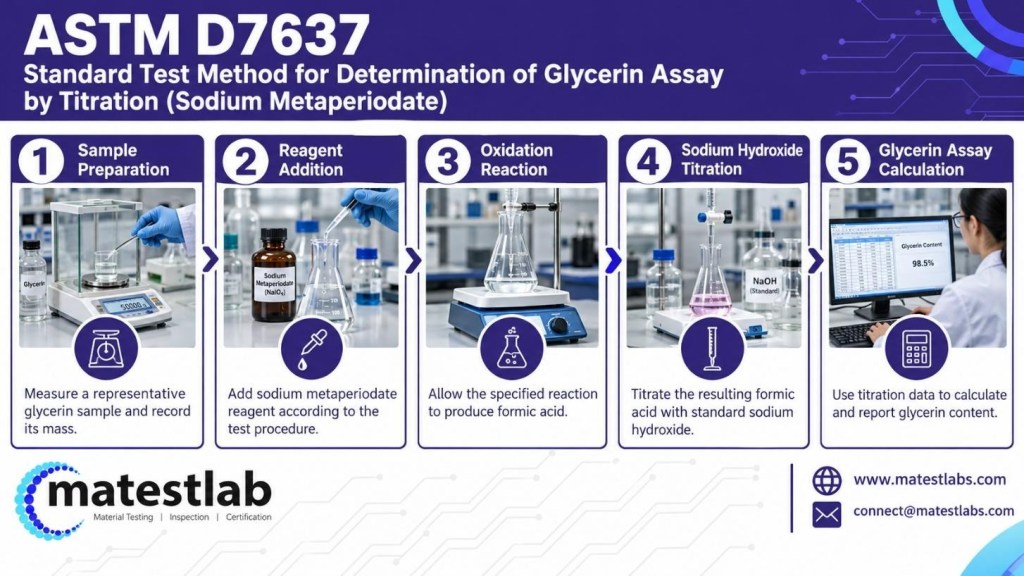
ASTM D7637 testing involves preparing glycerin samples, reacting them with sodium metaperiodate, and titrating the resulting formic acid with standard sodium hydroxide solution. Testing personnel record the titration data, calculate the glycerin content, and report the results according to the method’s requirements for samples containing more than 75% glycerin.
Testing personnel identify representative glycerin or glycerin-water mixture samples containing more than 75% glycerin. They record the sample details and measure the required quantity for analysis.
Initial measurements and reagent preparation
Personnel prepare the analytical glassware, sodium metaperiodate reagent, and standard sodium hydroxide solution. They verify the required reagent concentrations and record the initial sample measurements.
Glycerin oxidation
Personnel react the glycerin sample with sodium metaperiodate according to the specified procedure. They maintain the required reaction conditions to support the oxidation of glycerin and the formation of formic acid.
Titration and data collection
Personnel titrate the resulting formic acid with standard sodium hydroxide solution. They record the titration volume, reagent concentration, sample quantity, and other relevant analytical observations.
Glycerin content calculation
Personnel use the recorded titration data and the method’s calculation procedure to determine the glycerin content of the sample. They verify the calculations and review the results for consistency.
Result evaluation and reporting
Personnel document sample identification, reagent details, titration measurements, calculated glycerin content, and relevant observations. They report the findings according to the applicable requirements of ASTM D7637.
ASTM D7637 Testing Process and Data Collection
ASTM D7637 analysis, the analyst selects a suitable number of samples of glycerine or glycerine/water mixtures containing more than 75% glycerin and measures out the correct amount. The analyst then prepares the glassware for analysis. The sodium metaperiodate reagent and the standard sodium hydroxide solution are checked. The analyst reacts the sample with the sodium metaperiodate reagent according to the method. The analyst titrates the sample with the standard sodium hydroxide solution. The analyst records the amount of sample used, concentration of reagents, titer volume, and any other relevant information. The analyst then calculates the amount of glycerin present using the method. The analyst checks that the results are consistent. The analyst prepares a report containing details of the sample, conditions of the analysis, and the calculated amount of glycerin contained within the sample. Any anomalies or problems are also included.
ASTM D7637 Testing for Glycerin Assay by Sodium Metaperiodate Titration
ASTM D7637 Common Challenges and Troubleshooting
The following practices when measuring the sample, preparing the reagent, and performing the titration contribute to a reliable ASTM D7637 result. Calculations of the amount of glycerin may be influenced by incorrect sample quantities, improper reagent concentrations, incomplete reactions, and titration errors. Reagent concentrations, equipment checks, and required reaction/titration procedures should be performed by testing personnel. If they get different results, they should check their sample mass, reagent amounts, reaction conditions, volumes used in titration, and calculations. Personnel should also document any irregularities and interpret the results based on the type of samples and the method requirements.
ASTM D7637 Analysis Results and Interpretation
The test report presents glycerin assay results for glycerin or glycerin-water mixtures with over 75% glycerin. The results are interpreted by the analysts together with the quantity of samples and the concentrations of reagents, the results of the titration, and the analytical conditions recorded.
Analysts identified the Glycerin sample for analysis.
Analysts recorded details of the Sodium Metaperiodate reagent, Standard Sodium Hydroxide solution, and reaction conditions.
Analysts noted the volumes of titrant and other data.
Analysts calculated the Glycerin content.
Analysts evaluate the results to determine the glycerin concentration and assess sample composition within the method’s applicable range.
Analysts identify inconsistent titration endpoints, reagent preparation errors, calculation discrepancies, or deviations from the prescribed procedure.
Analysts compare the results against relevant product specifications/acceptance criteria.
Overall, this is a standardized method (ASTM D7637) for determining the assay of Glycerin by oxidation with Sodium Metaperiodate and Titration. The results can be used to give an idea of the composition of the sample, ensuring consistency between batches and helping with quality control. However, it cannot be used on its own to identify all impurities and to determine all aspects of quality.
ASTM D7637 determines the glycerin content of glycerin or glycerin-water mixtures containing more than 75% glycerin through sodium metaperiodate oxidation and titration.
Which analytical technique does ASTM D7637 use?
Analysts oxidize glycerin with sodium metaperiodate and titrate the resulting formic acid with a standard sodium hydroxide solution to calculate the glycerin content.
Why is ASTM D7637 testing important?
Manufacturers use the results to assess glycerin concentration, compare batches, and support product quality control.
Laraib Hashmi is an aspiring research enthusiast and science content professional with a strong interdisciplinary skill set, holding a postgraduate degree in Applied Microbiology from KIIT Bhubaneshwar, Odisha. Know More
Testimonials
Real results
Engineers trust us with what matters most
“We had a great experience working with this company for our ASTM E84 testing. They were the first company to respond to our inquiry within just a few minutes of submitting it. From start to finish, the communication was excellent, and the entire process was swift, straightforward, and hassle-free.”
Ivars FancyWalls
United States
“Very good communication, testing associates were very patient with delays on our end. Reasonable turnaround time for results and nicely detailed report. Analysts were also quick to answer any follow-up questions. Happy with results.”
Skye Henderson
United States
“Matestlab connected us with an accredited lab within days, cutting weeks off our product validation timeline.”
Rebecca Kozodoy-Pins
United States
Why Choose Matestlab?
Matestlab is a unified testing services partner based in the USA. Matestlab offers raw material and product testing services through accredited, expert laboratories primarily based in the USA. Matestlab supports physical, thermal, chemical, electrical, mechanical, environmental, and characterization testing needs through its global network of 2200+ accredited testing laboratories. Matestlab's in-house materials science experts curate and design comprehensive testing programs matched to the sample material and specific testing need, with regulatory requirements and confidentiality in mind.
If you are looking for a managed and trusted testing partner to achieve your research goals, feel free to schedule a meeting with us or send us a request at connect@matestlabs.com to learn more about our services. For a quick quote, call us at (302)244-7710. We are happy to serve you.
Start Your Testing Project Today
Define your requirements and get access to specialized laboratories ready to deliver results