ASTM D75 Standard Practice for Sampling Aggregates
What is ASTM D75/D75M?
ASTM D75/D75M is a standard practice for obtaining representative samples of coarse and fine aggregates for laboratory testing, production control, construction-site control, and acceptance or rejection. The practice recognizes that sampling is as important as testing because an improperly collected sample may not represent the aggregate’s nature and condition. It provides guidance on obtaining samples from aggregate production sites and handling areas, as well as avoiding sample bias due to segregation and variation within the material. ASTM D75/D75M addresses sampling for preliminary investigation of potential aggregate sources, control of aggregate at the source, control of operations at the site of use, and purchaser acceptance or rejection. Depending on the material and sampling situation, sampling can be done from aggregate streams, conveyor belts, stockpiles, and transportation units. ASTM D75/D75M (Standard Practice for Sampling Aggregates) also focuses on competent staff, appropriate equipment, appropriate sampling plans, and representative increments.
Get Certified ASTM D75/D75M Testing for Reliable Aggregate Sampling
Professional ASTM D75/D75M sampling services help laboratories and construction companies gather representative aggregate samples for further evaluation. Trained staff select sampling points and take samples incrementally to avoid segregation and sampling bias. Effective sampling helps ensure an accurate assessment of aggregate quality, consistency, and compliance with project specifications. Qualified laboratories can combine the ASTM D75/D75M sampling with the appropriate aggregate test procedures and quality-control programs.
What is the scope of ASTM D75/D75M?
ASTM D75/D75M is a standard practice for sampling both coarse and fine aggregates. The practice is designed for use when representative aggregate samples are required to determine potential sources, monitor production, control material at the construction site, or make acceptance or rejection decisions. The practice provides sampling principles for different aggregate locations and conditions.
Material: Coarse aggregates and fine aggregates used for construction and related applications.
Objective: Collect representative samples for source investigation, production control, site control, and material acceptance/rejection.
Property measurement: The measurement is not an aggregate property measurement; it is merely representative samples for subsequent applicable aggregate tests.
Method: Sampling using proper increments and sampling methods for aggregate streams, conveyor belts, stockpiles, and transportation units, as appropriate.
Result: A sample taken from a field that represents the unit or field condition being investigated.
Test Limitations: Sampling can be affected by segregation, material variability, sampling location, handling, and the competence of personnel.
Environmental conditions: Sampling should consider conditions that could affect or bias the material, such as segregation due to storage, handling, wind, rain, and other site conditions.
Applications: Aggregate source investigation, production quality control, construction-site control, and purchaser acceptance or rejection.
What are the uses of ASTM D75/D75M testing?
ASTM D75/D75M is used to establish representative aggregate samples before conducting the appropriate laboratory or field tests. The sampling approach depends on the aggregate source, condition of material, sampling location, and use of results. This standard-
Helps to explore potential aggregate sources prior to material selection.
Helps control aggregate production at the source by providing samples representative of material being produced.
Supports quality control at the construction site when aggregate is being incorporated into a project.
Provides a basis for samples used in acceptance or rejection decisions by purchasers or their authorized representatives.
Helps reduce sampling bias caused by segregation and nonuniform material distribution.
Guides sampling aggregates from flowing streams, conveyor belts, stockpiles, and transportation units, where applicable.
Which Materials Can Be Sampled Under ASTM D75/D75M?
This ASTM specification covers representative sampling of coarse aggregates and fine aggregates. The sampling procedure is identified based on the physical shape and location of the aggregate, such as in production streams, on a conveyor, in a stockpile, or in a transport unit.
Why is ASTM D75/D75M important?
Representative sampling is important because the results of the subsequent aggregate tests are valid only when the sample is representative of the material from which it is taken. ASTM D75/D75M specifically emphasizes precautions to obtain samples showing the nature and condition of the material they represent.
ASTM D75/D75M Equipment and Sample Preparation Guide
Technicians choose sampling equipment based on the type of aggregate, location of sampling, and the sampling procedure to be used. Skilled personnel inspect the material, identify potential variation or segregation, select representative locations, and collect increments using suitable tools or sampling devices.
Personnel identify the aggregate source, material type, sampling location, and purpose of sampling. Relevant information concerning the source and condition of the aggregate should be documented so the sample can be properly associated with the material it represents.
Standard Scope & Purpose
Provides standardized practice for obtaining representative samples of coarse and fine aggregates for preliminary source investigation, production control, site control, and acceptance or rejection activities.
Sampling Location
Skilled personnel select the sampling location according to the aggregate handling or storage condition. Sampling situations addressed by ASTM training materials include flowing aggregate streams, conveyor belts, stockpiles, transportation units, and roadways.
Sampling Equipment
Personnel use suitable sampling tools appropriate to the aggregate and sampling location, such as shovels, scoops, sampling devices, or other equipment capable of obtaining representative portions without selectively removing particular particle sizes.
Field Sample Collection
Analysts or trained samplers obtain the required field samples or increments according to the applicable sampling situation and sampling plan. The objective is to collect material that represents the source, lot, or production being evaluated.
Sample Handling & Transportation
Personnel protect collected samples from loss, contamination, segregation, or other changes that could affect their representativeness. Samples should be appropriately identified and handled during shipment or transfer to the testing facility.
Specimen Dimension(s)
ASTM D75/D75M does not establish one universal specimen geometry because it is a sampling practice rather than a property-specific test method. The quantity and form of material collected depend on the intended sampling and subsequent testing requirements.
Sample Reduction
When a collected field sample must be reduced to testing size, personnel should use the applicable ASTM procedure for aggregate sample reduction rather than treating D75/D75M as the sample-reduction method. ASTM identifies Practice C702/C702M as the practice for reducing aggregate samples to testing size.
Instrumentation
Sampling generally relies on appropriate field sampling equipment rather than analytical instrumentation. Equipment used for subsequent aggregate testing is selected according to the specific ASTM test method applied to the collected sample.
Testing Procedures and Requirements for ASTM D75/D75M
ASTM D75/D75M is the standard that specifies sampling procedures and not a laboratory measurement procedure. The type of sampling will depend on the location of the aggregate and the purpose of the sampling. Representative sampling requires appropriate increment selection and avoiding biased areas. Other reference ASTM documents include C125, C702, D8, D2234, D3665, E105, E122, and E141. The complete procedure for ASTM D75/D75M is given as:
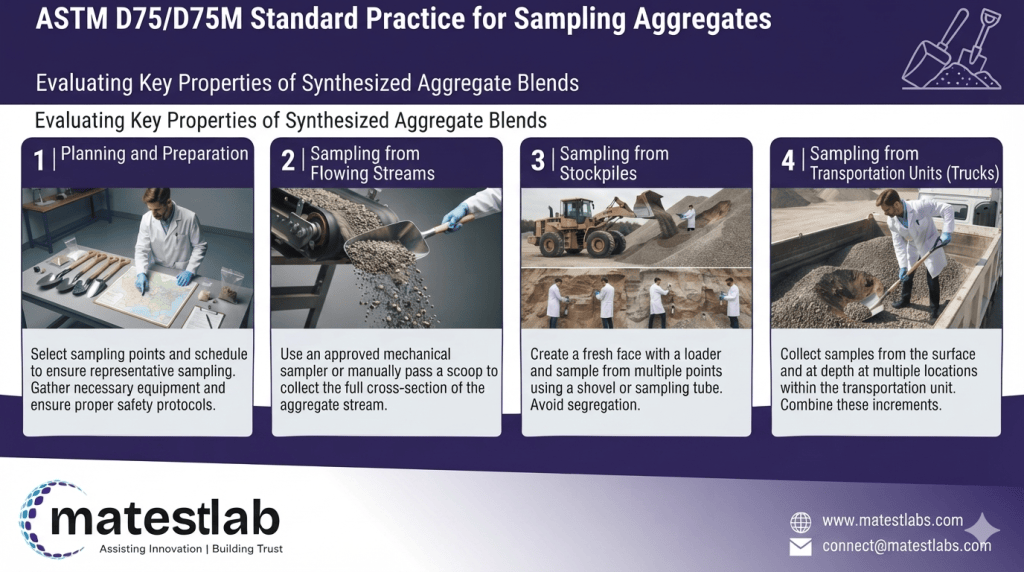
Skilled personnel visually inspect the aggregate for discernible variations before collecting samples. Where variation exists, separate sampling areas may be required to characterize the material appropriately.
Flowing Aggregate Stream
Stream technicians select sampling units by a random approach and collect approximately equal increments from the production stream. The increments are combined to form the field sample.
Conveyor-Belt Sampling
Analysts select representative units and collect multiple approximately equal increments from the conveyor material. The conveyor is stopped when necessary so that the full cross section can be sampled without selectively collecting only surface material.
Stockpile Sampling
Personnel should minimize segregation effects when sampling stockpiles. Power equipment is preferred for developing a separate sampling pile for coarse or mixed aggregate where practicable.
Stockpiles Without Power Equipment
When power equipment is unavailable, the practice provides an alternative approach involving increments from different elevations of the stockpile and measures to prevent additional material from rolling into the sampling area.
Fine Aggregate Stockpiles
For the alternative fine-aggregate procedure, personnel remove the outer layer affected by storage conditions and obtain material beneath it. Sampling tubes may be used at randomly selected locations.
Transportation Units and Field Sample Handling
Sampling from trucks, rail cars, barges, or other transportation units should be avoided when practicable for coarse or mixed aggregates when grading-related properties are being evaluated. Technicians combine representative increments and maintain sample identification and integrity before the sample is transported, reduced, or submitted for the applicable aggregate testing.
ASTM D75/D75M Testing Process and Data Collection
The ASTM D75/D75M process starts with identification of the type of aggregate, its site, and the sampling objective. Technicians check for any obvious variations in the material and design an appropriate sampling plan. Representative increments are then taken at the sampling location and mixed to create the field sample. Random selection of sampling units helps reduce selection bias for production streams and conveyor belts. Employees should be aware of segregation, especially the tendency of coarse particles to migrate to the upper and outer sections of a stockpile. Where appropriate, power equipment can be used to create a smaller sampling pile that provides a more suitable area for obtaining representative increments. After collection, the field sample is identified and protected during handling and transportation. When the intended laboratory test requires a smaller quantity, the field sample can be reduced using the applicable aggregate sample-reduction procedure referenced by ASTM D75/D75M.
ASTM D75/D75M Practice for Sampling Aggregates
Common Challenges and Troubleshooting
Sampling bias is one of the principal challenges in ASTM D75/D75M applications. Segregation of the aggregate can lead to a non-uniform distribution of coarse and fine particles, especially in stockpiles and transportation units. Technicians should inspect the material before sampling, select representative locations, avoid visibly segregated areas unless variability itself is being investigated, and use appropriate power equipment or sampling devices where required. Representativeness can also be affected by inadequate sample identification, contamination, loss of sample, or inadequate handling. Personnel competence, suitable equipment, calibration and maintenance, and adherence to an appropriate sampling plan are important for reliable results.
ASTM D75/D75M Analysis Results and Interpretation
ASTM D75/D75M analysis focuses on the representativeness of aggregate samples and the proper documentation of sampling conditions to ensure that collected samples accurately reflect the aggregate material being evaluated.
Laboratory reports identify the aggregate material, sampling location, sampling source, and other applicable sampling information using consistent units and terminology.
Technicians evaluate the collected aggregate samples and document the sampling method, sampling point, material condition, and procedures used to obtain representative samples.
Analysts review sample identification, quantity, segregation, contamination, moisture condition, and other observations that may affect the representativeness of the aggregate sample.
Analysts document sampling results and compare the collected sample information with the applicable requirements of ASTM D75/D75M and the intended aggregate testing program.
Analysts record relevant field observations and sampling conditions to support interpretation of sample representativeness, material uniformity, and the reliability of subsequent aggregate test results.
ASTM D75/D75M specifies the sampling of coarse and fine aggregates for preliminary investigation of sources, production control, site-use control, and material acceptance or rejection.
Is ASTM D75/D75M a test method?
No. ASTM D75/D75M is a Standard Practice for Sampling Aggregates. It provides a set of procedures for taking representative aggregate samples that can then be tested by suitable test methods.
Can ASTM D75/D75M be used for both coarse and fine aggregates?
Yes. The scope specifically covers sampling of both coarse and fine aggregates.
Davis Scott is an Electrical and Electronics Engineer specializing in multidisciplinary validation, quality assurance, and comprehensive electro-mechanical testing. Know More
Testimonials
Real results
Engineers trust us with what matters most
“We had a great experience working with this company for our ASTM E84 testing. They were the first company to respond to our inquiry within just a few minutes of submitting it. From start to finish, the communication was excellent, and the entire process was swift, straightforward, and hassle-free.”
Ivars FancyWalls
United States
“Very good communication, testing associates were very patient with delays on our end. Reasonable turnaround time for results and nicely detailed report. Analysts were also quick to answer any follow-up questions. Happy with results.”
Skye Henderson
United States
“Matestlab connected us with an accredited lab within days, cutting weeks off our product validation timeline.”
Rebecca Kozodoy-Pins
United States
Why Choose Matestlab?
Matestlab is a unified testing services partner based in the USA. Matestlab offers raw material and product testing services through accredited, expert laboratories primarily based in the USA. Matestlab supports physical, thermal, chemical, electrical, mechanical, environmental, and characterization testing needs through its global network of 2200+ accredited testing laboratories. Matestlab's in-house materials science experts curate and design comprehensive testing programs matched to the sample material and specific testing need, with regulatory requirements and confidentiality in mind.
If you are looking for a managed and trusted testing partner to achieve your research goals, feel free to schedule a meeting with us or send us a request at connect@matestlabs.com to learn more about our services. For a quick quote, call us at (302)244-7710. We are happy to serve you.
Start Your Testing Project Today
Define your requirements and get access to specialized laboratories ready to deliver results