ASTM D7213 Boiling Range Distribution of Petroleum Distillates

    What is ASTM D7213?

    ASTM D7213 is a standard test method that uses gas chromatography to measure the boiling range distribution of petroleum distillates. The method applies to petroleum products with a boiling range of 100 °C to 615 °C, extending GC-based boiling-range determination to light and medium petroleum distillates. The test method is used for petroleum distillates which have an initial boiling point over 100 °C and a final boiling point below 615 °C at atmospheric pressure. In this method, the hydrocarbon fraction is separated into different fractions according to boiling point as it passes through the non-polar capillary column of a temperature-programmed gas chromatograph, similar to distillation. The resulting chromatogram provides a detailed boiling-range distribution profile for product characterization, quality assessment, and compliance verification with industry specifications. The ASTM D7213 (Standard Test Methods for Analysis of Hydrochloric Acid) is essential in the petroleum and petrochemical sector for reliability testing, performance assessment, and specification testing. 

    Read more

    Get Certified ASTM D7213 Testing for Uncompromising Quality and Project Success 

    The certification ensures petroleum distillates are analyzed for the correct boiling-range distribution using standardized gas chromatography procedures. Laboratory testing provides significant value to manufacturers and refiners in verifying product quality, optimizing refining processes, and meeting regulatory requirements. ASTM D7213-certified testing supports quality control, material verification, and product development in the petroleum and petrochemical industry. Professional laboratory services guarantee that the standards are met and that the test outcomes are reliable. Quality control personnel and chemical engineers depend on certified testing for product uniformity, to improve refinery processes, and to meet customer requirements. 
    What is the Scope of the ASTM D7213Test Standard? 

    ASTM D7213 provides the method for gas chromatography determination of the boiling range distribution of petroleum distillates. This test method is used for the determination of the boiling range distribution of petroleum products in the boiling range from 100 °C to 615 °C. Specifications for apparatus, sample introduction, column temperature programming, detector operation, and data analysis are detailed in the standard. The scope of ASTM D7213 includes:

    Read more

    • Material type: Petroleum distillates (light and medium petroleum fractions, crude oil, lubricating base stocks, and synthetic hydrocarbons).
    • Application: Boiling range of petroleum components in the range of 100 ° C to 615 ° C. 
    • Purpose: Determination of boiling range distribution, quality control, product specification, refinery process optimization, and environmental compliance.
    • Property measured: Boiling range distribution of petroleum components between 100 °C and 615 °C.
    • Method: Gas Chromatography, Capillary Column (Non-polar), Oven (Temperature-programmed), and Flame Ionization Detector (FID).
    • Result: B.R.D. profile and the quantitation of the components of B.R.D. 
    • Result: Boiling range distribution profile and quantification of each component within that boiling range.
    • Test Limitations: This test method is applicable to petroleum distillates that have an initial boiling point above 100 °C and a final boiling point below 615 °C at 101.3 kPa (1 atmosphere). 
    • Units: The values given in SI (System of Units) are regarded as standard. 
    • Applications: Petroleum refining, petrochemical production, fuel quality testing, lubricant production, and environmental compliance testing. 

    What are the Uses of ASTM D7213Testing?

    ASTM D7213 testing helps manufacturers and refiners assess the boiling range distribution of petroleum distillates. Results are used for QC, product specification, process optimization in the refinery, and conformance. This standard is commonly used in the petroleum and petrochemical industries. This standard-

    • Determines the boiling range of petroleum products.
    • Identifies and measures the hydrocarbons in the sample.
    • Assesses products according to their quality, suitability, and consistency for various applications.
    • Aids in the quality control of petroleum refining and manufacturing.
    • Enables product specification and certification.
    • Improves the processes and efficiency of the refinery.
    • Complies with regulatory and customer requirements. 

    Which materials can be tested under ASTM D7213?

    ASTM D7213 is applicable to petroleum distillates such as crude oil fractions, specialty products, lubricating base stocks, and synthetic hydrocarbons. The method is suitable for complex mixtures and is used as a reference for the analysis of a variety of petroleum products. Typical uses include the petroleum distillates (such as naphtha, kerosene, diesel fuel, gas oil, specialty petroleum products), petroleum base stocks for lubrication, and synthetic hydrocarbons. 

    Why is ASTM D7213 Important? 

    ASTM D7213 is a standard method for the gas chromatographic determination of the boiling range distribution of petroleum distillates. This test method expands the boiling range to be above Test Method D2887 (538 °C) and above Test Method D6352 (700 °C). The boiling range distribution gives hints at the makeup of the product, its performance characteristics, and conformity to industry standards. The standard provides uniformity of testing procedures and interpretation of testing results between laboratories. It is used as a standard to assess and improve the efficiency of their processes, ensure product consistency, and meet regulatory requirements and customer expectations. ASTM D7213 is deemed one of the fundamental methods of petroleum testing.

    ASTM D7213 Equipment and Sample Preparation Guide

    ASTM D7213 specifies that a gas chromatograph be equipped with a non-polar capillary column and a flame ionization detector (FID) that has a temperature-programmable oven. Representative samples of petroleum distillate are carefully prepared in the laboratory for gas chromatographic analysis and evaluation. The equipment consists of a gas chromatograph, an autosampler or manual injection system, a non-polar capillary column, and a data acquisition system. 

    Read more

    Sample and Specimen Details Petroleum distillates (often referred to as crude oil fractions, naphtha, kerosene, diesel, gas oil, lubricating base stocks, synthetic hydrocarbons). The specimens are typical of the production lot. 
    Specimen Preparation Technicians condition and store samples as per requirements. They ensure samples are free from contamination. They inject the sample into the gas chromatograph using an autosampler or manual injection technique. 
    Specimen Dimensions The sample size varies with testing requirements. The injection volume must be consistent for reproducible results. 
    Instrumentation Gas chromatograph with programmable oven (up to ~400 °C), non-polar capillary column (e.g., 5 m × 0.53 mm dimethylsilicone), flame ionization detector (FID) with hydrogen and air supply, autosampler or manual injection system, data acquisition and analysis system, carrier gas supply (helium or nitrogen). 

    Testing Procedures and Requirements for ASTM D7213

    Laboratories test petroleum distillates for boiling range distribution according to ASTM D7213 to ensure consistent testing of oil samples. The tests are carried out in laboratories, and standardized procedures are used to ensure reliable and accurate results. Technicians prepare samples, inject them into the gas chromatograph, operate the temperature-programmed column, and analyze the chromatogram. The ASTM D7213 test method includes the following test procedure: 

    Read more

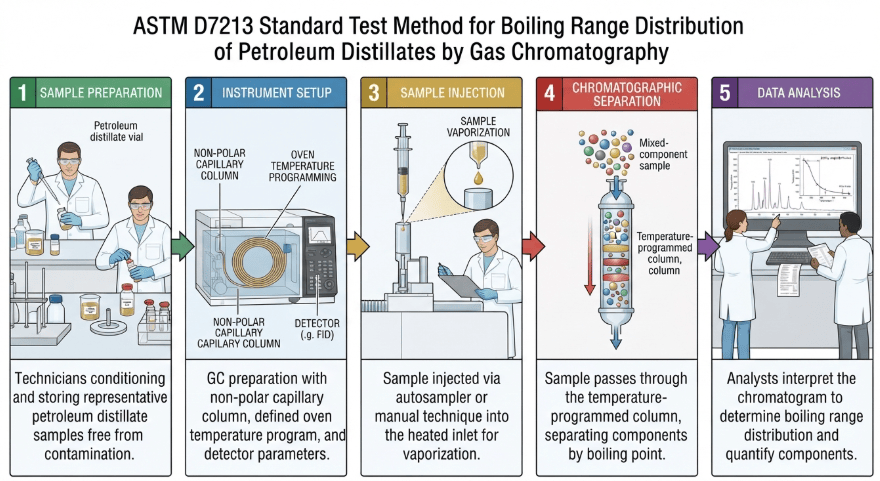
    Sample Preparation Technicians condition and store petroleum distillate samples as per requirements. They ensure samples are free from contamination and represent the production lot. 
    Instrument Setup Technicians set up the gas chromatograph with the appropriate non-polar capillary column. They program the oven temperature and set the detector parameters. 
    Sample Injection Technicians inject the sample into the gas chromatograph using an autosampler or manual injection technique. They vaporize the sample and introduce it into the column. 
    Chromatographic Separation The sample passes through the temperature-programmed column, separating into individual components based on their boiling points. The detector records the elution of each component. 
    Data Analysis Analysts interpret the chromatogram to determine the boiling range distribution. They quantify each component within the specified boiling range and report the results. 

    ASTM D7213 Testing Process and Data Collection

    The testing process begins with conditioning and storing the petroleum distillate sample according to standard testing procedures. Technicians ensure that samples are uncontaminated and representative of the production lot. They configure the gas chromatograph with a non-polar capillary column, set the oven temperature, and tune the detector. They inject the sample into the gas chromatograph, where it vaporizes and enters the temperature-programmed column. The sample is divided into its individual parts due to differences in boiling point as they move down the column. The detector records the flow of each component, creating a chromatogram. The chromatogram is interpreted to establish the boiling range distribution and the amount of each component within the boiling range. Laboratories take samples for quality control, product specifications, process optimization in the refinery, and for environmental compliance. 

     The image shows a gas chromatograph with a temperature-programmed oven, non-polar capillary column, and flame ionization detector used for boiling range distribution analysis of petroleum distillates as per ASTM D7213.
    ASTM D7213 Gas Chromatography Equipment for Boiling Range Distribution Analysis 

    Common Challenges and Troubleshooting

    Typical problems with ASTM D7213 include sample contamination, GC calibration problems, and injection volume variations. The boiling range distribution profile could be unduly affected by such issues. Sample contamination causes unwanted peaks which interfere with the analysis. The calibration errors result in incorrect retention times and wrong boiling points. Poor reproducibility and unreliable results may occur due to injection inconsistencies. Problems are minimized by consistent sample handling and injection technique, proper calibration of the gas chromatograph, and careful cleaning of equipment. Reliable results are obtained by experienced technicians who use standard procedures and proper equipment.

    ASTM D7213 Analysis Results and Interpretation

    The report provides a summary of the boiling range distribution analysis of the tested petroleum distillate sample. It displays the measured values for the selected parameters along with relevant units and specimen information. The interpretation focuses on comparing these measured values against specification requirements or performance benchmarks. Quality control professionals use these results to verify material compliance and ensure product quality.

    Read more

    • The laboratory reports the boiling range distribution profile of the petroleum distillate.
    • The laboratory identifies and quantifies individual hydrocarbons present in the sample.
    • Results indicate product quality, suitability, and consistency for various applications.
    • The laboratory provides performance comparison against specifications.
    • The laboratory documents testing conditions and specimen information.
    • Consistent sample preparation, proper instrument calibration, and uniform injection techniques help laboratories produce reliable results.
    • The boiling range distribution provides insight into product composition and performance properties.

    Link to ASTM D7213

    FAQ

    What is the principle behind ASTM D7213?
    The test method uses gas chromatography on a temperature-programmed, non-polar capillary column to separate petroleum components according to their boiling points. A flame ionization detector records each component, yielding a chromatogram that shows the boiling range distribution.
    ASTM D7213 covers the boiling range from 100 °C to 615 °C. The test method extends above Test Method D2887 (538 °C) and below Test Method D6352 (700 °C).
    Analysts report the petroleum distillate’s boiling range distribution profile. The laboratory provides identification and quantification of individual hydrocarbons, performance comparison with specifications, and a compliance report.

    Updated on September 17, 2026

    Divakar Shukla
    About Author
    Divakar Shukla is an Electrical and Electronics Engineer specializing in the convergence of embedded systems architecture, industrial automation, and applied artificial intelligence.
    Testimonials
    Real results
    Engineers trust us with what matters most
    Start Your Testing
    Project Today
    Define your requirements and get access to
    specialized laboratories ready to deliver results
    Partners with us
    Clients
    Vendors
    Process for testing
    • STEP 01

      You share your testing requirements

    • STEP 02

      You share your sample(s)

    • STEP 03

      We deliver your test reports

    Get your testing done

    Let us known your testing requirements and we will be right back with a solution.

      Let us root for each other. Collaborate to grow, expand, and accelerate our businesses.

      Partner with us

        Discover more from Matestlab

        Subscribe now to keep reading and get access to the full archive.

        Continue reading