
ASTM D709 Standard Specification for Laminated Thermosetting Materials

    What is ASTM D709?

    ASTM D709 is a standard specification for laminated thermosetting materials. It applies to laminated thermosetting materials produced by bonding layers of fibrous reinforcement with thermosetting resin systems. The specification defines requirements for various types of laminated materials, including construction, electrical, mechanical, and other applicable performance requirements. ASTM D709 (Standard Specification for Laminated Thermosetting Materials) is a standard for classification and specification of laminated thermosetting materials for specific applications and properties. Requirements for different material types and grades may include dielectric strength, insulation resistance, flexural strength, compressive strength, water absorption, and dimensional characteristics.

    Read more

    Get Certified ASTM D709 Testing

    ASTM D709 testing and specification evaluation supports manufacturers, suppliers, engineers, technicians, and quality-control professionals in ensuring that laminated thermosetting materials meet the material requirements applicable to their specific product. There are various applications where testing can be used for objective material qualification, production control, product comparison, and specification verification. An expert technician produces representative samples as specified in the appropriate ASTM D709 test and conducts physical, mechanical, electrical, and dimensional tests as required. The measured results are then compared to the requirements for the material type or grade specified.
    What is the scope of ASTM D709?

    ASTM D709 specifies the requirements for electrical, mechanical, and related applications of laminated thermosetting materials. The specification relates to laminated products produced by bonding layers of fibrous material with thermosetting resin and specifies classifications and properties of various product constructions. The scope includes:

    Read more

    • Material Type: Laminated thermosetting materials made from fibrous reinforcement and thermosetting resin. 
    • Construction: Laminates manufactured in layers using suitable reinforcing materials and resin systems. 
    • Electrical Properties: Requirements for applicable dielectric and insulating characteristics. 
    • Mechanical Properties: Requirements for properties such as flexural and compressive performance where applicable. 
    • Physical Properties: Evaluation of characteristics such as water absorption and dimensional behavior where specified. 
    • Material Classification: Different material types or grades are evaluated according to their applicable requirements. 
    • Dimensions and Workmanship: Laminated products should meet applicable dimensional and appearance requirements. 
    • Specification Compliance: Test results are compared with the requirements established for the applicable laminate type. 

    What are the uses of ASTM D709 testing?

    ASTM D709 offers a set of guidelines for the evaluation of laminated thermosetting materials for use where electrical insulation, mechanical strength, dimensional stability, or a combination of these properties is desirable. The specification ensures that the same quality of laminate is manufactured and gives the engineer information about the laminate that is standard. Typical uses include:

    • Electrical Insulation: Evaluate laminated materials used as electrical insulating components. 
    • Mechanical Components: Assess laminates used where mechanical strength and dimensional stability are important. 
    • Material Qualification: Verify that a laminated material meets the applicable grade requirements. 
    • Quality Control: Monitor production consistency between batches. 
    • Supplier Evaluation: Compare laminated thermosetting materials from different sources. 
    • Product Development: Evaluate changes in reinforcement, resin, processing, or laminate construction. 
    • Specification Verification: Provide test data for comparison with applicable ASTM D709 requirements. 
    • Engineering Selection: Support selection of laminated materials for electrical and mechanical applications. 

    Which Materials Can Be Tested According to ASTM D709?

    This ASTM D709 specification is for laminated thermosetting materials made from an appropriate fibrous reinforcement and a thermosetting resin system. Requirements vary according to the application, the grade, and the construction of the laminate. Examples include:

    • Fabric-Reinforced Laminates: Laminates produced with woven or other fibrous fabrics. 
    • Paper-Reinforced Laminates: Thermosetting laminates that are covered by the applicable classification and reinforced with paper. 
    • Glass-Reinforced Laminates: Laminates with glass fiber reinforcement. 
    • Resin-Bonded Laminates: Materials made by the impregnation and consolidation of the reinforcement with thermosetting resin. 
    • Electrical Laminates: Materials used for electrical parts and insulation. 
    • Mechanical Laminates: Laminated products for use in applications that demand strength and dimensional stability.

    Why is ASTM D709 Testing Important?

    ASTM D709 testing is vital, as laminated thermosetting materials can be used in both electrical and mechanical applications, and their properties are dependent on the reinforcement, resin system, laminate construction, and manufacturing process. The use of standardized evaluation allows an evaluation of variations in mechanical, electrical, and physical properties. It also gives the manufacturers and engineers similar data to qualify, control, and select materials for products.

    ASTM D709 Equipment and Sample Preparation Guide

    ASTM D709 is a material specification, which means the equipment required will be influenced by the type of laminate and the property being evaluated. It is important for the technicians to prepare specimens following the applicable ASTM test method specified in the specification, not a “one-size-fits-all” approach.

    Read more

    Micrometer / dimensional measuring equipmentTechnicians measure specimen thickness, width, length, and other required dimensions.
    Analytical balanceTechnician determines specimen mass for applicable physical-property evaluations.
    Specimen-cutting and preparation equipmentTechnicians produce representative specimens with the required geometry and surface condition.
    Specimen DimensionsThe technician should record specimen length, width, and thickness in mm, together with laminate construction, reinforcement type, resin system, orientation, and conditioning history where required.

    ASTM D709 Testing Procedures and Requirements

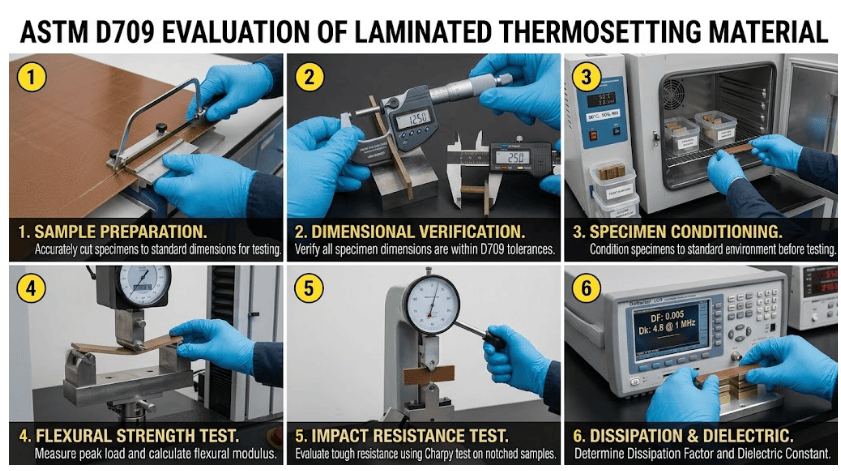
    ASTM D709 is a specification rather than a single test method, so the testing sequence depends on the material classification and the requirements applicable to the selected laminate. Technicians may perform mechanical, electrical, physical, dimensional, and visual evaluations using the referenced ASTM methods. The testing process includes the following steps.

    Read more

    Material Identification and Specimen PreparationTechnicians identify the laminate construction and prepare representative specimens for the required evaluations.
    Dimensional and Physical EvaluationTechnicians verify dimensions and applicable physical characteristics such as water absorption or workmanship.
    Mechanical Property TestingTechnicians determine required strength or mechanical performance using the applicable ASTM test method.
    Electrical Property TestingTechnicians evaluate dielectric, insulation, or other applicable electrical characteristics.

    ASTM D709 Testing Process and Data Collection

    The technician selects representative specimens and conditions them according to the applicable test requirements.  The technician performs the required mechanical, electrical, physical, and dimensional evaluations using calibrated equipment. The analyst records the measured values and compares them with the applicable ASTM D709 requirements for the specified material classification. The technician enters specimen identification, laminate construction, type of reinforcement, resin data, specimen dimensions (mm), conditioning data, and individual test data. The analyst records the results of calculated mechanical, electrical, or physical properties and determines if the material conforms to the relevant specification requirements.

    The image shows laminated thermosetting material specimens prepared for dimensional, mechanical, and electrical property evaluation according to ASTM D709 requirements.
    ASTM D709 evaluation of laminated thermosetting material 

    Common Challenges and Troubleshooting

    The proper classification of materials is critical, as ASTM D709 requirements vary by laminate type and grade. Before deciding on the tests to be used, the technician should confirm the material designation, reinforcement, the resin system, and the use. The mechanical and electrical results can be greatly affected by how the specimen is prepared. Variability can be caused by incorrect dimensions, damaged edges, wrong orientation, or different conditions. The referenced test method should be followed carefully, and the preparation and measurement equipment calibrated for the applicable technique. The analyst needs to record the conditions of the samples and make sure that they are in the desired condition for analysis.

    Analysis Results and Interpretation

    The ASTM D709 test results provide information about the performance of the tested laminated thermosetting material against the requirements applicable to its specified material classification. Analysts should report the measured values together with specimen information, laminate construction, dimensions, conditioning, and test conditions for proper interpretation and comparison.

    Read more

    • Mechanical results are reported according to the applicable test method and may include strength or other mechanical-property values. Report electrical results using the applicable electrical units, and report physical and dimensional characteristics using the units specified by the referenced procedure.
    • The technician records specimen identification, laminate type, reinforcement and resin information, specimen dimensions in mm, conditioning conditions, and individual measurements. The analyst documents measured and calculated mechanical, electrical, physical, and dimensional properties and compares them with the applicable ASTM D709 requirements.
    • The report contains the material designation, laminate construction, specimen information, dimensions, test methods, conditioning conditions, measured results, calculated properties, applicable specification limits, and compliance evaluation.
    • Mechanical properties may be reported in MPa, electrical properties using applicable units such as V/m, Ω, or Ω·m, and dimensions in mm, depending on the specific test. The exact reporting units and acceptance criteria depend on the applicable ASTM D709 material classification and referenced test method.
    • Techniques and analysts will have consistent, reliable, and comparable ASTM D709 results when they prepare and condition the specimens, measure dimensions, conduct mechanical and electrical testing, calibrate the equipment, and evaluate the data.

    Link to ASTM D709

    FAQ

    What properties can be evaluated under ASTM D709?
    Depending on the specified laminate classification, evaluation can include mechanical, electrical, physical, dimensional, and workmanship characteristics using the applicable referenced test methods.
    No. Specimen dimensions depend on the particular property being tested and the referenced ASTM test method.
    The specification covers suitable laminated thermosetting materials manufactured from fibrous reinforcement and thermosetting resin systems, with specific requirements depending on the applicable material classification.
    Units depend on the property being evaluated. Mechanical properties may be reported in MPa, dimensions in mm, and electrical properties using the applicable electrical units.
    Different laminated thermosetting material types and grades can have different performance requirements. Correct classification ensures that technicians perform the appropriate tests and compare results with the correct acceptance criteria.

    Updated on September 22, 2026

    Gokula Srinivasan Selvam
    About Author
    Gokula Srinivasan Selvam is a Material Testing Associate at Matestlab Inc. and holds a postgraduate degree in Ceramic Engineering from IIT (BHU), Varanasi. His academic background and professional experience are centered on advanced ceramic materials, their processing, characterization, and performance evaluation.
    Know More
    Testimonials
    Real results
    Engineers trust us with what matters most
    Why Choose Matestlab?
    Matestlab is a unified testing services partner based in the USA. Matestlab offers raw material and product testing services through accredited, expert laboratories primarily based in the USA. Matestlab supports physical, thermal, chemical, electrical, mechanical, environmental, and characterization testing needs through its global network of 2200+ accredited testing laboratories. Matestlab's in-house materials science experts curate and design comprehensive testing programs matched to the sample material and specific testing need, with regulatory requirements and confidentiality in mind.

    If you are looking for a managed and trusted testing partner to achieve your research goals, feel free to schedule a meeting with us or send us a request at connect@matestlabs.com to learn more about our services. For a quick quote, call us at (302)244-7710. We are happy to serve you.
    Start Your Testing
    Project Today
    Define your requirements and get access to
    specialized laboratories ready to deliver results
    Partners with us
    Clients
    Vendors
    Process for testing
    • STEP 01

      You share your testing requirements

    • STEP 02

      You share your sample(s)

    • STEP 03

      We deliver your test reports

    Get your testing done

    Let us know your testing requirements and we will be right back with a solution.

      Let us root for each other. Collaborate to grow, expand, and accelerate our businesses.

      Partner with us