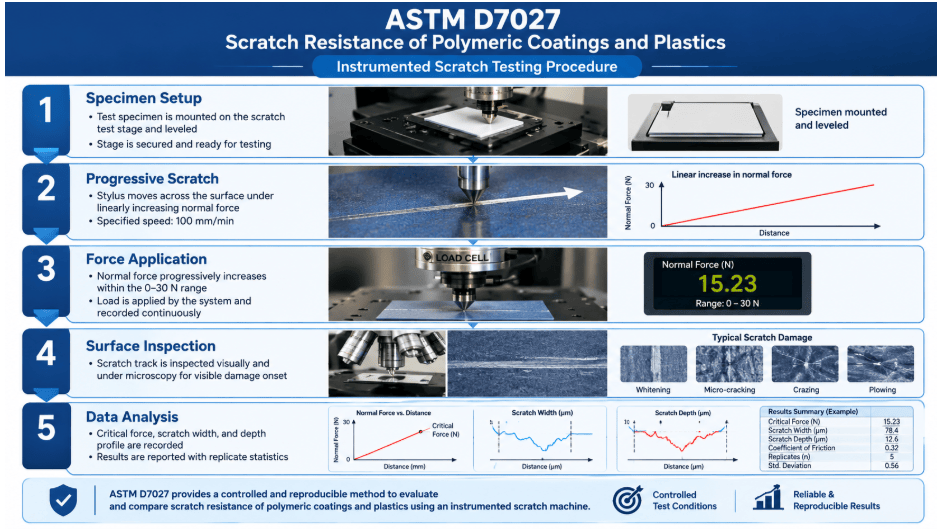
ASTM D7027 Standard Test Method for Evaluation of Scratch Resistance of Polymeric Coatings and Plastics

    What is ASTM D7027?

    ASTM D7027 is a standard test method for determining the scratch resistance of polymeric coatings and plastics using an instrumented scratch machine. Scratch resistance is a material’s ability to resist surface damage from mechanical contact. This property is significant in applications where surface appearance and durability are important. In the automotive industry, interiors with high scratch resistance are essential for a premium appearance and user experience. Consumer electronics housings require similar protection to prevent scratches and ensure a sleek look and touch. Protective coatings on consumer electronics, such as mobile phones and remote controls, also require high scratch resistance. ASTM D7027 (Standard Test Method for Evaluation of Scratch Resistance of Polymeric Coatings and Plastics Using an Instrumented Scratch Machine) uses a progressive-load scratch test with a spherical stylus to evaluate scratch resistance. The automated process eliminates user-induced data effects.

    Read more

    Get Certified ASTM D7027 Testing for Uncompromising Quality and Project Success

    Scratch damage affects product appearance, customer satisfaction, and service life. ASTM D7027 certification guarantees that polymeric coatings and plastic surfaces are durable in the marketplace. Qualified laboratory testing gives accurate and reproducible data to compare materials and for quality assurance purposes. The testing provides valuable insights to develop self-healing and scratch-resistant coatings and assists manufacturers in certifying their products against stringent criteria. 

    What is the Scope of the ASTM D7027 Test Standard?

    ASTM D7027 is a test method for determining the scratch resistance of polymeric coatings and plastics using an instrumented scratch machine. The standard aims to evaluate surface damage on polymeric materials under controlled conditions using a progressive-load scratch technique with a spherical stylus. The methods described are used to evaluate either coatings or plastic substrates in labs. The standard sets out test conditions and includes quantitative data for comparing materials. The ASTM D7027 scope includes-

    Read more

    • Material type: Polymeric coatings, plastics, and polymer compounds used in visible or high-contact applications.  
    • Purpose: Quantification for evaluation of scratch and mar resistance.  
    • Property measured: The test measures critical visible scratch force (Fc), the scratch width profile, the scratch depth profile, scratch coefficient of friction, surface recovery percentage, and whitening onset load. 
    • Method: ASTM D7027 is a progressive-load scratch technique in which a spherical-tipped stylus traverses the surface under a linearly increasing normal load. 
    • Result: The testing laboratory gets quantitative scratch performance data from the specimens it tests. 
    • Test Limitations: The standard sets no universal acceptance criteria; results are relative and designed to rank materials. 
    • Environmental conditions: The test program also adds control of temperature and humidity for repeatability of results. 
    • Applications: Engineers use ASTM D7027 to evaluate polymeric coatings and plastics for automotive interiors, consumer electronics, and protective coating applications where surface aesthetics and durability are important. 

    What are the Uses of ASTM D7027 Testing?

    Laboratories use ASTM D7027 testing to generate quantitative data to support material development and quality assurance. These results are fed into the engineering and manufacturing processes to optimize formulations and choose materials for challenging applications. This standard-

    • Evaluating “scratch” performance of various polymer formulations and coatings.
    • Setting critical load values for onset of surface damage
    • Assessing self-healing and scratch-resistant coating technologies
    • Applicable materials for interior/exterior of cars
    • Providing technology for product development for consumer electronics and appliances
    • Reducing variation in manufacturing practices.
    • Write a scratching simulation for fingernails and objects 

    Which materials can be tested under ASTM D7027?

    ASTM D7027 applies to polymeric coatings and plastic substrates that can be fabricated into appropriate test specimens. It is typically applied to test automotive clear coat systems, interior automotive trim coatings, packaging materials, protective coatings for eyewear and optics, and protective coatings for appliances. With the proper specimen configuration, the practice is applied to test different polymer formulations, coatings, and finished products. 

    Why is ASTM D7027 Important?

    ASTM D7027 sets controlled test conditions for evaluation of scratch resistance of polymeric materials. Surface scratching can change properties such as appearance, gloss, and surface integrity. The results help engineers to compare the properties of plastic materials and decide if a polymer formulation or coating would be suitable for service conditions. Because the mechanical properties of polymers are significantly affected by temperature, the test standard is intended to provide repeatable results when the user tests under similar testing conditions and on specimens of the same material and surface texture and conditions them in the same way. 

    ASTM D7027 Equipment and Sample Preparation Guide

    ASTM D7027 requires an instrumented scratch machine with the capability to control normal force and data acquisition. Laboratory technicians conduct scratch tests on representative samples with appropriate surfaces and then evaluate the results.

    Read more

    Sample and Specimen Details Laboratory technicians test representative samples of polymeric coatings and plastic materials and prepare them for controlled scratch testing.
    Specimen PreparationTechnicians prepare, identify, and measure the specimens before testing and record their initial surface condition or selected properties. 
    Specimen DimensionsTechnicians prepare specimens with a flat surface long enough to accommodate the full scratch length, commonly in the range of 50 to 80 mm. 
    InstrumentationThe test uses an instrumented scratch machine, a spherical-tipped stylus, a load cell, an optical microscope or profilometer, and a data acquisition system. 

    Testing Procedures and Requirements for ASTM D7027

    The normal technique involves preparing and mounting the specimen. ASTM D7027 is equivalent to ISO 19252. The SI system is used as the standard system for the test. The scratch test is carried out as follows: 

    Read more

    Specimen Setup Technicians mount the test specimen on the scratch-test stage and level it properly before testing.
    Progressive Scratch Technicians move the stylus across the surface at a specified speed of 100 mm/min while the normal force increases linearly.
    Force Application Technicians progressively increase the normal force within the specified 0–30 N range.
    Surface Inspection Analysts inspect the scratch track visually and under a microscope to identify the onset of visible surface damage.
    Data Analysis Analysts record the critical force, scratch width, and depth profile and report the results with replicate statistics.

    ASTM D7027 Testing Process and Data Collection

    Representative specimens are picked out and fixed on the scratch machine stage. As the stylus moves automatically across the surface, the data acquisition system collects data on force, scratch width, scratch depth, and coefficient of friction under increasing normal force. The test is continued until maximum load is achieved. Post-test microscopic examination yields the critical scratch force (Fc) and damage dimensions, enabling quantitative material comparisons. 

    The image depicts a spherical-tipped stylus being drawn across a plastic specimen surface under progressive normal force during ASTM D7027 scratch resistance testing.
    ASTM D7027 Instrumented Scratch Testing of Polymeric Coatings

    Common Challenges and Troubleshooting in ASTM D7027

    Proper specimen surface texture and testing environment are essential to getting the correct results using ASTM D7027. Mechanical properties of polymers are temperature-dependent; thus, it is necessary to control the temperature. Self-healing materials pose a difficulty in measurement because the content of the scratch profile changes with time, due to viscoelastic recovery. The suggested 24-hour recovery period tackles this challenge. Other factors include surface contamination, stylus alignment, and forces applied. Laboratories have reliable data because they carefully condition specimens, regularly calibrate their equipment, and employ trained and skilled staff members who follow standardized protocols.

    ASTM D7027 Analysis Results and Interpretation

    The laboratory reports the measured scratch resistance parameters of the tested polymeric coating or plastic specimen. ASTM D7027 addresses scratch depth, whitening onset, and coefficient of friction rather than a general overall material-performance rating.

    Read more

    • The laboratory reports scratch depth in micrometers, distinguishing between instantaneous and residual damage where applicable.
    • The technician characterizes the material state being tested, such as self-healing characteristics or viscoelastic recovery behavior.
    • The analyst reports the critical load at which the whitening is visible and correlates the results with the tested material and its surface finish.
    • The engineer takes into account scratch speed, test temperature, and recovery time when interpreting scratch resistance.
    • Engineers use the measured scratch resistance values to support material selection for visible, high-contact applications. 

    Link to ASTM D7027

    FAQ

    What is Fc in ASTM D7027?
    The critical normal force (f.c) is the smallest force at which the scratch is first observed by the unaided eye in standard lighting. It is the first value used as the basis for scratch resistance in ASTM D7027.
    ASTM D7027 is equivalent to ISO 19252. Both standards use a progressive-load scratch technique with a spherical stylus and produce similar results.
    Yes. ASTM D7027 takes into consideration viscoelastic recovery in self-healing polymers, suggesting a 24-hour waiting period prior to measuring the scratch depth.
    Gokula Srinivasan Selvam
    About Author
    Gokula Srinivasan Selvam
    Gokula Srinivasan Selvam is a Material Testing Associate at MaTestLab Inc. and holds a postgraduate degree in Ceramic Engineering from IIT (BHU), Varanasi.
    Testimonials
    Real results
    Engineers trust us with what matters most
    Start Your Testing
    Project Today
    Define your requirements and get access to
    specialized laboratories ready to deliver results
    Partners with us
    Clients
    Vendors
    Process for testing
    • STEP 01

      You share your testing requirements

    • STEP 02

      You share your sample(s)

    • STEP 03

      We deliver your test reports

    Get your testing done

    Let us known your testing requirements and we will be right back with a solution.

      Let us root for each other. Collaborate to grow, expand, and accelerate our businesses.

      Partner with us

        Contact Us

        Discover more from Matestlab Inc

        Subscribe now to keep reading and get access to the full archive.

        Continue reading