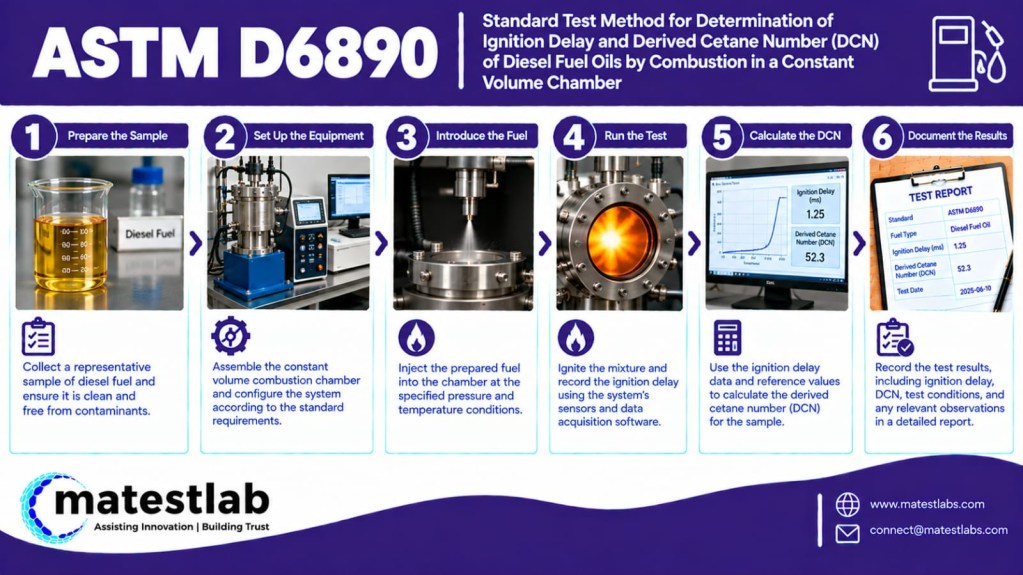
ASTM D6890 Standard Test Method for Determination of Ignition Delay and Derived Cetane Number (DCN) of Diesel Fuel Oils
What is ASTM D6890?
ASTM D6890 is a standard test method that determines the ignition delay and derived cetane number (DCN) of diesel fuel oils using combustion in a constant-volume chamber. In addition, the method evaluates how readily a diesel fuel ignites when injected into heated, compressed air under controlled laboratory conditions. Furthermore, the method applies to conventional diesel fuels, hydrocarbon oils, biodiesel blends, fuels containing cetane improver additives, and diesel blending components. Technicians use an automated combustion analyzer to measure ignition delay, which the method correlates with cetane number to obtain the DCN. In addition, the procedure typically requires approximately 100 mL of fuel and about 20 minutes on a suitable instrument. Results help laboratories assess the ignition characteristics, compare fuel samples, and support fuel specification checks. Moreover, this method is useful in fuel research, quality control, and application-related evaluations for compression-ignition engines.
Get Certified ASTM D6890 Testing for Reliable Evaluation of Diesel Fuels
ASTM D6890 provides a standardized approach for evaluating the ignition characteristics of diesel fuel oils through ignition delay and derived cetane number measurements. In addition, proper testing helps fuel producers, suppliers, and laboratories compare the fuel performance indicators and assess compliance with applicable fuel specifications. Furthermore, qualified laboratories use suitable combustion analyzers, follow the standard test procedure, and maintain traceable records of the sample conditions and results. These evaluations support fuel quality control, product comparison, and technical assessments for diesel fuel applications.
What is the Scope of ASTM D6890?
ASTM D6890 is a standard test method that covers the quantitative determination of ignition characteristics in conventional diesel fuel oils and specified fuel blends using an automated laboratory method. In addition, the method calculates the ignition delay in a constant-volume combustion chamber and correlates the result with cetane number to determine DCN.
Purpose: The method helps to determine the ignition delay and derived cetane number under controlled laboratory conditions.
Properties evaluated: Ignition delay, reported in milliseconds (ms), and derived cetane number (DCN).
Testing method: Direct fuel injection into heated, compressed air in a constant-volume combustion chamber.
Result: The test produces an ignition-delay measurement and a calculated DCN. The stated ignition-delay range is 2.64 ms to 6.90 ms, corresponding to 75.1 DCN to 31.5 DCN in ASTM D6890-25.
Test limitations: Precision may be affected when ignition delay falls outside the stated range. The relationship between DCN results and performance in full-scale engines is not completely understood.
Methodology: Technicians adhere to the standard instrument procedure and establish appropriate safety, health, and environmental practices.
Application: The method supports fuel quality control, fuel comparison, research, and ignition-characteristic assessments for compression-ignition engines.
What Are the Uses of ASTM D6890 Testing?
ASTM D6890 is a standard test method that allows laboratories to determine the ignition properties of diesel fuels by measuring the ignition delay and calculating the derived cetane number. In addition, the test results are used to compare different fuels and check their specifications. In real-world applications, these results support fuel quality control, batch-to-batch consistency, and assessment of diesel fuels for use in compression-ignition engines. The Standard method:
Helps to evaluate ignition delay of the tested fuel under controlled combustion conditions.
Helps the technician calculate the derived cetane number from the measured ignition delay.
Aids diesel fuel manufacturers to analyze the ignition properties of produced fuel batches.
Supports researchers in studying the ignition characteristics of the tested fuel under the defined conditions.
Allows checking the quality of motor fuels and comparing the characteristics of different products to ensure their suitability for specific engines as per the results.
Why is ASTM D6890 Important?
Diesel fuels can differ in their ignition characteristics because of their composition and formulation. In addition, ASTM D6890 helps to provide a standard laboratory method to analyze the ignition delay and derive a cetane number. Furthermore, manufacturers, fuel suppliers, and laboratories can use these results to differentiate different samples, support quality control, and allow them to assess fuel suitability in contrast to the standard specifications. However, the DCN result does not fully establish how a fuel will perform in every operating condition of a full-scale diesel engine.
Why is a constant-volume combustion chamber used in ASTM D6890?
The constant-volume combustion chamber helps to provide a controlled environment for evaluating diesel fuel ignition characteristics. In addition, the instrument injects fuel into heated, compressed air and calculates the ignition delay under the method’s prescribed conditions. Furthermore, the controlled setup helps the technician achieve relevant results when the equipment is properly maintained and operated. Thus, the resulting data supports the comparison of fuel samples using the ASTM D6890 procedure.
ASTM D6890 Equipment and Sample Preparation Guide
Proper assessment requires a representative diesel fuel sample and a combustion analyzer capable of determining ignition delay and DCN. In addition, technicians confirm the instrument’s operating condition, identify the fuel sample, and prepare the equipment in accordance with the current test method.
Technicians obtain a representative diesel fuel sample suitable for the intended evaluation. The sample may be conventional diesel fuel, an applicable blend, or a diesel blending component covered by the method.
Sample Preparation
Technicians identify the sample and prepare it for testing in accordance with the applicable method and instrument instructions and handle the fuel in accordance with appropriate laboratory safety practices to avoid contamination.
Sample Dimensions
ASTM D6890 typically requires approximately 100 mL of fuel for a test. This is an approximate sample volume, not a specimen dimension.
Instrumentation
Technicians use an automated combustion analyzer that includes a constant-volume combustion chamber, a fuel-injection system, heated compressed-air controls, and measurement and analysis functions for determining ignition delay and DCN.
ASTM D6890 Testing Procedures and Requirements
Technicians determine the diesel fuel ignition parameters by injecting fuel into heated, compressed air inside a constant-volume combustion chamber. In addition, the analyzer examines the ignition delay and further calculates the derived cetane number using the parameters specified by the method. Furthermore, the exact operating sequence adheres to the current standard and the requirements of the instrument. ASTM D6890 testing procedure is as follows:
Technicians identify the fuel sample and confirm that it falls within the intended scope of ASTM D6890.
Instrument preparation
Technicians check the combustion analyzer and prepare the chamber, injection system, and measurement functions according to the prescribed procedure.
Sample Preparation
Technicians prepare the representative fuel sample and ensure that it is suitable for introduction into the analyzer.
Operating condition verification
Technicians confirm that the instrument has reached the required test conditions before beginning the measurement sequence.
Fuel injection
Technicians operate the analyzer to inject fuel directly into heated, compressed air within the constant-volume combustion chamber.
Ignition-delay measurement
The analyzer examines the interval between fuel injection and ignition under the specified test conditions.
DCN determination
The analyzer applies the specified correlation to the measured ignition delay to obtain the derived cetane number.
Result assessment
Technicians review the ignition-delay and DCN results, record the findings, and assess them against the applicable fuel specification or evaluation criteria.
ASTM D6890 Testing Process and Data Collection
The testing process begins by identifying the sample since the fuel type determines the scope of the method. Additionally, technicians will prepare the combustion analyzer, confirm its condition, and introduce the fuel into the process in a prescribed manner. The analyzer will then inject the fuel into heated and compressed air inside the constant-volume chamber and measure the ignition delay. Technicians record the sample identification, ignition-delay measurement, DCN result, and instrument information. Furthermore, they review the results for abnormal indications or invalid tests. Finally, analysts will then compare the results with the relevant fuel specifications or evaluation criteria. Overall, consistent sample preparation, appropriate instrument operation, and traceability records enable labs to consistently manage data for fuel quality control and comparisons.
Diesel fuel evaluated for ignition delay and derived cetane number using a constant-volume combustion chamber according to ASTM D6890.
Common Problems and Troubleshooting
During D6890 ASTM testing, technicians may encounter irregularities in ignition-delay analysis that are caused by dirty samples, incorrect sample preparation, or faulty instruments. In addition, samples of fuel with an abnormal delay in ignition may indicate poor reproducibility of measurements. As a result, a technician should first examine the sample’s nature, the instrument’s condition, and the test’s requirements before identifying the problem. At the same time, varying fuel formulations cause different DCN values, so technicians should keep in mind that the same diesel burns differently under the same conditions. Thus, technicians make sure that all tools are in good condition, strictly follow the instructions for the test, prevent sample contamination, and keep a record of any abnormal measurements. Additionally, analysts should note that DCN testing reflects the actual performance of the diesel engine at full scale.
ASTM D6890 Analysis, Results and Interpretation
ASTM D6890 provides information on diesel fuel ignitability through ignition delay and derived cetane number measurements. In general, the results allow analysts to compare fuel samples under the specified laboratory conditions. Therefore, the overall findings characterize the fuel and its quality; however, the actual performance depends on the additional operational conditions and factors. The main points of interpretation are:
Technicians identify the ignition delay, expressed in milliseconds (ms), which represents the time interval between fuel injection and ignition.
The testing team examines the derived cetane number, a calculated value used to estimate ignition characteristics according to the specified correlation.
Analysts evaluate the range that helps to determine if the ignition-delay result falls within the stated range of the method.
Quality control teams compare whether the fuel is relevant to the samples tested under comparable conditions.
Overall, laboratories ensure proper specification during examination to check if the result applies to the specified fuel requirements, provided relevant criteria are available.
The derived cetane number describes the ignition quality of a diesel fuel according to the ASTM D6890 specification.
How much sample is needed for the test?
A representative sample of approximately 100 mL is required for analysis on the appropriate instrument.
Can biodiesel blends be tested using ASTM D6890?
The method includes applicable biodiesel blends as well as other diesel fuels.
Does the method predict engine performance?
The DCN is determined from combustion characteristics measured in a single-cylinder test engine according to the ASTM D6890 specification; however, the relation to engine performance data is only partially established.
Zunaira Tehseen is a scientific content specialist who bridges interdisciplinary research across biochemistry, molecular genetics, and materials science with technical content management. Leveraging expertise in bio-interface characterization, advanced materials evaluation, and AI-driven workflows, she curates, structures, and communicates complex technical data. At Matestlab, she leads content strategy and documentation for metallographic testing, mechanical characterization, and compliance with international standards such as ASTM and ISO, delivering precise, high-impact technical assets for industrial and scientific audiences. Know More
Testimonials
Real results
Engineers trust us with what matters most
“We had a great experience working with this company for our ASTM E84 testing. They were the first company to respond to our inquiry within just a few minutes of submitting it. From start to finish, the communication was excellent, and the entire process was swift, straightforward, and hassle-free.”
Ivars FancyWalls
United States
“Very good communication, testing associates were very patient with delays on our end. Reasonable turnaround time for results and nicely detailed report. Analysts were also quick to answer any follow-up questions. Happy with results.”
Skye Henderson
United States
“Matestlab connected us with an accredited lab within days, cutting weeks off our product validation timeline.”
Rebecca Kozodoy-Pins
United States
Why Choose Matestlab?
Matestlab is a unified testing services partner based in the USA. Matestlab offers raw material and product testing services through accredited, expert laboratories primarily based in the USA. Matestlab supports physical, thermal, chemical, electrical, mechanical, environmental, and characterization testing needs through its global network of 2200+ accredited testing laboratories. Matestlab's in-house materials science experts curate and design comprehensive testing programs matched to the sample material and specific testing need, with regulatory requirements and confidentiality in mind.
If you are looking for a managed and trusted testing partner to achieve your research goals, feel free to schedule a meeting with us or send us a request at connect@matestlabs.com to learn more about our services. For a quick quote, call us at (302)244-7710. We are happy to serve you.
Start Your Testing Project Today
Define your requirements and get access to specialized laboratories ready to deliver results