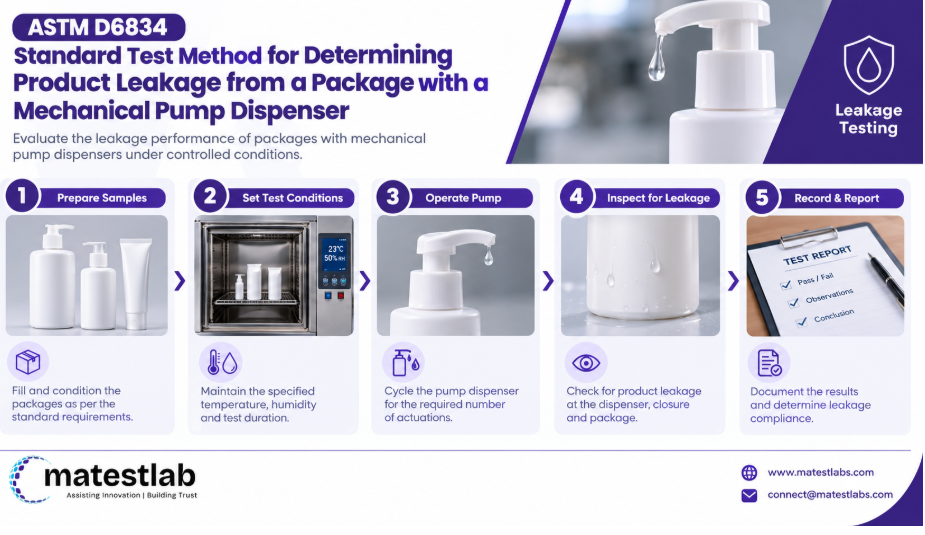
ASTM D6834 is a standard test method that determines whether a container system can securely hold fluid contents without experiencing failures under standard transit or atmospheric pressure changes. It defines precise, standardized steps to check the structural integrity of both the pumping component itself and the critical sealing points where the container throat joins the closure. By comparing realistic atmospheric challenges and shipping-induced vibration stresses, the method permits developers to verify structural or geometric flaws before mass production. Consequently, the scope of ASTM D6834 includes testing methods to determine physical liquid escape under controlled vacuum forces.
The scope of ASTM D6834 includes:
- Material type: Consumer product packaging configurations constructed from plastic, glass, or metal that are explicitly fitted with functional mechanical pump dispensers.
- Purpose: Evaluates and establishes exact compliance specifications regarding product leakage prevention for both individual pump dispensers and finalized consumer packaging units.
- Properties measured: Mechanical component seal reliability, physical container/closure neckline integrity, liquid retention capabilities, and mass/weight loss or physical product escape.
- Method: Outlines two distinct approaches: Method A (Product Leakage Test without Vibration Pre-conditioning) and Method B (Product Leakage Test with Vibration Pre-conditioning to mimic transport handling).
- Result: Documented visual confirmation of physical fluid escape or quantitative measurement of leaked liquid volume to determine an official pass or fail grade.
- Test Limitations: Primarily assesses static and environmental pressure leakage; it does not explicitly address chemical formulation compatibility or long-term component degradation over years.
- Environmental conditions: Conducted within a tightly regulated vacuum testing chamber held under controlled atmospheric test temperatures (typically 23°C ± 2°C).
- Applications: Quality control, packaging design validation, and transit durability testing for cosmetic, pharmaceutical, household chemical, and liquid food packaging systems.
What are the Uses of ASTM D6834 Testing?
ASTM D6834 testing is applied across the packaging, cosmetic, and pharmaceutical industries to examine the containment safety of mechanical pumps. It develops liquid retention baselines before mass distribution. This standard,
- Helps manufacturers prevent expensive product loss and shipping spills during long-distance transit and air cargo transport.
- Assists package designers in verifying that dispensing pumps form an airtight, leak-proof seal with container necks.
- Protects brand reputation by ensuring consumer products do not arrive messy, damaged, or partially empty.
- Permits quality control teams to benchmark different supplier components against uniform vacuum pressure guidelines.
What Materials Can Be Tested Under ASTM D6834?
ASTM D6834 testing methods test various packaging configurations that can be examined to guarantee sealing integrity under atmospheric stress. The standard mainly tests consumer packaging systems that utilize a rigid or semi-rigid primary body structure coupled with a mechanical dispensing mechanism. This encompasses plastic, glass, and aluminum bottles fitted with lotion pumps, fine-mist sprayers, trigger actuators, and foaming pump closures. These diverse material contexts are tested to guarantee their critical mechanical neck joins successfully retain high- to low-viscosity liquid products.
Why is ASTM D6834 Important?
ASTM D6834 testing is important because it directly avoids structural product leakage, protecting a financial bottom line and reputation during global distribution. When consumer items are shipped via air cargo or ground transit, they encounter significant atmospheric pressure fluctuations and physical vibrations. Without verifying compliance under this standard, manufacturers risk catastrophic seal failures, leading to costly inventory damage, hazardous chemical spills, and high retail return rates. Therefore, adhering to this protocol guarantees that mechanical pump dispensers arrive in better, functional condition, maintaining consumer trust and guaranteeing absolute packaging safety.