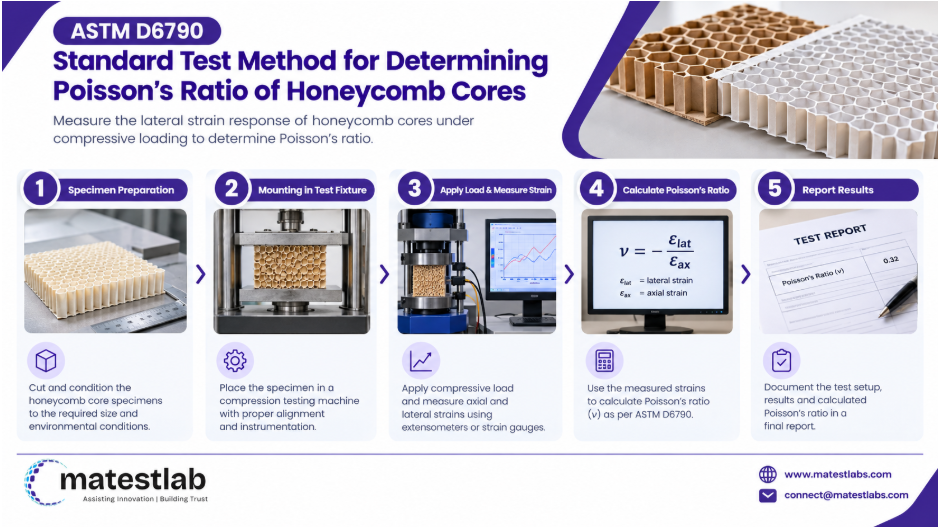
ASTM D6790/D6790M is a standard test method for determining the Poisson’s ratio of sandwich honeycomb cores using an anticlastic curvature method. Because conventional uniaxial tensile or compressive testing cannot capture the complex, multidirectional behavior of cellular geometries, this specialized standard examines how a core sample deforms in a transverse direction when bent longitudinally around a cylindrical surface. It develops a standardized structure for design engineering, material qualification, product research, and quality assurance, guaranteeing continuous calculations of critical elastic properties across both international SI and inch-pound structural measurement systems.
The scope of ASTM D6790 includes:
- Material type: Lightweight structural sandwich honeycomb cores (including metallic, aramid paper, fiberglass, and polymer-based cellular structures).
- Purpose: Provides a reliable, repeatable methodology to evaluate the Poisson’s ratio for structural modeling, finite element analysis (FEA), and material procurement specifications.
- Properties measured: The dimensionless Poisson’s ratio (ν) of the cellular core matrix.
- Method: Bending the rectangular honeycomb core specimen around a cylinder of known radius and measuring the resulting anticlastic curvature radii.
- Result: Calculated transverse-to-longitudinal strain deformation metrics compiled into an ASTM-compliant engineering report.
- Test Limitations: Cannot utilize standard direct extensometer tensile methods; structural metrics are heavily influenced by cell geometry, wall thickness, fabrication errors, and core nonuniformity.
- Environmental conditions: Specimens must be completely dry (typically oven-dried at 50°C for 2 hours) and tested under stable ambient laboratory temperature and humidity controls to minimize environmental error.
- Applications: Material characterization for high-performance sandwich composite panels deployed in the aerospace, automotive, marine, and commercial defense sectors.
What are the Uses of ASTM D6790 Testing?
ASTM D6790 testing provides data for the structural examination of sandwich panels. By determining precise cellular deformation, it enables engineers to optimize core designs, verify material qualities, and ensure aerospace-grade safety. This standard,
- Examines honeycomb cores to determine the exact Poisson’s ratio required for precise finite element analysis (FEA).
- Certifies structural safety and material qualification for high-performance aircraft fuselages, wing panels, and aerospace components.
- Provides manufacturing quality control metrics to ensure consistency in metallic, aramid, and polymer cellular structures.
- Supports research and development teams by quantifying how new lightweight geometries deform under complex mechanical loading.
What Materials Can Be Tested Under ASTM D6790?
ASTM D6790 is engineered to test an array of lightweight cellular and core structures commonly used in high-performance sandwich panel assemblies. The standard primarily applies to metallic cores, such as aluminum honeycombs, alongside non-metallic variations like aramid paper (Nomex), fiberglass-reinforced polymers, and advanced thermoplastics. It examines these materials regardless of their ribbon directions or cell geometries. By testing these lightweight matrix configurations, engineers can correctly capture the unique mechanical behaviors of complex geometries that conventional monolithic material testing protocols simply cannot accommodate.
Why is ASTM D6790 Important?
ASTM D6790 is essential because it provides the only standardized method to correctly measure the Poisson’s ratio of honeycomb sandwich cores using an anticlastic curvature technique. Conventional structural tests fail to capture how these complex, multi-directional cellular geometries deform under real-world mechanical loads. Without this specific data, structural engineers cannot build definitive finite element analysis (FEA) computer models, leading to catastrophic material failures or costly over-engineering. Therefore, this standard guarantees the mechanical safety, structural integrity, and regulatory compliance of lightweight composite panels used in high-stakes industries like aerospace, defense, and automotive manufacturing.