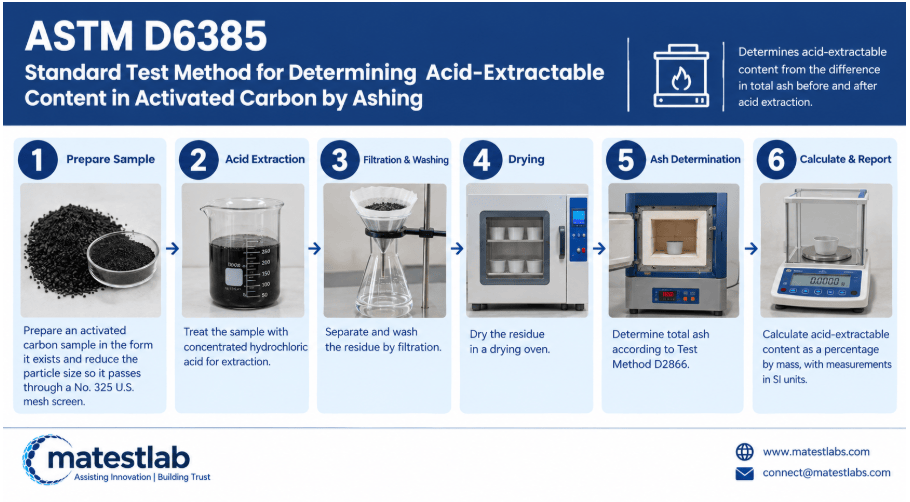
ASTM D6385 Standard Test Method for Determining Acid-Extractable Content in Activated Carbon by Ashing
What is ASTM D6385?
ASTM D6385 is a standard test method for determining the acid-extractable content of activated carbon by ashing. The method finds acid-extractable content from the comparison of the percent mass of total ash in an untreated activated carbon sample to the percent mass of total ash in a sample after acid extraction. The testing method makes use of concentrated hydrochloric acid for extracting the sample and requires Test Method D2866 for the corresponding total ash measurement. The analysts apply ASTM D6385 (Standard Test Method for Determining Acid-Extractable Content in Activated Carbon by Ashing) to analyze an activated carbon sample that contains acid-soluble impurities and determine the relevance to applications. For a more extensive activated carbon testing spectrum, engineers and chemists might find it beneficial to analyze related properties that come together with the acid-extractable content.
Get Certified ASTM D6385 Testing for Reliable Activated Carbon Purity
Activated carbon may well contain acid-soluble impurities that are a limitation to its applications. ASTM D6385 provides a quantitative way of analyzing the acid-extractable content of activated carbon by comparing its total ash content before and after acid extraction. Producers and users of activated carbon can use an associated value with acid-soluble content for carbon with acid-extractable materials in a sample and compare findings with the applicable material or purchase requirements.
What is the Scope of the ASTM D6385 Test Standard?
ASTM D6385 quantifies the acid-extractable part of a material of activated carbon by comparing the percentage of mass of total ash before and after acid extraction. The method deals with activated carbon in any form.
Material type: Activated carbon in any form suitable for the test method.
Purpose: Determination of the acid-extractable content of an activated carbon sample.
Properties evaluated: Acid-extractable content based on the difference between the percent mass of total ash before and after acid extraction.
Testing method: A chemist treats the activated carbon with concentrated hydrochloric acid, separates and washes the residue by filtration, and determines total ash according to Test Method D2866.
Results: Acid-extractable content reported as a percentage by mass, with measurements expressed in SI units.
Test limitations: The method assumes that acid-extracted elements or compounds form water-soluble chloride salts, and hydrochloric acid may not solubilize all impurities in activated carbon.
Use conditions: Technicians handle concentrated hydrochloric acid with appropriate eye and skin protection in a properly operating fume hood
Applications: Evaluation of activated carbon samples containing acid-soluble impurities that can affect their applications.
What are the Uses of ASTM D6385 Testing?
ASTM D6385 provides a quantitative value for evaluating acid-soluble impurities in activated carbon. The test method:
Determines the acid-extractable fraction based on a comparison of total ash before and after acid extraction.
Provides data that can support evaluation of activated carbon for its intended application.
Helps users compare acid-extractable content between activated carbon samples.
Supports quality evaluation when acid-soluble impurities can affect carbon performance or application requirements.
Which materials can be tested under ASTM D6385?
ASTM D6385 applies to activated carbon in any form in which the material may exist. The method determines the acid-extractable content of the sample and requires Test Method D2866 for the corresponding total ash determination. Therefore, technicians should prepare representative activated carbon samples according to the applicable sampling and test requirements before extraction and ashing.
Why is ASTM D6385 Important?
ASTM D6385 helps to evaluate activated carbon for its acid-soluble impurities. These impurities can negatively affect the uses of activated carbon, and thus, the acid-extractable content gives valuable quantitative insight into the sample material. The method helps distinguish the total ash content from its acid-extracted value, and this difference is used to evaluate the carbon in accordance with the specifications.
ASTM D6385 Equipment and Sample Preparation Guide
ASTM D6385 requires equipment for acid extraction, vacuum filtration, drying, weighing, and ash determination. The method specifies the following glassware, filtration equipment, muffle furnace, desiccator, and balance capable of measuring 0.1 mg, equipment for reducing activated carbon particle size so that the material passes through a No. 325 U.S. mesh screen.
Technicians prepare an activated carbon sample in the form in which the material exists and reduce the particle size so the material passes through a No. 325 U.S. mesh screen.
Specimen Preparation
Technicians prepare the activated carbon for determining total ash by the applicable procedures and acid extraction using equipment that does not contaminate the activated carbon with acid-soluble materials
Specimen Dimensions
The test method requires reducing particle size so that the carbon passes through a No. 325 U.S. mesh screen.
Instrumentation
The test uses a 250 mL glass beaker or a 125 mL capacity block-heater digestion vessel, a suitable watch glass, 100 mL and 25 mL graduated cylinders, a 7 cm ID Buchner vacuum funnel or equivalent, a 500 mL vacuum filter flask, a vacuum filter collar, hardened ashless filter paper with a pore size of ≤8 µm and a recommended diameter of 7 cm, a drying oven maintained at 150°C ±5°C, a muffle furnace specified by Test Method D2866, porcelain crucibles, a desiccator, a balance capable of measuring 0.1 mg, and suitable particle-size reduction equipment.
Testing Procedures and Requirements for ASTM D6385
The test methods separate acid-soluble elements from the total ash content in activated carbon. The technician has to determine total ash before extraction, and the chemist will carry out hydrochloric acid extraction; the same ash procedure will run a second time on the extracted residue. The ASTM D6385 test methods comprise the following test procedure-
Technicians prepare the activated carbon sample and reduce it to its particle size so that it passes the mesh of No. 325 U.S. mesh screen; however, the size reduction equipment shall not contaminate the sample with acid-soluble materials.
Initial Ash Determination
Technicians determine the total ash of the activated carbon sample according to ASTM D2866 to establish the total ash value before acid extraction.
Acid Extraction
Analysts treat the prepared activated carbon with concentrated hydrochloric acid, following required safety precautions and using a proper fume hood; they cover the mixture, bring it to a boil, and maintain it at a boil for 5 min ±10 s.
Filtration and Washing
After the extraction, a chemist separates the extracted material by vacuum filtration using the specified ashless filter paper and washes the residue with the required reagent water.
Drying
A technician dries the filtered material using the specified drying equipment maintained at 150°C ±5°C.
Residual Ash Determination
Analysts determine the total ash of the acid-extracted material using the applicable procedure in Test Method D2866.
Calculation and Reporting
Engineers determine the acid-extractable content from the difference between the percent mass of total ash before acid extraction and the percent mass of total ash after the acid extraction and records the result with the suitable sample and test information.
ASTM D6385 Testing Process and Data Collection
Technicians prepare the activated carbon sample in accordance with all applicable requirements and determine its total ash by Test Method D2866. The chemist will treat the prepared carbon with concentrated hydrochloric acid, heat the covered mixture to boiling over the specified period of time, separate the extracted material by vacuum filtration, wash the residue with the required reagent water, and the technician will dry the material from the filtration at 150°C ±5°C, then determine its total ash. The analyst compares the percent mass of the total ash with and without acid extraction, calculates the acid-extractable content from the difference, records sample identification and appropriate conditions as per the test, measures sample and ash masses by a suitable balance for measuring 0.1 mg, and finally reports the acid-extractable content as percent by mass (%) based on these calculations.
ASTM D6385 Acid-Extractable Content Testing of Activated Carbon by Ashing
Common Challenges and Troubleshooting
Accurate ASTM D6385 results rely on adequate sample preparation, the appropriate sizing-reduction, proper drying, effective filtration, and ash determination. Technicians have to try to avoid contamination during particle size reduction and use hardened, no-ash paper as filter material because it enters the ashing process. Technicians should maintain the drying oven at 150°C ±5°C and use a balance capable of measuring 0.1 mg. Analysts should also recognize that hydrochloric acid may not solubilize all impurities present in activated carbon; therefore, the result represents the acid-extractable content as obtained by this particular method.
ASTM D6385 Analysis Results and Interpretation
The report contains the acid-extractable content calculated from the difference between the percent mass of total ash before and the percent mass of total ash after acid extraction. Analysts use measured ash values and sample information to perform calculations and report results in accordance with the method.
The analyst records the sample identification and relevant preparation and test conditions.
The technician records the measured sample and ash masses using a balance capable of measuring 0.1 mg of mass.
The analyst reports the acid-extractable content expressed as percent by mass (%) based on calculations and the difference between the total ash percentage before and after acid extraction.
The report identifies the total ash content of the untreated sample and the total ash content of the acid-extracted sample that was used in order to determine the calculations.
The analyst interprets the results in relation to the intended application or applicable material requirements, taking into account that hydrochloric acid may not solubilize every impurity in activated carbon.
What Factors Should You Consider for ASTM D6385 Testing?
Expertise: Skilled chemists handle concentrated hydrochloric acid safely while technicians work on specimen preparation, filtration, drying, and ash determination, and analysts calculate the reported acid extractable contents.
Speed: Testing time depends on sample preparation, acid extraction, filtration, drying, and ash determination requirements.
Cost: Testing costs depend on the number of samples, preparation requirements, equipment use, and the number of analyses required.
Confidentiality: Matestlab ensures complete confidentiality in all aspects of the testing process, and the results are only shared with the concerned stakeholders.
How does ASTM D6385 measure acid-extractable content?
ASTM D6385 determines acid-extractable content from the difference between the percent mass of total ash before acid extraction and the percent mass of total ash after acid extraction.
What equipment is required for ASTM D6385 testing?
The method requires glassware for boiling, vacuum filtration equipment, a drying oven, a muffle furnace, porcelain crucibles, a desiccator, a balance capable of measuring 0.1 mg, and equipment for reducing activated carbon to pass through a No. 325 U.S. mesh screen
How does ASTM D6385 differ from total ash testing?
ASTM D6385 determines acid-extractable content from the difference between the total ash percentage before acid extraction and the total ash percentage after acid extraction. Total ash testing alone does not provide this specific acid-extractable measurement.
In what units are ASTM D6385 results reported?
ASTM D6385 states that SI units are standard and does not include other units of measurement. Acid-extractable content is expressed as a percentage by mass.
Suyog Kamble is an Operations Associate at Matestlab Inc. Suyog holds a postgraduate degree in organic chemistry and is trained in material science topics. Know More
Testimonials
Real results
Engineers trust us with what matters most
“We had a great experience working with this company for our ASTM E84 testing. They were the first company to respond to our inquiry within just a few minutes of submitting it. From start to finish, the communication was excellent, and the entire process was swift, straightforward, and hassle-free.”
Ivars FancyWalls
United States
“Very good communication, testing associates were very patient with delays on our end. Reasonable turnaround time for results and nicely detailed report. Analysts were also quick to answer any follow-up questions. Happy with results.”
Skye Henderson
United States
“Matestlab connected us with an accredited lab within days, cutting weeks off our product validation timeline.”
Rebecca Kozodoy-Pins
United States
Why Choose Matestlab?
Matestlab is a unified testing services partner based in the USA. Matestlab offers raw material and product testing services through accredited, expert laboratories primarily based in the USA. Matestlab supports physical, thermal, chemical, electrical, mechanical, environmental, and characterization testing needs through its global network of 2200+ accredited testing laboratories. Matestlab's in-house materials science experts curate and design comprehensive testing programs matched to the sample material and specific testing need, with regulatory requirements and confidentiality in mind.
If you are looking for a managed and trusted testing partner to achieve your research goals, feel free to schedule a meeting with us or send us a request at connect@matestlabs.com to learn more about our services. For a quick quote, call us at (302)244-7710. We are happy to serve you.
Start Your Testing Project Today
Define your requirements and get access to specialized laboratories ready to deliver results