
ASTM D6247 Standard Test Method for Determination of Elemental Content of Polyolefins by Wavelength Dispersive X-ray Fluorescence Spectrometry

    What is ASTM D6247?

    ASTM D6247 is a standard test method for determining the elemental content of polyolefins using wavelength-dispersive X-ray fluorescence (WDXRF) spectrometry. The method determines the presence of elements typically added to polyethylene (PE) and polypropylene (PP) through additives, catalysts, or reactor processes. Technicians prepare the polymer into a clean, uniform plaque and load it into the WDXRF spectrometer. When primary X-rays strike the specimen, the elements emit characteristic fluorescent X-rays. The instrument measures these wavelengths and intensities to calculate element mass fractions. Engineers use ASTM D6247 (Standard Test Method for Determination of Elemental Content of Polyolefins by Wavelength Dispersive X-ray Fluorescence Spectrometry) for quality control, post-reactor studies, additive-level evaluation, finished-product testing, research, and material comparison.

    Read more

    Get Certified ASTM D6247 Testing for Reliable Elemental Content Evaluation 

    ASTM D6247 is a test method for elemental composition data for polyethylene and polypropylene by WDXRF spectrometry. Technicians prepare homogeneous polymer plaques and keep surfaces clean and uniform before measurement. Experts adjust and stabilize the WDXRF system and determine analytical conditions for each element. Analysts evaluate the measured X-ray intensities and determine the elemental mass fractions in the polyolefin specimen.

    What is the scope of ASTM D6247? 

    ASTM D6247 is a method for elemental analyses of polyolefins by wavelength-dispersive X-ray fluorescence spectrometry (WDXRF). The method is applicable to the range of mass fractions employed in additive, catalyst, and reactor processes. Covered elements include fluorine, sodium, magnesium, aluminum, silicon, phosphorus, sulfur, calcium, titanium, chromium, and zinc.

    This ASTM D6247 standard includes:

    • Material type: Polyolefin thermoplastics, primarily polyethylene (PE) and polypropylene (PP). 
    • Purpose: Elemental content of polyolefin materials for quality control, additive evaluation, reactor studies, and finished product analysis. 
    • Property measured: Elemental mass fraction of selected elements: F, Na, Mg, Al, Si, P, S, Ca, Ti, Cr, Zn. 
    • Method: Prepare a clean and uniform polymer plaque and expose it to primary X-ray in a wavelength-dispersive XRF spectrometer, and measure the characteristic fluorescent X-ray. 
    • Result: Provides quantitative elemental content for the elements and concentration ranges covered by the method. 
    • Test Limitations: The method does not apply to polymers that contain specific flame-retardant systems or high levels of elements that are likely to cause spectral interference or interelement effects. 
    • Environmental conditions: To minimize contamination and measurement drift, technicians should keep the surface of specimens clean, the operating conditions of the WDXRF stable, the instrument calibrated properly, and specimen handling controlled. 
    • Applications: Quality control, post-reactor studies, additive level determination, catalyst evaluation, finished product analysis, and research and development.

    What are the uses of ASTM D6247 testing? 

    ASTM D6247 provides a relatively fast approach for determining multiple elemental mass fractions in polyethylene and polypropylene. Engineers use these results to monitor additives, catalysts, and elemental residues in formulated and finished polyolefin products. This standard-

    • Determines selected elemental content in polyethylene and polypropylene. 
    • Supports quality control of formulated resins. 
    • Helps evaluate additive concentrations. 
    • Assists studies related to post-reactor and catalyst. 
    • Helps manufacturers monitor finished-product composition. 
    • Performs multi-element analysis of a single prepared specimen. 
    • Facilitates research, development, and material comparisons.

    Which Materials Can Be Tested Under ASTM D6247? 

    ASTM D6247 applies to polyethylene and polypropylene materials. These materials can be prepared as compression-molded or injection-molded plaques having clean, uniform surfaces. The method is based on elemental concentrations within the specified ranges for the elements covered.

    Why is ASTM D6247 important? 

    ASTM D6247 offers a standardized WDXRF method for measurement of multiple elements in polyolefin materials. Manufacturers use elemental analysis data to monitor additive levels, catalyst-related residues, post-reactor composition, and finished-product quality.

    ASTM D6247 Equipment and Sample Preparation Guide 

    ASTM D6247 specifies a wavelength-dispersive XRF spectrometer and equipment for making repeatable polymer plaques. A thermal press and a flash-type mold may be used for compression molding, and injection molding can be another approach for specimen preparation.

    Read more

    Sample and Specimen DetailsAnalysts use representative polyethylene or polypropylene materials containing elements of interest within the applicable concentration ranges.
    Sample PreparationTechnicians weigh the polymer, homogenize it as required, and compression-mold or injection-mold it into a clean, uniform plaque. They should handle the finished plaque by its sides to minimize contamination.
    Specimen DimensionASTM D6247 does not establish one universal plaque thickness for every application. Analysts should maintain a consistent thickness appropriate for the element and WDXRF measurement; specimens should provide a uniform analytical surface.
    InstrumentationWavelength-dispersive XRF spectrometer, X-ray tube, analytical balance with 0.1-mg sensitivity, thermal press, flash-type mold, stainless-steel backing plates, parting film, specimen-handling equipment, and suitable drift-correction monitors.

    Testing Procedures and Requirements for ASTM D6247 

    Before WDXRF measurement, ASTM D6247 preforms the polyolefin into a homogeneous plaque. Skilled experts establish the appropriate spectrometer conditions for the elements of interest and use calibration materials with known elemental concentrations. Other reference ASTM documents include D1118, D883, D4703, D6247, E29, E135, E1361, E1601, and E1621. The complete procedure for ASTM D6247 is given as: 

    Read more

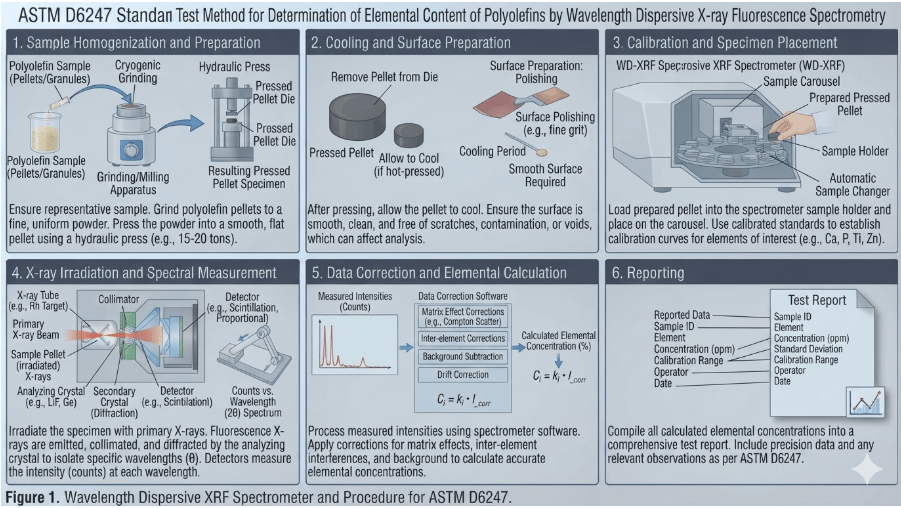
    Sample Homogenization and PreparationTechnicians homogenize the polyethylene or polypropylene sample using suitable melt-compounding equipment or another accepted preparation approach. Analysts weigh the required polymer mass and prepare a clean, uniform plaque using a thermal press and mold or an appropriate injection-molding process.
    Cooling and Surface PreparationSkilled personnel cool the plaque to produce a uniform surface and clean the analytical surface when required before measurement.
    Calibration and Specimen PlacementAnalysts establish calibration using appropriate elemental standards or reference materials with known elemental concentrations. Technicians position the polymer plaque in the WDXRF spectrometer with the analytical surface correctly aligned for measurement.
    X-ray Irradiation and Spectral MeasurementThe WDXRF system irradiates the specimen with primary X-rays, causing the elements in the polymer to emit characteristic fluorescent X-rays. Analysts measure the selected characteristic wavelengths and intensities for the elements of interest.
    Data Correction and Elemental CalculationThe instrumental drift, spectral overlap, and inter-element and matrix effects are corrected by skilled experts applying suitable correction procedures. Analysts convert the measured X-ray response into elemental mass fractions using the applicable calibration relationship.
    ReportingTechnicians document the specimen identification, type of polymer, elements measured, calibration data, analytical conditions, and calculated elemental concentrations.

    ASTM D6247 Testing Process and Data Collection 

    Technicians first homogenize the polyolefin and prepare a clean, uniform plaque. Analysts establish and verify the WDXRF calibration before placing the specimen in the spectrometer. The instrument emits primary X-rays onto the plaque and collects the characteristic fluorescent X-ray wavelengths and intensities from the elements chosen. Experts apply appropriate instrumental drift, spectral overlap, and interelement correction techniques. They then calculate the elemental mass fractions and record the polymer identification, analytical conditions, calibration information, and measured elemental concentrations.

    This image shows a wavelength-dispersive XRF spectrometer used to determine elemental content as per ASTM D6247.
    ASTM D6247 Testing Procedure Using a Wavelength-Dispersive XRF Spectrometer

    Common Challenges and Troubleshooting 

    To achieve accurate results, the specimen’s homogeneity, the thickness of the specimen, cleanliness of the surfaces, proper calibration, and control of spectral and matrix effects should be maintained. The uniform plaque should be prepared by the technician and should have no contact with analytical surfaces because contamination will affect the measurement of the elements. The analyst must confirm calibration and observe instrument drift prior to taking a measurement. Unexpected results should also be examined by skilled personnel for spectral overlaps, interelement effects, lack of specimen homogeneity, inappropriate thickness, contamination, etc.

    ASTM D6247 Analysis Results and Interpretation 

    The report summarizes the elemental content of the tested polyethylene or polypropylene specimen measured by WDXRF spectrometry. The results can facilitate the engineering assessment of the composition of additives, catalysts, reactors, and products and can be compared to applicable material specifications.

    Read more

    • The laboratory reports elemental content as mass fraction, typically in % or mg/kg, according to the applicable calibration range and reporting requirements. 
    • Technicians document the measured elemental concentrations together with the polymer type, specimen preparation conditions, and analytical conditions used for the WDXRF measurement. 
    • Analysts document the specimen identification, elements analyzed, calibration information, relevant spectral corrections, and observations concerning specimen homogeneity or surface condition. 
    • Engineers compare the measured elemental content with applicable material or product requirements to evaluate the tested polyolefin’s composition and additive or process-related elemental levels.

    Link to ASTM D6247

    FAQ

    What does ASTM D6247 measure?
    ASTM D6247 uses wavelength-dispersive X-ray fluorescence spectrometry to examine the elemental makeup of polyolefins.
    The method applies to polyethylene (PE) and polypropylene (PP) polyolefins.
    The method covers the determination of fluorine, sodium, magnesium, aluminum, silicon, phosphorus, sulfur, calcium, titanium, chromium, and zinc in the specified composition range.

    Updated on September 13, 2026

    Suyog Kamble
    About Author
    Suyog Kamble is an Operations Associate at Matestlab Inc. Suyog holds a postgraduate degree in organic chemistry and is trained in material science topics.
    Know More
    Testimonials
    Real results
    Engineers trust us with what matters most
    Start Your Testing
    Project Today
    Define your requirements and get access to
    specialized laboratories ready to deliver results
    Partners with us
    Clients
    Vendors
    Process for testing
    • STEP 01

      You share your testing requirements

    • STEP 02

      You share your sample(s)

    • STEP 03

      We deliver your test reports

    Get your testing done

    Let us know your testing requirements and we will be right back with a solution.

      Let us root for each other. Collaborate to grow, expand, and accelerate our businesses.

      Partner with us

        Discover more from Matestlab

        Subscribe now to keep reading and get access to the full archive.

        Continue reading