ASTM D6208 Standard Test Method for Repassivation Potential of Aluminum and Its Alloys by Galvanostatic Measurement

    What is ASTM D6208? 

    ASTM D6208 is a standard test method for determining the repassivation potential of aluminum and its alloys by galvanostatic polarization. The method specifically evaluates aluminum alloy 3003-H14 (UNS A93003) as a measure of relative susceptibility to pitting corrosion and guides similar measurements on other aluminum alloys and metals. During testing, technicians polarize an aluminum specimen at a fixed current density for 20 min in a coolant and corrosive-water solution containing chloride. Analysts record the potential as a function of time and determine the break potential and protection potential. ASTM D6208 (Standard Test Method for Repassivation Potential of Aluminum and Its Alloys by Galvanostatic Measurement) is also applicable for assessing inhibitors against pitting corrosion.

    Read more

    Get Certified ASTM D6208 Testing for Reliable Repassivation Potential Evaluation 

    The electrochemical behavior of aluminum when subjected to controlled galvanostatic polarization is determined by ASTM D6208. The technicians place an aluminum coupon into a coolant and corrosive-water solution with a constant current density. Technicians record the potential vs. time response and find out the range of max. and min. potential needed for the method. To obtain reliable and reproducible ASTM D6208 results, it is important that the specimen is prepared appropriately, the current is controlled, the position of the electrodes is correct, and the potential is recorded accurately.

    What is the scope of ASTM D6208? 

    ASTM D6208 specifies a method for assessing the repassivation potential of aluminum alloy 3003-H14 as a relative measure of susceptibility to pitting corrosion. The method involves galvanostatic polarization and measuring the electrical potential generated during the test. The method also guides similar measurements on other aluminum alloys and metals.

    Read more

    This standard includes:

    • Material type: Aluminum alloy 3003-H14 (UNS A93003) as the standard material, with guidance for similar testing of other aluminum alloys and metals. 
    • Purpose: Determine repassivation behavior and evaluate relative susceptibility to pitting corrosion. 
    • Property measured: Break potential, E_B, and protection or repassivation potential, E-G. 
    • Method: Galvanostatic polarization for 20 min at constant current density in corrosive water solution containing a coolant and chloride. 
    • Result: Maximum potential during initial polarization, minimum potential after reaching that maximum, and potential-time behavior. 
    • Test Limitations: The measurements are not intended to provide a quantitative correlation with other test methods or with localized corrosion susceptibility in service. The method is mainly used to assess the relative behavior in the given laboratory conditions. 
    • Environmental conditions: The controlled test solution is composed of coolant and corrosive water with chloride, sulfate, and bicarbonate, and the electrochemical configuration is maintained. 
    • Applications: Pitting-corrosion evaluation, inhibitor effectiveness studies, aluminum-alloy comparison, corrosion research, and electrochemical testing.

    What are the uses of ASTM D6208 testing? 

    ASTM D6208 testing allows laboratories to understand the behavior of aluminum alloys under conditions that can promote pitting corrosion. The method is especially useful for the study of corrosion inhibitors, as the protection potential is responsive to inhibitors’ performance. This standard-

    • Determines the break and protection potentials of aluminum. 
    • Evaluates relative susceptibility to pitting corrosion. 
    • Helps assess the effectiveness of corrosion inhibitors.
    • Facilitates comparison of corrosion behavior of aluminum alloys. 
    • Provides potential-versus-time data for electrochemical analysis. 
    • Supports coolant and corrosion research. 
    • Assists in visual examination of specimens to detect pitting and repassivation behavior.

    Which Materials Can Be Tested Under ASTM D6208? 

    ASTM D6208 refers to the AA3003-H14 (UNS A93003) standard aluminum alloy for precision and bias work. The standard also guides similar measurements on other aluminum alloys and metals. The working electrode is an aluminum coupon of 2 to 6 mm thick cut from sheet material.

    Why is ASTM D6208 important? 

    ASTM D6208 is a controlled electrochemical method for determining the susceptibility of the passive layer to breakdown and the ability of the aluminum surface to repassivate after localized corrosion. The maximum potential, E_B, refers to resistance to oxide-film breakdown, whereas the minimum potential after the maximum, E-G, gives information about protection against continued pitting.

    ASTM D6208 Equipment and Sample Preparation Guide 

    ASTM D6208 employs an electrochemical cell with a working electrode, auxiliary electrode, and reference electrode. In addition, apparatus must include a constant current supply and a recorder or appropriate potentiostat/galvanostat system. The standard working electrode is a 51 × 51 mm aluminum coupon from a 2-6 mm thick sheet.

    Read more

    Sample and Specimen DetailsAnalysts use AA3003-H14 aluminum as the standard working electrode. The test also guides other aluminum alloys and metals.
    Sample PreparationTechnicians rinse both sides of the aluminum coupon thoroughly with methanol and place it in a low-temperature drying oven. The standard does not require additional surface preparation.
    Specimen DimensionAluminum working electrode: 51 × 51 mm (2 × 2 in.), cut from sheet 2 to 6 mm thick.
    InstrumentationElectrochemical cell, constant-current supply, potential recorder or potentiostat/galvanostat, working electrode, auxiliary electrode, reference electrode, and Luggin probe.

    Testing Procedures and Requirements for ASTM D6208 

    ASTM D6208 polarizes the aluminum working electrode at a fixed current density for 20 min in a chloride-containing coolant/corrosive-water solution. Skilled experts record the potential continuously and determine the break and protection potentials from the resulting potential-time curve. Other reference ASTM documents include D1193, D3585, G3, G15, and G46. The complete procedure for ASTM D6208 is given below:

    Read more

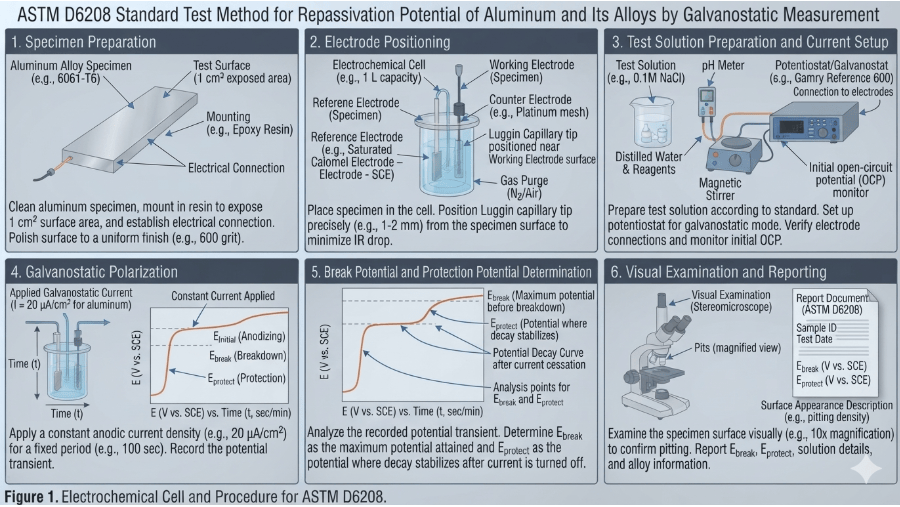
    Specimen PreparationTechnicians prepare the aluminum coupon by rinsing both sides with methanol and drying it in a low-temperature oven.
    Electrode PositioningAnalysts position the auxiliary electrode and Luggin probe at the specified distances from the working electrode to establish a consistent electrochemical configuration.
    Test Solution Preparation and Current SetupSkilled personnel prepare the coolant and corrosive-water test solution containing chloride and establish sufficient solution volume for the cell and Luggin probe. Technicians set the current generator to 872 μA, corresponding to a current density of approximately 100 μA/cm² for the specified working-electrode area.
    Galvanostatic PolarizationAnalysts apply the constant current to the aluminum specimen for 20 min while recording potential as a function of time.
    Break Potential and Protection Potential DeterminationSkilled experts calculate the maximum potential E-B achieved during the first polarization time interval or as applicable to the potential-time response. Analysts determine E-G, the minimum potential reached after the maximum potential, according to the observed potential-time curve.
    Visual Examination and ReportingTechnicians may rinse and examine the specimen for pits, pit depth, deposits, and surface discoloration to support interpretation of the electrochemical results. Analysts record the measured potentials, test configuration, specimen identification, current conditions, potential-time behavior, and visual observations.

    ASTM D6208 Testing Process and Data Collection 

    Technicians prepare the aluminum working electrode and the coolant/corrosive-water test solution. Analysts assemble the three-electrode cell and position the reference and auxiliary electrodes correctly. Skilled personnel apply a constant current of 872 μA, equivalent to approximately 100 μA/cm², for 20 min. The system preserves the potential as a function of time. From the potential-time curve, the maximum potential E_B and the next minimum potential E_G are identified. Technicians can then test the aluminum surface for pits, deposits, and discoloration as a supporting check for interpretation.

    This image depicts an electrochemical cell used to determine the repassivation potential of aluminum as per ASTM D6206.
    ASTM D6208 Testing Procedure Using Electrochemical Cell

    Common Challenges and Troubleshooting 

    The correct specimen preparation, positioning of electrodes, current control and potential recording are essential for obtaining accurate results. The technicians should clean the aluminum coupon in a consistent way without any unnecessary surface preparation that could have an impact on the passive film. The analyst should defoam the Luggin and assure the correct spacing of electrodes and correct current output prior to the test. Unusual potential-time curves should also be examined by skilled people and the pitting behavior should be distinguished from general corrosion or from unstable electrochemical conditions.

    ASTM D6208 Analysis Results and Interpretation 

    The report shows the electrochemical behavior of the aluminum specimen during galvanostatic polarization, and the break and protection potentials are determined. Based on these results, engineers can estimate passive-film breakdown resistance, progressive pitting resistance, and the relative activity of corrosion inhibitors.

    Read more

    • The laboratory reports E-B and E-G in V versus the standard hydrogen electrode (SHE) and records the applied current density in A/m².
    • Technicians document the highest voltage achieved during initial polarization, the lowest voltage after reaching the peak, polarization time, and test conditions.
    • Analysts record the specimen identification, alloy condition, electrode configuration, potential-time curve type, pit number, pit depth, deposits, or surface discoloration. 
    • Engineers use the potential and corrosion observed to compare against applicable inhibitor and material specifications to assess pitting initiation and protection.

    Link to ASTM D6208

    FAQ

    What does ASTM D6208 measure?
    ASTM D6208 determines the repassivation potential of aluminum and its alloys using galvanostatic polarization. It assesses relative susceptibility to pitting corrosion.
    The aluminum specimen is galvanostatically polarized for 20 minutes.
    The standard gives a constant current of 872 μA for the working-electrode area of 10 cm².

    Updated on September 13, 2026

    Suyog Kamble
    About Author
    Suyog Kamble is an Operations Associate at Matestlab Inc. Suyog holds a postgraduate degree in organic chemistry and is trained in material science topics.
    Know More
    Testimonials
    Real results
    Engineers trust us with what matters most
    Start Your Testing
    Project Today
    Define your requirements and get access to
    specialized laboratories ready to deliver results
    Partners with us
    Clients
    Vendors
    Process for testing
    • STEP 01

      You share your testing requirements

    • STEP 02

      You share your sample(s)

    • STEP 03

      We deliver your test reports

    Get your testing done

    Let us know your testing requirements and we will be right back with a solution.

      Let us root for each other. Collaborate to grow, expand, and accelerate our businesses.

      Partner with us

        Discover more from Matestlab

        Subscribe now to keep reading and get access to the full archive.

        Continue reading