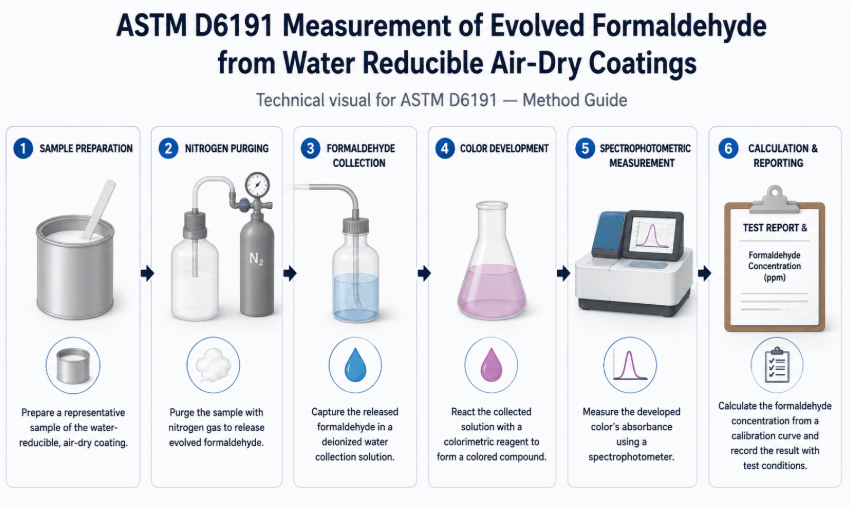
ASTM D6191 is a standard test method for determining the amount of formaldehyde released by water-reducible air-dry coatings, such as latexes, resin emulsions, or water-reducible alkyds. In this test procedure, the coating is purged with nitrogen gas to release formaldehyde, which is then scrubbed into deionized water, and the resulting concentration is measured using a colorimetric reaction with a spectrophotometer. Chemists and coating manufacturers apply ASTM D6191 (Standard Test Method for Measurement of Evolved Formaldehyde from Water Reducible Air-Dry Coatings) to determine how much “free” formaldehyde a coating actually evolves, along with other coating test methods used for paint and coatings quality control. Analysts then compare the measured formaldehyde level with a specified target or regulatory limit to decide whether the coating formulation is acceptable.
Get Certified ASTM D6191 Testing for Reliable Coatings Formaldehyde Data
Water-reducible coatings may contain residual formaldehyde from the manufacturing process or preservatives that were added, and the amount evolved from the coating during or after application is a factor in indoor air quality and regulatory compliance. ASTM D6191 provides chemists with an accurate way to measure the amount of formaldehyde that a coating actually releases instead of relying on the total amount of formaldehyde present in the coating. Chemists use ASTM D6191 results to support product safety, quality control, and regulatory compliance testing for formaldehyde emissions from coatings.