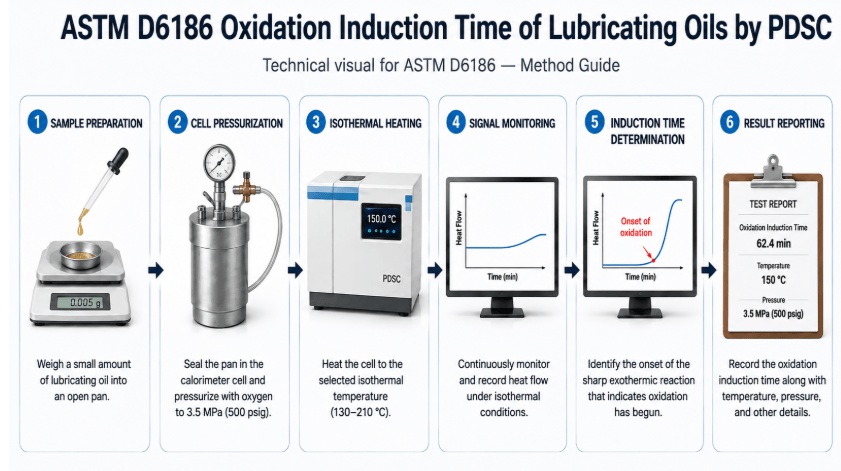
ASTM D6186 describes a standard test method for determining the oxidation induction time of lubricating oils using pressure differential scanning calorimetry. This procedure involves placing a small quantity of the oil under investigation in a pressure calorimeter cell at 3.5 MPa (500 psig) oxygen and heating it to an isothermal test temperature of 130 or 210 degrees Celsius to measure the time of heat evolution following an exothermic reaction. Chemists and lubricant formulators use ASTM D6186 (Standard Test Method for Oxidation Induction Time of Lubricating Oils by Pressure Differential Scanning Calorimetry (PDSC)) to determine the oxidation stability of a lubricating oil based on a rapid method requiring minimal amounts of test material, while also drawing on a range of materials testing services for lubricant quality assurance. Analysts can compare the oxidation induction time to that of a reference oil or specification to determine the oxidation resistance properties of an oil formulation.
Get Certified ASTM D6186 Testing for Reliable Lubricant Oxidation Stability Data
Lubricating oils are more prone to oxidation once it begins, which causes the formation of sludge, varnish, and other acidic by-products that can affect the performance of engines and other equipment. ASTM D6186 offers the chemical analyzer a rapid pressure differential scanning calorimetry method for estimation of oxidation stability of lubricants in considerably less time than other oxidation test methods. Chemists use ASTM D6186 results for research and development, quality control, and specification testing of an extensive range of lubricating oils.