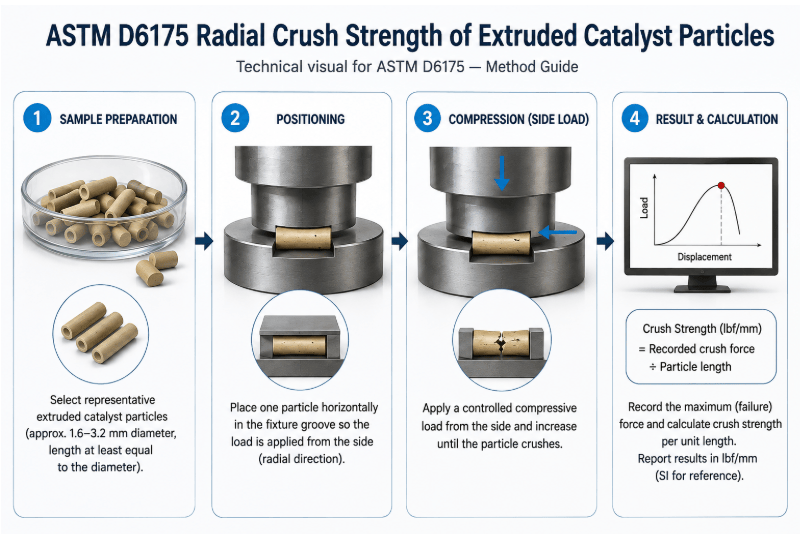
ASTM D6175 is the standard test method for radial crush strength of extruded catalyst and catalyst carrier particles. Analysts measure the crush strength of extruded catalytic particles by applying a compressive load laterally until failure and recording the load that caused breakage relative to the length of the extruded particle. Engineers and manufacturers use ASTM D6175 (Standard Test Method for Radial Crush Strength of Extruded Catalyst and Catalyst Carrier Particles) to confirm an extruded catalyst carrier support has sufficient resistance to unwanted crushing during processing and transfer within the reactor, supported by materials testing services to ensure catalyst and petrochemical quality control. Analysts relate the obtained crush strength to a minimum requirement to confirm the strength of a lot of catalyst for a specific application.
Get Certified ASTM D6175 Testing for Reliable Catalyst Strength Data
Extruded catalysts and catalyst carriers undergo a number of mechanical stresses throughout fabrication, transportation, charging, and operation within a reactor. Weak catalysts generate fines that raise the pressure drop of a catalyst bed. ASTM D6175 radial crush strength testing provides engineers with a compression test simulating the loading of an extruded catalytic particle laterally inside a reactor and determining the point of failure. Engineers use the results of the ASTM D6175 testing to compare catalyst grades, evaluate received lots, and confirm that a catalyst can withstand expected compressive forces during service.
What is the Scope of the ASTM D6175 Test Standard?
ASTM D6175 is the standard test method for radial crush strength of extruded catalyst and catalyst carrier particles. The test applies an increasing compressive force laterally to extruded catalytic particles until failure occurs. ASTM D6175 standard
- Determines the resistance of extruded catalyst and catalyst carrier particles to compressive force applied from the side.
- Applies to extruded particles roughly 1.6 to 3.2 mm in diameter with a length-to-diameter ratio of at least 1:1, though other diameters may also be tested with this method.
- Covers mean crush-strength values of between 0 and 15 lbf/mm (between 0 and 65 N/mm).
- Reports results as crush strength in terms of force per unit length instead of total force.
- Tests only radial, side-directed crushing, not axial, end-to-end crushing.
- Treats inch-pound units as standard, with SI values given for reference only.
What are the Uses of ASTM D6175 Testing?
ASTM D6175 testing helps engineers confirm that an extruded catalyst can hold together under the mechanical stress of loading, handling, and reactor operation. Manufacturers then use the results to compare catalyst formulations and screen out batches too weak for service. This standard-
- Determines whether an extruded catalyst meets the minimum requirements for crush strength.
- Supports comparison between different catalyst extrusion formulations or manufacturing batches.
- Assists manufacturers to estimate the likely performance of a catalyst under the compressive stress of a packed-bed reactor.
- Helps identify weak batches of catalyst that are likely to generate fines during service.
- Assists researchers developing new catalyst supports or carrier materials.
Which Materials Can Be Tested Under ASTM D6175?
ASTM D6175 is a test method for extruded catalyst particles of approximate diameter of 1.6 mm to 3.2 mm and length at least equal to the diameter. The test method covers the determination of crush strength for extruded catalyst particles. This refers to testing individual particles and not a bed of particles; the standard ASTM D7084 covers testing of a bed of extruded catalyst particles. An analyst takes a sample of extruded catalyst particles from a larger lot or from manufacturing and confirms that the sample meets the standard specifications before testing.
Why is ASTM D6175 Important?
ASTM D6175 testing provides a standard for manufacturers and refiners to indicate that an extruded catalyst can withstand the forces it is likely to experience in service. Catalysts with inadequate crush strengths will crush under the increased pressure of a packed bed reactor, forming undesirable fines that raise the pressure drop across the reactor bed and lead to frequent maintenance downtime. The radial crush strength, as defined by the ASTM D6175 standard, is crucial to the performance of a catalyst since it simulates the direction of the applied force on the catalyst particle, as opposed to the largely axial forces during normal operation in a reactor.