
ASTM D6129 Standard Test Method for Silicon in Engine Coolant Concentrates by Atomic Absorption Spectroscopy

    What is ASTM D6129?

    ASTM D6129 is a standard test method for silicon content in engine coolant concentrates using atomic absorption spectroscopy. Technicians dilute the coolant sample with water and prepare silicon calibration standards. Technicians measure silicon at a wavelength of 251.6 nm using a flame with a mixture of nitrous oxide and acetylene. Technicians determine the silicon concentration using flame atomic absorption spectroscopy (FAAS) by comparing the sample absorbance with a standard curve. The method applies to Engine Coolant Concentrates containing silicon from 200 to 500 ppm. Technicians can analyze samples of different sizes by appropriately adjusting the sample size. ASTM D6129 (Standard Test Method for Silicon in Engine Coolant Concentrates by Atomic Absorption Spectroscopy) helps meet coolant quality-control requirements, supports formulation evaluation, and assesses specification compliance. The standard uses SI units. 

    Read more

    Get Certified ASTM D6129 Testing Services

    ASTM D6129 testing determines the concentration of silicon in engine coolant concentrates and aids technicians. Technicians prepare the sample, make calibration standards, optimize the atomic absorption spectrometer, and measure the sample absorbance. Engineers use the results to assess coolant quality and compare the silicon content with the relevant specifications. The method uses a nitrous oxide-acetylene flame and a silicon hollow-cathode lamp. 
    What is the Scope of ASTM D6129? 

    ASTM D6129 provides a standard method for determining silicon in engine coolant concentrates using atomic absorption spectroscopy. The standard specifies sample preparation, instrument setup, calibration, and measurement procedures. This ASTM D6129 standard-

    Read more

    • Determines silicon in engine coolant concentrates from 200 ppm to 500 ppm.
    • Measures silicon using atomic absorption spectroscopy.
    • Requires an NOâ‚‚/acetylene flame for analysis.
    • Specifies SI units as the standard measurement units.
    • Allows analysis of coolants containing silicon outside the standard range by adjusting the sample size.
    • Requires the standard glycol concentration to match the sample solution under analysis.
    • Applies to both ethylene glycol and propylene glycol coolants.

    What are the Uses of ASTM D6129 Testing?

    ASTM D6129 testing helps laboratories determine the silicate level in engine coolants as silicon. Manufacturers and engineers use the results to control quality, validate formulations, and develop new products. This standard-

    • Measures the concentration of silicon in engine coolant concentrates.
    • Supports quality control in coolant manufacturing.
    • Validates coolant mixtures to ensure proper engine operation.
    • Checks silicon levels to avoid problems caused by excessive silicon content.
    • Supports research and development of coolant additives.
    • Supports monitoring of cooling-system performance.
    • Aids laboratory compliance testing and regulatory documentation

    What Materials Can Be Tested Under ASTM D6129? 

    ASTM D6129 applies to engine coolant concentrates that technicians can prepare for atomic absorption spectrophotometer testing. It covers both ethylene glycol and propylene glycol-based coolants. If technicians find the silicon content outside the range of 200 ppm to 500 ppm, they can analyze the sample with an appropriate sample size adjustment. Technicians ensure that the working standards and sample solution have the same glycol content.

    Why is ASTM D6129 Important? 

    ASTM D6129 is a standard method for determining silicon concentration in engine coolants by atomic absorption spectroscopy. Silicon is a vital ingredient in engine coolants used for corrosion protection and other parts of the coolant. This method quickly and accurately determines silicon content, thus providing consistent coolant quality and eliminating risks of improper silicon levels. The method allows an operator to perform fewer tasks, thus enabling it to support routine quality control and monitoring programs. The test results help manufacturers and engineers to confirm coolant formulations, compare different products, and ensure consistent performance. 

    ASTM D6129 Equipment and Sample Preparation Guide

    ASTM D6129 require an atomic absorption spectrometer that is fitted with a nitrous oxide-acetylene flame and a silicon hollow-cathode lamp. Other materials used by technicians are volumetric flasks, water, sodium hydroxide, ethylene glycol or propylene glycol, and silicon standards. 

    Read more

    Sample and Specimen DetailsTechnicians use representative engine coolant concentrate samples to determine their silicon content by atomic absorption spectroscopy. 
    Specimen PreparationTechnicians weigh 5 g of engine coolant concentrate to the nearest 0.001 g, transfer the sample to a 50 mL volumetric flask, dissolve it in water, and dilute it to the calibration range. 
    Specimen DimensionsAnalysts use a 50 mL volumetric flask for the standard sample preparation. 
    InstrumentationEngineers use an atomic absorption spectrometer with a nitrous oxide-acetylene flame and a silicon hollow-cathode lamp to measure silicon at 251.6 nm. 

     Testing Procedures and Requirements for ASTM D6129 

    The laboratory creates representative coolant samples and assesses the silicon content through atomic absorption spectroscopy. The laboratory measures the absorbance, compares it with the calibration standards, and calculates the silicon concentration.The ASTM D6129 test methods comprise the following test procedure-

    Read more

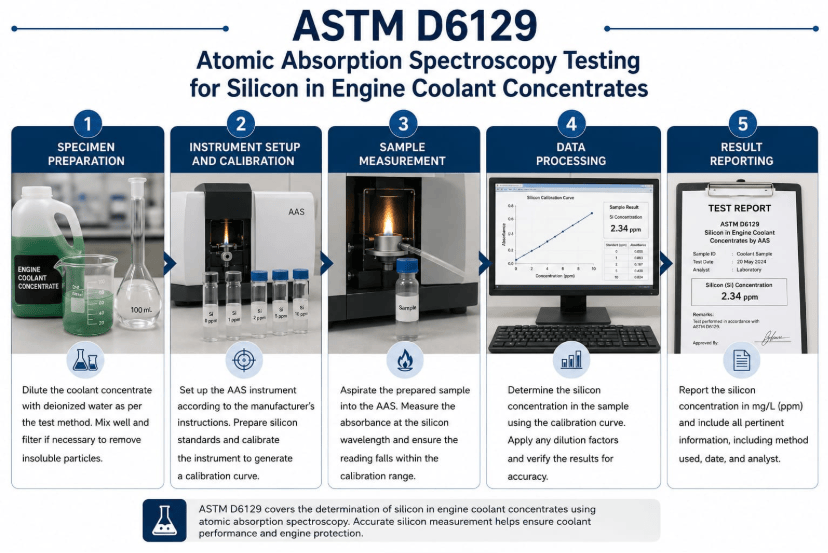
    Specimen Preparation & Conditioning Technicians weigh a 5 g ± 0.001 g sample and dilute it to 50 mL with water. They prepare working standards with glycol content matching the sample solution being analyzed.
    Instrument Setup & Calibration Technicians adjust the spectrometer to 251.6 nm wavelength and zero it using a standard solution. They establish a standard curve relating absorbance values to silicon concentrations 
    Sample Measurement Analysts measure the absorbance of the standards and sample solutions using the atomic absorption spectrometer with a nitrous oxide-acetylene flame 
    Data Processing Technicians plot the calibration curve and determine the silicon concentration from the sample absorbance relative to the curve.
    Result Reporting Laboratories report silicon concentration values in ppm, calibration curves, absorbance data, and compliance test documentation.

    ASTM D6093 Testing Process and Data Collection

    The technician determines the engine coolant concentrate by weighing a 5 g sample and then diluting it to 50 mL with water. The technician sets the atomic absorption spectrometer to 251.6 nm and zeros it with a standard solution. The technician prepares a standard curve by measuring the absorbances of standard solutions. The technician then measures the sample solution’s absorbance using a nitrous oxide-acetylene flame. The laboratory determines the silicon concentration from the calibration curve. The technicians record the absorbance measurement, concentration, specimen identification, and test conditions.

     This infographic shows silicon determination in engine coolant by atomic absorption spectroscopy, including specimen preparation, instrument setup and calibration, sample measurement, data processing, and result reporting.
    ASTM D6129 Atomic Absorption Spectroscopy Testing for Silicon in Engine Coolant Concentrates

    Common Challenges and Troubleshooting

    The ASTM D6129 test is not accurate when technicians perform improper sampling, use incorrect glycol matching of the standards, or calibrate the instruments improperly. The glycol level in the working standards should match the glycol level in the sample solution under analysis. This technique avoids reagent instability, which creates problems with photometric methods. Technicians always prepare the samples according to the standard and calibrate the spectrometer according to the standard. If technicians observe any significant difference between repeated measurements, the laboratory should confirm the validity of the sample preparation, instrument calibration, or measurement setup before reporting the final measurement. 

    ASTM D6093 Analysis Results and Interpretation

    The laboratory uses the results from atomic absorption spectroscopy to measure the silicon concentration of engine coolants. Engineers use the measured silicon content and then compare it to applicable specifications to assess the quality of the coolant and consistency of the formulation.

    Read more

    • The silicon concentration is the level of silicon in the engine coolant concentrate. The proper level of silicon is important for good corrosion protection and for optimum cooling system performance. The standard range of the laboratory is from 200 to 500 ppm and its concentration is reported in ppm.
    • Technicians use a nitrous oxide-acetylene flame to measure silicon at 251.6 nm and compare the absorbance with the calibration curve, which technicians create using silicon standards at 0, 20, 40, and 60 mg/L. Working standards should have the same glycol concentration as the sample solution to ensure an accurate measurement.
    • Analysts weigh 5 g of engine coolant concentrate and then dilute it with water to 50 mL for analysis. If the results are not within the standard range, technicians must adjust the sample quantity. Engineers determine coolant suitability by referencing product specifications, while manufacturers maintain quality by comparing final values with the product specifications.

    For the silicon determination, they use a nitrous oxide-acetylene flame.

    Link to  ASTM D6129

    FAQ

    What does ASTM D6129 determine?
    The silicon concentration of engine coolant concentrates is measured by atomic absorption spectroscopy per ASTM D6129. Technicians report the concentration in parts per million (ppm) based on the silicon response.
    ASTM D6129 covers engine coolant concentrates containing silicon levels between 200 and 500 ppm. If the silicon level falls outside this range, technicians can modify the sample quantity.
    Atomic absorption spectroscopy is used to measure silicon at a wavelength of 251.6 nm.

    Updated on September 9, 2026

    Suyog Kamble
    About Author
    Suyog Kamble is an Operations Associate at Matestlab Inc. Suyog holds a postgraduate degree in organic chemistry and is trained in material science topics.
    Know More
    Testimonials
    Real results
    Engineers trust us with what matters most
    Start Your Testing
    Project Today
    Define your requirements and get access to
    specialized laboratories ready to deliver results
    Partners with us
    Clients
    Vendors
    Process for testing
    • STEP 01

      You share your testing requirements

    • STEP 02

      You share your sample(s)

    • STEP 03

      We deliver your test reports

    Get your testing done

    Let us know your testing requirements and we will be right back with a solution.

      Let us root for each other. Collaborate to grow, expand, and accelerate our businesses.

      Partner with us

        Discover more from Matestlab

        Subscribe now to keep reading and get access to the full archive.

        Continue reading