
ASTM D6113 Standard Test Method for Using Cone Calorimeter to Determine Fire-Test-Response Characteristics of Insulating Materials Contained in Electrical or Optical Fiber Cables

    What is ASTM D6113? 

    ASTM D6113 describes a fire-test-response standard for using a cone calorimeter to measure the performance of insulating materials in electrical and optical fiber cables under a specified radiant heat flux. The method determines or computes fire-test-response properties such as time to sustained flaming, heat release rate, total heat released, effective heat of combustion, and specific extinction area. The test is quantitative and helps design and develop electrical and optical cables for fire response. ASTM D6113 (Standard Test Method for Using Cone Calorimeter to Determine Fire-Test-Response Characteristics of Insulating Materials Contained in Electrical or Optical Fiber Cables) ensures consistent evaluation of cable insulation fire performance through standardized testing procedures. 

    Read more

    Get Certified ASTM D6113 

    ASTM D6113 is a controlled test of the fire response of insulating material from electrical or optical fiber cables. The cone calorimeter applies a defined radiant heat flux to the sample and measures the fire-response properties that it produces. However, quantitative heat-release measurements help compare insulating materials and assess changes resulting from component changes or composite constructions. The results help with product development and cable design studies. 
    What is the Scope of ASTM D6113? 

    ASTM D6113 determines the fire-test response of insulating material installed within electrical or optical fiber cables that are exposed to radiant heat. This standard-

    Read more

    • Determines the time to sustained flaming.
    • Measures the amount of heat produced.
    • Calculates overall heat emitted.
    • Calculates efficient heat of combustion.
    • Determines specific extinction area.
    • Uses a constant radiant heat flux.
    • Tests electrical insulating materials in electrical or optical fiber cables. 

    What are the Uses of ASTM D6113 Testing?

    ASTM D6113 is a fire test for cable insulating materials that provides quantitative data on their fire response. Laboratories use the results to test material changes and to compare fire performance in a controlled cone calorimeter. This standard-

    • Assists in electrical and optical cable design.
    • Supports product development.
    • Aids in the comparison of changes in fire performance.
    • Gives quantitative data on heat release.
    • Aids in the classification of the fire response of cable insulating materials. 

    What Materials Can Be Tested Under ASTM D6113? 

    The test method applies to insulating materials used in electrical or optical fiber cables. The tests include a burning test of the electrical insulating materials in the cables when technicians subject the cable test specimens (excluding accessories) to radiant heat. Factors that influence fire-test response characteristics include the thickness of the material used as a test specimen (whether as a plaque or as a coating on a wire or cable) and the diameter of the wire or cable.

    Why is ASTM D6113 Important? 

    ASTM D6113 provides quantitative data on the fire response of the insulating components of electrical and optical cables. This method enables laboratories to determine several fire-response properties under controlled radiant exposure. It is used as a tool to detect alterations in fire performance after altering single components or composite cable structures. Additionally, according to ASTM, the fire-test-response characteristics vary depending on specimen thickness and the diameter of the cable/wire. 

    ASTM D6113 Equipment and Sample Preparation Guide

    The ASTM D6113 test method uses a cone calorimeter apparatus to apply a specified radiant heat flux to the cable’s insulating material and observe its fire behavior. The configuration of the specimen follows the requirements of the current standard. 

    Read more

    Sample and Specimen DetailsTechnicians use cable specimens containing insulating materials from electrical or optical fiber cables. They prepare specimens excluding accessories. 
    Specimen PreparationTechnicians prepare cable specimens of appropriate length and configuration for the cone calorimeter. They may test specimens as plaques or as coating on a wire or cable. 
    Specimen DimensionsTechnicians typically prepare specimens as 100 mm by 100 mm sections, up to 50 mm thick, and can test them in either horizontal or vertical orientation. 
    InstrumentationTechnicians use a cone calorimeter apparatus with a truncated cone heater, an oxygen consumption measurement system, a load cell for mass loss measurement, a smoke measurement system, and a data acquisition system to record fire-test-response characteristics. 

    Testing Procedures and Requirements for ASTM D6113  

    Technicians install the prepared cable specimen in the cone calorimeter and subject it to a defined constant radiant heat flux. The apparatus measures the response to fire as the insulating material burns in the controlled test conditions. The laboratory uses test data to determine the time to sustained flaming, heat release rate, total heat released, effective heat of combustion, and specific extinction area. ASTM D6113 testing process is as follows-

    Read more

    Specimen Preparation and Mounting Technicians prepare cable specimens of appropriate length and configuration and mount them in the cone calorimeter specimen holder. 
    Radiant Heat Exposure Technicians expose the specimen to a constant radiant heat flux using the cone heater. They can test the specimen in horizontal or vertical orientation with heating fluxes from 0 to over 100 kW/m². 
    Ignition and Data Collection The system measures time to sustained flaming, heat release rate, total heat released, effective heat of combustion, and specific extinction area during the test. 
    Data Analysis Technicians analyze the collected data to determine the fire-test-response characteristics using oxygen consumption calorimetry principles. 
    Result Reporting Laboratories report fire-test-response characteristics in SI units. 

    ASTM D6113  Testing Process and Data Collection

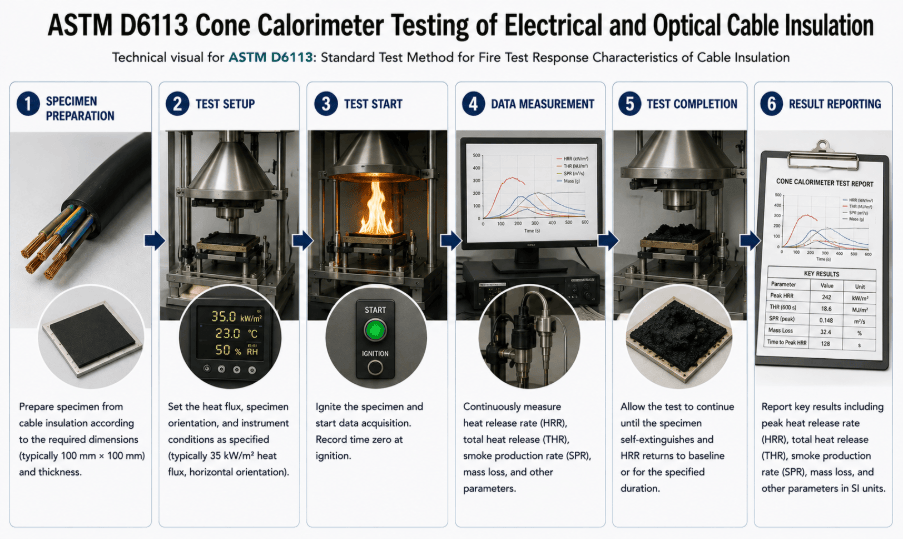
    Technicians prepare the cable test specimen and subject the cable’s insulating material to a specified constant radiant heat flux in the cone calorimeter. The apparatus keeps track of the fire response during the exposure. The laboratory records the data required to determine time to sustained flaming, heat release rate, total heat released, effective heat of combustion, and specific extinction area. The analyst then compares those measurements to determine the fire response of the tested insulating material. 

     The image shows a cone calorimeter being used to evaluate the fire-test-response characteristics of insulating material contained in an electrical or optical fiber cable.
    ASTM D6113 Cone Calorimeter Testing of Electrical and Optical Cable Insulation

    Common Challenges and Troubleshooting

    Accurate results require consistent specimen preparation, controlled radiant exposure, and proper operation of the cone calorimeter. Technicians maintain the specified test conditions throughout the measurement. The laboratory should also take into account the thickness of the specimen and the diameter of the cable or wire, as these influence fire-test-response results. 

    ASTM D6113 Analysis Results and Interpretation

    The laboratory reports fire-test-response characteristics measured or calculated during the cone-calorimeter exposure.

    Read more

    • The technician records the time required for the tested insulating material to sustain a flaming burn.
    • The analyst determines the heat release rate and total heat released from the measured fire response.
    • The laboratory determines the effective heat of combustion and specific extinction area according to the applicable procedure.
    • The engineer considers the specimen thickness and the wire or cable diameter when interpreting the measured fire-response characteristics, as the ASTM does.
    • Engineers use the resulting fire-response data to support cable design, product development, and comparison of changes in fire performance under controlled test conditions. 

    Link to ASTM D6113

    FAQ

    What materials are covered under ASTM D6113?
    This test method applies to insulating materials found in electrical or optical fiber cables. When technicians expose cable test specimens (excluding accessories) to radiant heat, they burn the electrical insulating materials within them.
    The method determines the time to sustained burning, heat release rate, total heat released, effective heat of combustion, and specific extinction area at a constant radiant heat flux.
    The cone calorimeter is a second-generation rate of heat release device based on the oxygen consumption calorimetry theory. The device exposes specimens to heating fluxes ranging from 0 to more than 100 kW/m² using a heater shaped like a truncated cone.

    Updated on September 6, 2026

    Gokula Srinivasan Selvam
    About Author
    Gokula Srinivasan Selvam is a Material Testing Associate at Matestlab Inc. and holds a postgraduate degree in Ceramic Engineering from IIT (BHU), Varanasi. His academic background and professional experience are centered on advanced ceramic materials, their processing, characterization, and performance evaluation.
    Know More
    Testimonials
    Real results
    Engineers trust us with what matters most
    Why Choose Matestlab?
    Matestlab is a unified testing services partner based in the USA. Matestlab offers raw material and product testing services through accredited, expert laboratories primarily based in the USA. Matestlab supports physical, thermal, chemical, electrical, mechanical, environmental, and characterization testing needs through its global network of 2200+ accredited testing laboratories. Matestlab's in-house materials science experts curate and design comprehensive testing programs matched to the sample material and specific testing need, with regulatory requirements and confidentiality in mind.

    If you are looking for a managed and trusted testing partner to achieve your research goals, feel free to schedule a meeting with us or send us a request at connect@matestlabs.com to learn more about our services. For a quick quote, call us at (302)244-7710. We are happy to serve you.
    Start Your Testing
    Project Today
    Define your requirements and get access to
    specialized laboratories ready to deliver results
    Partners with us
    Clients
    Vendors
    Process for testing
    • STEP 01

      You share your testing requirements

    • STEP 02

      You share your sample(s)

    • STEP 03

      We deliver your test reports

    Get your testing done

    Let us know your testing requirements and we will be right back with a solution.

      Let us root for each other. Collaborate to grow, expand, and accelerate our businesses.

      Partner with us