
ASTM D6099 Standard Test Method for Polyurethane Raw Materials: Determination of Acidity in Moderate to High Acidity Aromatic Isocyanates

    What is ASTM D6099? 

    ASTM D6099 measures the acidity of aromatic isocyanate samples and reports the measurement as parts per million (ppm) of HCl. The method applies to samples with an acidity of more than 100 ppm and covers products based on toluene diisocyanate (TDI) or methylene-bis-(4-phenylisocyanate) (MDI). The method provides a standardized approach for characterizing moderate- to high-acidity aromatic isocyanates and prepolymers. ASTM D6099 (Standard Test Method for Polyurethane Raw Materials: Determination of Acidity in Moderate to High Acidity Aromatic Isocyanates) also states that acidity can correlate with performance in some polyurethane systems. 

    Read more

     Get Certified ASTM D6099 

    ASTM D6099 is a standard method for characterizing moderately-to-highly-acidic aromatic isocyanates and prepolymers. This method involves forming the urethane with excess methanol and cosolvent, producing further acid as part of the urethane reaction and potentiometrically titrating the acid with methanolic KOH. Reliable testing helps laboratories determine acidity as ppm HCl and generate data for research and quality-control applications. The measured acidity can also correlate with performance in some polyurethane systems.

    What is the Scope of ASTM 6099? 

    ASTM D6099 measures the acidity of aromatic isocyanates and reports the result in ppm of HCl. This standard-

    • Measures the acidity of aromatic isocyanate samples.
    • Represents acidity in terms of the number of ppm of HCl.
    • Applies to samples with acidity greater than 100 ppm.
    • Provides products based on toluene diisocyanate.
    • Covers products containing methylene-bis-(4-phenylisocyanate).
    • Supports characterization of moderate-high acid aromatic isocyanates.
    • Equivalent to ISO 14898, Test Method A. 

    What are the Uses of ASTM D6099 Testing?

    ASTM D6099 testing helps laboratories to characterize aromatic isocyanates and prepolymers with moderate to high acidity. Manufacturers and laboratories use the results for research and quality-control purposes. This standard-

    • Evaluates the acidity of aromatic isocyanates.
    • Supports quality-control in isocyanate manufacturing
    • Supports research applications.
    • Supports the characterization of raw materials used for the manufacture of polyurethane.
    • Provides acidity data which may correlate with the performance of some polyurethane systems. 

    What Materials Can Be Tested Under ASTM D6099? 

    ASTM D6099 is used for samples of aromatic isocyanates containing more than 100 ppm of acidity. The method includes products based on toluene diisocyanate (TDI) and methylene-bis-(4-phenylisocyanate) (MDI). 

    Why is ASTM D6099 Important? 

    ASTM D6099 is important because it provides a consistent method for determining acidity in aromatic isocyanates and prepolymers with moderate to high acidity. The standard identifies acidity as acid strength in ppm HCl. The method involves reacting the isocyanate with an excess of methanol and cosolvent, followed by potentiometric titration with methanolic KOH to determine the liberated acid. This method provides a laboratory with a measurable value of acidity for research and quality control uses. 
    ASTM D6099 Equipment and Sample Preparation Guide

    ASTM D6099 requires automatic titration equipment, a pH glass electrode or combination pH electrode, a magnetic stirrer, stir bars, watch glasses, and an analytical balance. The standard also specifies methanolic KOH, dried toluene or 1,2,4-trichlorobenzene, and anhydrous methanol as materials. 

    Read more

    Sample and Specimen Details Technicians use representative samples of aromatic isocyanates or prepolymers derived from TDI or MDI with acidity greater than 100 ppm.  
    Specimen Preparation Technicians prepare the isocyanate sample by dissolving it in a suitable solvent system. They add excess methanol and a cosolvent to the sample. 
    Specimen Dimensions The method specifies sample mass for the titration procedure. The test uses Class A volumetric pipets (50-mL and 100-mL) for accurate measurement.
    Instrumentation The test uses potentiometric titration equipment with a pH meter or automatic titrator, a burette for methanolic KOH titrant, and appropriate glassware for sample preparation and titration.

    Testing Procedures and Requirements for ASTM D6099 

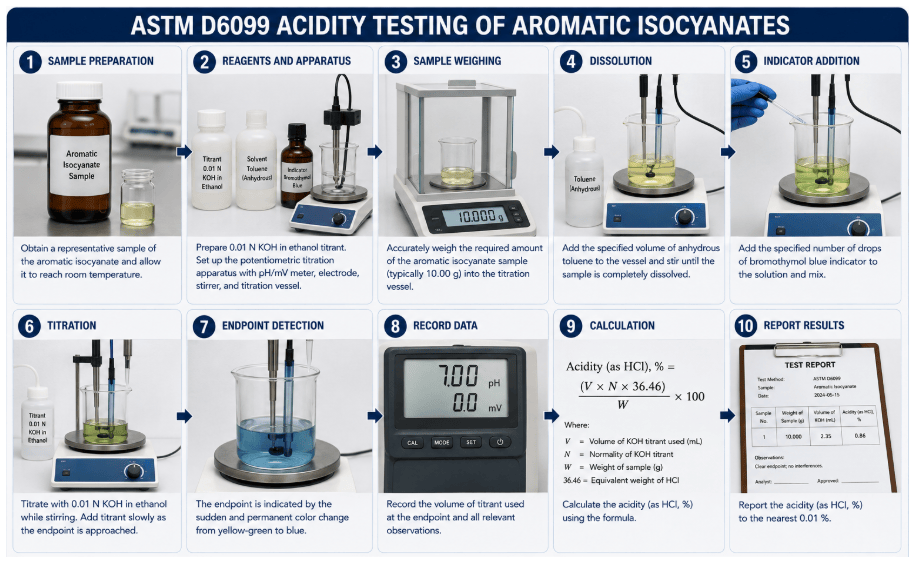
    The sample is precisely weighed and then added to dried 1,2,4-trichlorobenzene or toluene and methanol. They add a stir bar, cover the beaker, and stir for 20 minutes. The standard requires all samples to undergo testing in duplicate. The mixture is then automatically titrated with 0.02 N methanolic KOH to an inflection point in the apparent pH range from 4 to 9, as determined potentiometrically. The titration result determines the acidity of the isocyanate sample. 

    Sample Weighing Technicians accurately weigh 10 g of the isocyanate sample (to the nearest 1 mg) into a 250-mL beaker. 
    Solvent Addition & Stirring Technicians add 50 mL of dried toluene or TCB and 100 mL of methanol into the solution. They then add a stir bar, cover with a watch glass, and stir for 20 minutes. 
    Titration Technicians titrate the mixture with 0.02 N methanolic KOH through the potentiometrically determined inflection endpoint between apparent pH 4 and 9. 
    Acidity Calculation Technicians calculate the acidity from the titer and express results as parts per million (ppm) of HCl. 
    Result Reporting Laboratories report acidity values in ppm HCl, sample mass, titrant volume, and testing conditions.

    ASTM D6099 Testing Process and Data Collection

    Technicians accurately weigh 10 g of sample into a 250-mL beaker and add 50 mL of dried toluene or 1,2,4-trichlorobenzene followed by 100 mL of methanol. They mix the solution for 20 min before titration. Automatic titration of the sample with 0.02 N methanolic KOH to identify the potentiometric inflection endpoint. Technicians complete each determination in duplicate and calculate the acidity from the titration result, reported in ppm HCl. Moisture control is also important because organic isocyanates react with moisture in the air. The standard therefore requires careful sampling and moisture exclusion during testing. 

    The image shows a laboratory setup for determining the acidity of an aromatic isocyanate sample by potentiometric titration.
    ASTM D6099 Acidity Testing of Aromatic Isocyanates

    Common Challenges and Troubleshooting

    Accurate results require proper sample preparation, suitable equipment, accurate weighing, and careful control of moisture. Organic isocyanates can react with atmospheric moisture and cause urea contamination that can be insoluble and cause problems for technicians. The technicians calibrate the electrodes using aqueous buffers of pH 4 and pH 7, and ensure that the samples are at room temperature before titration.

    ASTM D6099 Analysis Results and Interpretation

    This standard measures the acidity of the tested aromatic isocyanate or prepolymer. ASTM D6099 addresses the acidity rather than a general overall material-performance rating.

    Read more

    • The laboratory reports acidity in units of parts per million (ppm) HCl.
    • The technician determines the tested material, whether an aromatic isocyanate derived from TDI or MDI.
    • The analyst notes the acidity, which is used under the specified laboratory conditions, and compares it to the tested material and its condition.
    • Engineers consider factors such as moisture content, sample handling, and titrant preparation when interpreting acidity results for polyurethane applications.
    • The measured acidities are utilized in polyurethane systems for quality control, research, and performance evaluation. 

    Link to ASTM D6099

    FAQ

    Why is ASTM D6099 important?
    The acidity of isocyanates impacts the performance of polyurethane systems. The standardized test helps to maintain the quality uniformity of products and to guarantee the specification requirements of polyurethane raw material manufacturers.
    This test method applies to all aromatic isocyanates and prepolymers containing aromatic isocyanates having an acidity greater than 100 ppm HCl.
    The method measures the acidity of moderate- to high-acidity aromatic isocyanates in parts per million (ppm) as HCl.

    Updated on September 5, 2026

    Laraib Hashmi
    About Author
    Laraib Hashmi is an aspiring research enthusiast and science content professional with a strong interdisciplinary skill set, holding a postgraduate degree in Applied Microbiology from KIIT Bhubaneshwar, Odisha.
    Know More
    Testimonials
    Real results
    Engineers trust us with what matters most
    Start Your Testing
    Project Today
    Define your requirements and get access to
    specialized laboratories ready to deliver results
    Partners with us
    Clients
    Vendors
    Process for testing
    • STEP 01

      You share your testing requirements

    • STEP 02

      You share your sample(s)

    • STEP 03

      We deliver your test reports

    Get your testing done

    Let us know your testing requirements and we will be right back with a solution.

      Let us root for each other. Collaborate to grow, expand, and accelerate our businesses.

      Partner with us

        Discover more from Matestlab

        Subscribe now to keep reading and get access to the full archive.

        Continue reading