
ASTM D6097 Standard Test Method for Relative Resistance to Vented Water-Tree Growth in Solid Dielectric Insulating Materials

    What is ASTM D6097? 

    ASTM D6097 describes a standard test method to determine the relative resistance of solid dielectric insulating materials to vented water-tree growth. The method is a controlled laboratory procedure that allows comparison of insulating-material behavior under conditions that encourage water-tree development. Two types of water-trees form: bow-tie trees within the dielectric and vented water-trees formed from the conductive/insulating material interface into the insulating material. The test is helpful for laboratories to characterize the water-treeing resistance of solid dielectric insulators and for comparing the water-treeing resistance of various insulating materials for electrical applications. 

    Read more

     Get Certified ASTM D6097 Testing for Reliable Cable Insulation Performance 

    ASTM D6097 is a standard method used for comparing solid dielectric insulating materials under conditions that facilitate vented water-tree growth. The method is based on the relative resistance of the materials, rather than establishing an absolute service-life prediction. A reliable test provides comparative data for laboratories to use for material development, quality-control programs, and evaluation of dielectric insulation materials. 
    What is the Scope of ASTM D6097? 

    ASTM D6097 measures the relative resistance to vented water-tree growth of solid dielectric insulating materials. The test method is especially applicable to extruded polymeric insulation materials used in medium-voltage cables.  This standard-

    Read more

    • Evaluates resistance to vented water-tree growth.
    • Applicable to solid dielectric insulating materials.
    • Provides a comparative laboratory test method.
    • Evaluates water-tree growth under laboratory conditions.
    • Supports comparisons of various insulating materials.
    • Provides information for evaluating dielectric insulation performance. 

    What are the Uses of ASTM D6097 Testing?

    ASTM D6097 testing is used to provide a means for comparing the resistance of solid dielectric insulating materials to vented water-tree growth in laboratories. This standard-

    • Comparatively evaluates dielectric insulation.
    • Assists in describing resistance to water-tree growth.
    • Supports material-development studies.
    • Helps conduct quality-control assessments.
    • Assists laboratories in comparing insulating materials under controlled conditions. 

    What Materials Can Be Tested Under ASTM D6097? 

    ASTM D6097 applies to solid translucent thermoplastic or cross-linked electrical insulating materials, especially extruded polymeric insulation materials used in medium-voltage cables. The test method compares these materials in terms of resistance to vented water trees under the test conditions. 

    Why is ASTM D6097 Important? 

    ASTM D6097 is significant because water tree growth impacts the performance of solid dielectric insulation. The standardized procedure enables laboratories to compare materials under controlled conditions that facilitate water-tree development. This comparative data is helpful for engineers and material specialists to assess the difference in resistance between the various dielectric insulating materials. 

    ASTM D6097 Equipment and Sample Preparation Guide

    The laboratory creates solid dielectric samples, as per the needs of the test method, and submits them to the specified water-treeing situation. The test setup maintains the necessary electrical, environmental, and specimen conditions during exposure. 

    Read more

    Sample and Specimen Details Technicians use representative samples of solid translucent thermoplastic or cross-linked electrical insulating materials. The material must be translucent and suitable for optical observation of water-trees after staining. 
    Specimen Preparation Technicians prepare the insulating material specimen with a sharp protrusion at the insulating and conductive interface to simulate a defect that initiates water-tree growth. The specimen must be prepared to allow contact with the salt solution on both sides. 
    Specimen Dimensions The vented water-tree growth procedure recommends disc specimens 1 inch (25.4 mm) in diameter and 250 mils (6.35 mm) thick, with a standard conical defect. The resulting disc samples have a diameter of approximately 25.4 mm, a thickness of approximately 6.4 mm, and a needle depth of approximately 3.2 mm. 
    Instrumentation Technicians use a water-electrode system with salt solution, an AC voltage source (1 kHz frequency), temperature control equipment, and optical microscopy equipment for measuring water-tree length after staining.

    Testing Procedures and Requirements for ASTM D6097

    Technicians prepare the dielectric specimens and establish the specified conditions for vented water-tree growth. The test subjects the specimens to the controlled conditions as specified in the method for the specified period. Technicians then inspect the specimens and measure the level of water-tree growth as in the standard. 

    Read more

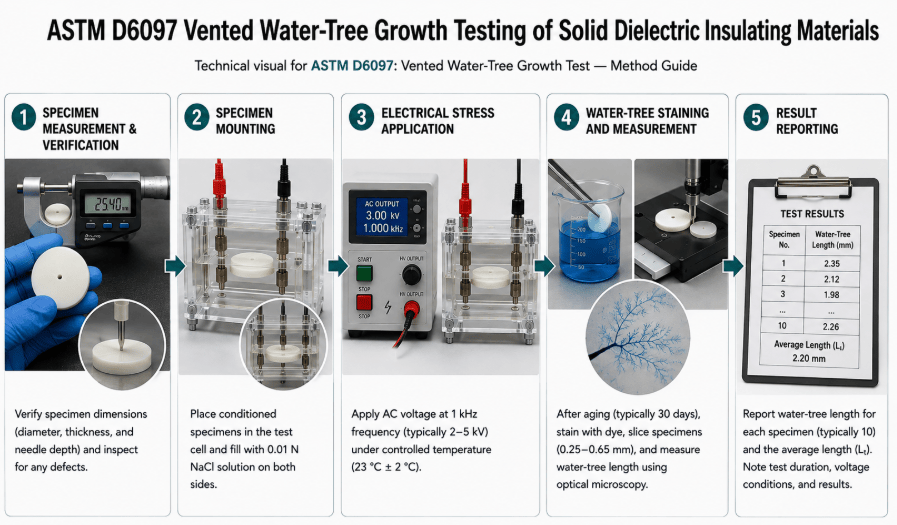
    Specimen Measurement and Verification Technicians verify specimen dimensions (diameter, thickness, and needle depth) and inspect for any surface defects or contamination before testing. 
    Specimen Mounting Technicians place the conditioned specimens in the test cell with 0.01 N sodium chloride solution on both sides. 
    Electrical Stress Application Technicians apply AC voltage at 1 kHz (typically 2–5 kV) at a controlled temperature (23 °C ± 2 °C). 
    Water-Tree Staining and Measurement After aging (typically 30 days), technicians remove the specimens, stain the oxidized regions with dye (e.g., methylene blue), and slice the specimens to 0.25–0.65 mm thickness. They measure water-tree length using optical microscopy. 
    Result Reporting Laboratories report water-tree length measurements for each sample (typically 10 specimens) and report the average length (Lt). They also note test duration, voltage conditions, and comparative performance data in SI units. 

    ASTM D6097 Testing Process and Data Collection

    Technicians prepare the solid dielectric specimens and set up the electrical and environmental parameters required by the test method. They expose the specimens for a certain number of days to encourage vented water-tree growth. The laboratory then examines the specimens and records the measurements needed for water-tree evaluation after exposure. Engineers use the resulting data to compare the relative resistance of the tested insulating materials to vented water-tree growth. 

    The image shows laboratory testing of a solid dielectric insulating specimen under controlled conditions to evaluate its relative resistance to vented water-tree growth.
    ASTM D6097 Vented Water-Tree Growth Testing of Solid Dielectric Insulating Material

    Common Challenges and Troubleshooting

    Accurate comparative results require consistent specimen preparation and controlled exposure conditions. Technicians maintain the specified test conditions and test specimen configuration during the whole procedure. Regular testing and measurement of water-tree growth help laboratories make meaningful comparisons among various types of dielectric materials. 

    ASTM D6097 Analysis Results and Interpretation

    The laboratory reports summarize the measurements obtained from the evaluation of vented water-tree growth in the tested solid dielectric insulating material.

    Read more

    • The technician records the measured water-tree growth after the required exposure period. 
    • The analyst assesses the observed water-tree development according to the measurement method specified in the standard.
    • The engineer compares the measured results among the various dielectric materials tested to come up with the relative resistance to water-treeing of the materials.
    • Engineers use the comparative results to support evaluation and development of solid dielectric insulating materials. 

    Link to ASTM D6079

    FAQ

    What is ASTM D6097?
    ASTM D6097 is a standard method used for comparing solid dielectric insulating materials under conditions that facilitate vented water-tree growth.
    This test method is suitable for all solid translucent thermoplastic and crosslinked electrical insulating materials, particularly polymeric insulation materials extruded in the medium-voltage cable industry.
    Standard test conditions are a 1 kHz frequency, temperature control, and a specified salt solution. For materials that are more resistant, longer times (180 days) or higher voltage (10 kV or 15 kV) may be needed.
    Gokula Srinivasan Selvam
    About Author
    Gokula Srinivasan Selvam
    Gokula Srinivasan Selvam is a Material Testing Associate at MaTestLab Inc. and holds a postgraduate degree in Ceramic Engineering from IIT (BHU), Varanasi.
    Testimonials
    Real results
    Engineers trust us with what matters most
    Start Your Testing
    Project Today
    Define your requirements and get access to
    specialized laboratories ready to deliver results
    Partners with us
    Clients
    Vendors
    Process for testing
    • STEP 01

      You share your testing requirements

    • STEP 02

      You share your sample(s)

    • STEP 03

      We deliver your test reports

    Get your testing done

    Let us known your testing requirements and we will be right back with a solution.

      Let us root for each other. Collaborate to grow, expand, and accelerate our businesses.

      Partner with us

        Contact Us

        Discover more from Matestlab Inc

        Subscribe now to keep reading and get access to the full archive.

        Continue reading