
ASTM D6093 describes a standard test method for determining percent volume nonvolatile matter in clear or pigmented coatings using a helium gas pycnometer. This test method determines the percent volume nonvolatile matter of a range of clear and pigmented coatings. The approach provides results more quickly and accurately than the liquid displacement technique, especially when the coating is difficult to wet or contains voids, cracks, or other forms of defects. The improved accuracy stems from helium gas under pressure penetrating very small pores and surface irregularities in dried films. This provides a more accurate determination of void volumes than liquid displacement can obtain. The method applies to liquid coatings, resins, and other materials where volatiles and non-volatiles affect performance.
ASTM D6093 Standard Test Method for Percent Volume Nonvolatile Matter in Clear or Pigmented Coatings Using a Helium Gas Pycnometer
What is ASTM D6093?
What is the Scope of ASTM D6093?
ASTM D6093 specifies the percent volume nonvolatile matter of a variety of clear and pigmented coatings using the helium gas pycnometer. The helium gas pycnometer has a stability of ±0.005 cm³, and the test specimen weight is more than 1 g with this technique. The ASTM D6099 standard-
- Measures the acidity of an aromatic isocyanate sample.
- Expresses acidity in terms of number of ppm of HCl.
- Applies to samples with acidity greater than 100 ppm.
- Covers products derived from toluene diisocyanate.
- Provides coverage for products made from methylene bis-(4-phenylisocyanate).
- Supports characterization of aromatic isocyanates with moderate to high acidity.
What are the Uses of ASTM D6093 Testing?
ASTM D6093 testing helps coating manufacturers determine percent volume nonvolatile matter in coatings. Formulators use these results to determine VOC content, estimate coverage, and optimize formulations. This standard-
- Measures volume nonvolatile matter using a helium gas pycnometer
- Provides faster and more accurate results than liquid displacement
- Allows for VOC content calculation for regulatory compliance
- Estimates coating coverage at specified dry film thickness
- Assists in developing and quality controlling formulations
- Determines dry film density and void volume
- Requires minimal sample quantity (1–5 g)
- Uses a pycnometer with stability greater than ±0.005 cm³
What Materials Can Be Tested Under ASTM D6093?
ASTM D6099 applies to samples of aromatic isocyanate having greater than 100 ppm acidity. The method applies to products containing toluene diisocyanate (TDI) and methylene-bis-(4-phenylisocyanate) (MDI).
Why is ASTM D6093 Important?
ASTM D6099 is significant because it offers a standardized procedure for measuring the acidity of aromatic isocyanates and prepolymers of moderate to high acidity. The standard defines acidity as acid strength expressed in ppm HCl. This method involves mixing the isocyanate with excess methanol and cosolvent, and free acid is titrated with methanolic KOH. This method provides laboratories with a measurable acidity value for research and quality control purposes.
ASTM D6093 Equipment and Sample Preparation Guide
The ASTM D6099 requires automatic titration equipment, a pH glass electrode or combination pH electrode, a magnetic stirrer, stir bars, watch glasses, and an analytical balance. Other materials mentioned in the standard are methanolic KOH, dried toluene or 1,2,4-trichlorobenzene, and anhydrous methanol.
| Sample and Specimen Details | Technicians use representative samples of clear or pigmented coatings, resins, or similar materials. The sample must represent the material being tested. |
| Specimen Preparation | Technicians weigh a portion of the coating sample (greater than 1 g) into the pycnometer cell and evaporate the volatiles under specified conditions to form a dried film. The helium gas pycnometer has stability greater than ±0.005 cm³. |
| Specimen Dimensions | Sample size depends on mass, not physical dimensions. Test specimen weights must be greater than 1 g. The method requires a minimal sample quantity of 1–5 g. |
| Instrumentation | Technicians use a helium gas pycnometer with stability greater than ±0.005 cm³, a precision analytical balance (accuracy ±0.0001 g), a forced-air drying oven (110 ± 5 °C), sample containers, and data processing software. |
Testing Procedures and Requirements for ASTM D6093
Technicians accurately weigh the sample and mix it with dried toluene or 1,2,4-trichlorobenzene and methanol. They stir the mixture for 20 min after adding a stir bar and then cover the beaker. The standard requires all samples to undergo testing in duplicate. The analyst then automatically adds 0.02 N methanolic KOH to the mixture, using a potentiometrically determined inflection point located between apparent pH 4 and 9. Engineers use the titration result to determine the isocyanate sample’s acidity.
| Sample Preparation | Technicians prepare the coating sample by applying a uniform film (typically 25–46 μm dry film thickness) onto a panel, baking it at 110 ± 5 °C for 60 minutes, and cooling it to room temperature. They then strip the dried film, treat it with an anti-static device, and cut it into small strips |
| Volume Measurement | Technicians place the pycnometer cell in the helium gas pycnometer and measure the volume of the nonvolatile matter using helium gas displacement. The pycnometer measures the reduction of gas capacity in the sample chamber caused by the presence of the test specimen |
| Density Calculation | Technicians calculate the dry film density from the measured weight and volume of the specimen using the formula Df = Film Weight (g) / Volume Displacement (mL) |
| Percent Volume Nonvolatile Calculation | Technicians calculate the percent volume nonvolatile content of the coating using the dry film density, liquid coating density, and the weight percent nonvolatile content of the coating |
| Result Reporting | Laboratories state values in inch-pound units as the standard and report the percent volume nonvolatile matter and testing conditions |
ASTM D6093 Testing Process and Data Collection
Technicians precisely weigh 10 g of sample into a 250-mL beaker, then pour in 50 mL of dried toluene or 1,2,4-trichlorobenzene and 100 mL of methanol. They stir the mixture for 20 min before titration. The laboratory automatically titrates the sample with 0.02 N methanolic KOH and determines the potentiometric inflection endpoint. Technicians perform every sample determination in duplicate and use the titration result to calculate acidity as ppm HCl. Moisture control is also essential, as organic isocyanates react with moisture in the atmosphere. The standard therefore requires careful sampling and exclusion of moisture during testing.
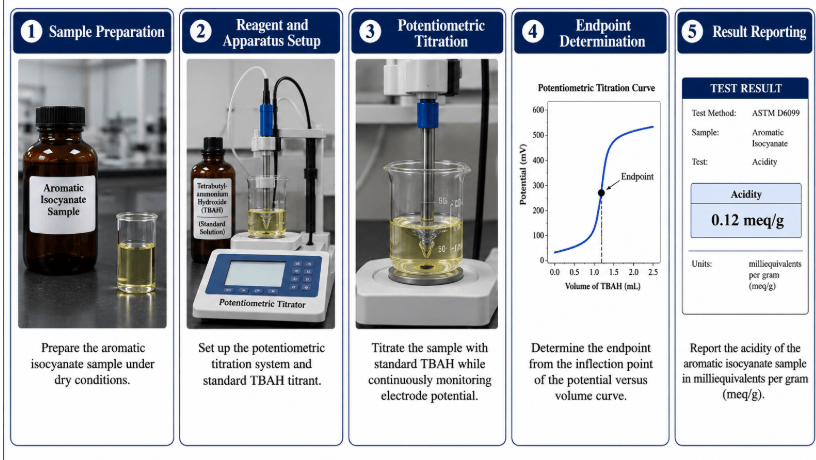
Common Challenges and Troubleshooting
Accurate results require proper sample preparation, suitable equipment, accurate weighing, and careful control of moisture. Technicians protect samples from atmospheric moisture because organic isocyanates can react with it and form insoluble urea contamination. Technicians also use pH 4 and pH 7 aqueous buffers to calibrate the electrodes before titration and make sure that the samples are at room temperature before titration.
ASTM D6093 Analysis Results and Interpretation
The report summarizes the performance of the tested coating material by providing the percent volume nonvolatile matter. It displays the test result, units, and sample data. Laboratories report the percent volume nonvolatile matter as a percent of the volume of dry coating obtainable from a given volume of liquid coating.
- Results are reported in inch-pound units.
- ASTM D6093 produces property-specific results rather than a single overall test value.
- The outcome helps to calculate the volatile organic compound (VOC) level of a coating.
- The result is an estimate of coverage (square feet of surface at a given dry film thickness per unit volume) for various coating products.
- Standardized specimen preparation, appropriate equipment, and controlled testing conditions enable laboratories to deliver reliable results.
Get Certified ASTM D6093 Testing for Reliable Aromatic Isocyanate Analysis
ASTM D6099 provides a standard procedure for characterizing moderately to highly acidic aromatic isocyanates and prepolymers. This method combines the isocyanate with an excess of methanol and a cosolvent and introduces extra acid during urethane formation, which is then measured by potentiometric titration with methanolic KOH. Accurate testing allows the laboratory to identify acidity, expressed in ppm HCl, and provide data for research and quality control. The measured acidity can also be related to the performance of some polyurethane systems.
FAQ
Updated on September 4, 2026


Project Today
specialized laboratories ready to deliver results