
ASTM D6090 Standard Test Method for Softening Point Resins (Mettler Cup and Ball Method)

    What is ASTM D6090?

    ASTM D6090 is a standard test method for the softening point of resins, using the Mettler cup and ball method. The technique measures the temperature at which a resin specimen becomes soft enough under the specified temperature program to allow a steel ball to pass through. Technicians prepare a resin specimen in the specified cup and mount the required ball on it. They raise the test assembly temperature at a steady rate and measure it. As the temperature rises, the resin softens, and the ball flows through the specimen under the test conditions. ASTM D6090 testing (Standard Test Method for Softening Point Resins (Mettler Cup and Ball Method)) gives details regarding the thermal softening traits of applicable resins. Results can be compared between resin materials, used to track consistency of production, assess changes in formulations, and used as a help in material development by manufacturers, suppliers, engineers, and quality control. 

    Read more

    Get Certified ASTM D6090 Resin Softening Point Testing

    Resin manufacturers, suppliers, processors, engineers, and quality control personnel use ASTM D6090 testing to identify the softening attributes of applicable resin materials. Technicians select and process representative resin samples and transfer the processed specimen to the appropriate test cup. They set up the test equipment, insert the specimen, and heat it under controlled conditions, including the ball. As part of the test, the technicians keep track of the temperature and the softening of the resin. The instrument or technician takes the temperature reading at the desired endpoint.  The results can support material comparison, quality control, production monitoring, formulation evaluation, and product development.
    What is the scope of ASTM D6090?

    ASTM D6090 provides a method for determining the softening point of applicable resins using the Mettler cup and ball procedure. The standard covers:

    Read more

    • Resin Softening Point: Determines the temperature associated with the specified softening endpoint of the resin.
    • Controlled Heating: Heats the resin specimen under controlled test conditions.
    • Cup and Ball Evaluation: Uses the specified cup and ball assembly to determine the softening behavior of the material.
    • Thermal Characteristics: Provides information about the temperature-related softening behavior of applicable resins.
    • Material Comparison: Supports comparison of the softening characteristics of different resin materials or formulations.
    • Quality Control: Helps manufacturers monitor consistency between resin production batches.

    What are the uses of ASTM D6090 testing?

    ASTM D6090 provides softening-point information that helps manufacturers and technical personnel evaluate the thermal behavior of applicable resin materials. The test helps to:

    • Determine the softening point of applicable resins.
    • Evaluate the thermal softening characteristics of resin materials.
    • Compare different resin grades or formulations.
    • Monitor consistency between production batches.
    • Identify changes in resin processing or formulation.
    • Support quality-control activities.
    • Assist material selection and product development.
    • Provide information for resin processing and technical evaluation.

    Which Materials Can Be Tested According to ASTM D6090?

    ASTM D6090 applies to resin materials for which softening-point determination using the Mettler cup and ball method is required. The method may apply to:

    • Resins: Evaluates applicable resin materials for softening-point characteristics.
    • Thermoplastic Resins: Supports testing of applicable thermoplastic resin materials.
    • Resin Grades: Allows comparison of softening characteristics between applicable resin grades.
    • Resin Formulations: Helps evaluate changes in formulations that may affect thermal softening behavior.
    • Production Samples: Supports testing of representative resin samples from production batches.

    Technicians should verify the resin type, sample condition, and applicable test requirements before testing.

    Why is ASTM D6090 Testing Important?

    The softening characteristics of a resin may affect handling, processing, and performance at higher temperatures. Variations in resin composition, molecular structure, formulation, or processing can affect the temperature at which the resin will achieve a given softening point. ASTM D6090 is a controlled procedure to obtain the softening point of applicable resins. A standardized procedure allows for materials to be tested under similar conditions and for technicians and analysts to compare these materials. The results can help manufacturers monitor resin consistency, evaluate formulation changes, support material development, and maintain quality control.

    ASTM D6090 Equipment and Sample Preparation Guide

    Technicians need representative resin samples and suitable equipment for preparing the specimen, applying the required cup and ball arrangement, heating the sample, and measuring temperature.

    Read more

    Sample IdentificationTechnicians identify the resin type, grade, formulation, production batch, and other relevant sample information before testing.
    Specimen PreparationTechnicians prepare representative resin specimens and place the material in the specified test cup according to the applicable requirements.
    Mettler Cup and Ball AssemblyTechnicians use the specified cup and ball arrangement to evaluate the softening behavior of the resin.
    Heating EquipmentTechnicians use suitable controlled heating equipment to raise the temperature of the specimen according to the required procedure.
    Temperature Measurement EquipmentTechnicians use suitable calibrated temperature-measuring equipment to monitor and record the softening-point temperature.

    ASTM D6090 Testing Procedures and Requirements

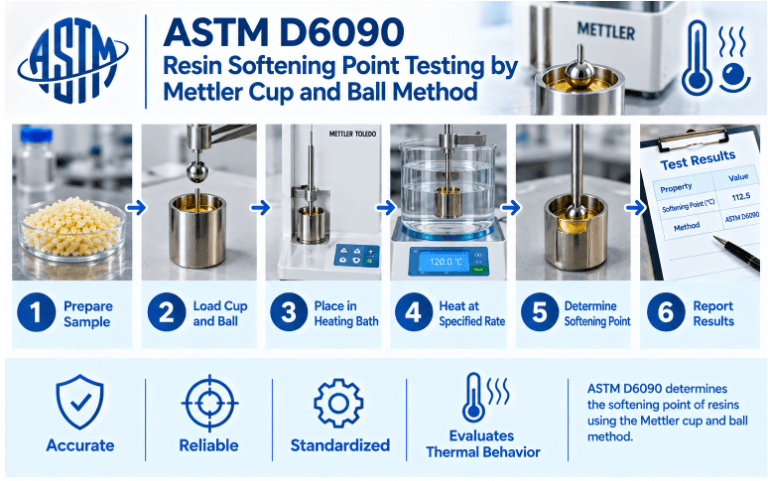
    Technicians first identify and prepare a representative resin sample. They place the specimen in the specified Mettler cup and assemble the cup and ball arrangement according to the applicable procedure. Technicians place the test assembly in the required heating system and increase the temperature under controlled conditions. As the resin temperature increases, the material gradually softens. The test reaches its specified endpoint when the ball passes through the softened resin according to the procedure. Technicians record the corresponding temperature and relevant test information. The testing procedure includes the following steps.

    Read more

    Sample Identification and PreparationTechnicians identify the resin and prepare a representative specimen according to the applicable requirements.
    Cup and Ball AssemblyTechnicians place the resin specimen in the specified cup and position the required ball according to the test procedure.
    Controlled HeatingTechnicians heat the test assembly under the specified controlled conditions.
    Softening Endpoint DeterminationTechnicians determine the specified endpoint as the resin softens and the ball passes through the material.
    Data Recording and Result ReportingTechnicians record the applicable temperature and test information, while analysts review and report the softening-point result.

    ASTM D6090 Testing Process and Data Collection

    Technicians identify the resin sample and prepare a representative test specimen. They place the specimen in the specified Mettler cup and prepare the cup and ball assembly. The technicians position the test assembly in the required heating apparatus and increase the temperature under controlled conditions. As the temperature rises, the resin gradually softens. Technicians observe the specified test endpoint and record the corresponding temperature. They also record the resin identification, specimen information, heating conditions, and other relevant test observations. Analysts review the recorded information and report the softening point of the tested resin according to the applicable procedure.

     ASTM D6090 testing process showing resin sample identification and preparation, placement of the specimen in a Mettler cup, positioning of the ball, controlled heating of the resin, softening of the specimen, determination of the endpoint, and recording of the softening-point temperature.
    ASTM D6090 Resin Softening Point Testing by Mettler Cup and Ball Method

    Common Challenges and Troubleshooting

    Improper specimen preparation, contamination, incorrect ball positioning, temperature-control variations, inaccurate heating rates, and temperature-measurement errors can affect ASTM D6090 results. Technicians should prepare specimens and ensure that the test cup and ball assembly are clean and correctly positioned. They should verify the procedure and calibration of the heating and temperature-measurement equipment before testing. Consistent specimen preparation, controlled heating, and accurate temperature measurement help technicians produce comparable softening-point results.

    Analysis Results and Interpretation

    The report summarizes the softening-point characteristics of the tested resin. It includes the measured softening-point temperature together with the relevant sample identification, specimen information, and applicable test conditions.

    Read more

    • ASTM D6090 provides a temperature-specific softening-point result for the tested resin.
    • Technicians report the softening point in degrees Celsius (°C) or the applicable SI temperature unit required by the procedure.
    • The report identifies the tested resin and relevant sample information.
    • Technicians record the applicable test conditions and observations associated with the softening-point determination.
    • Analysts can compare softening-point results between applicable resin materials or production samples.
    • Consistent specimen preparation, controlled heating, accurate endpoint determination, and calibrated temperature-measurement equipment help produce reliable and comparable results.

    Link to ASTM D6090

    FAQ

    What does ASTM D6090 measure?
    ASTM D6090 determines the softening point of applicable resins using the Mettler cup and ball method.
    The method applies to applicable resin materials for which softening-point determination using the specified procedure is required.
    The method consists of placing a resin specimen in a specified cup and placing a ball on the material. A specialist can heat the specimen under controlled conditions and identify the temperature at which the given softening point occurs.
    The softening-point temperature is usually reported in degrees Celsius (ºC).
    The softening point also offers insight into the temperature-dependent softening characteristics of resin that can be used by engineers to compare materials, ensure consistency, and assess formulation changes.
    Laraib Hashmi
    About Author
    Laraib Hashmi
    Laraib Hashmi is an aspiring research enthusiast and science content professional with a strong interdisciplinary skill set, holding a postgraduate degree in Applied Microbiology from KIIT Bhubaneshwar, Odisha.
    Testimonials
    Real results
    Engineers trust us with what matters most
    Start Your Testing
    Project Today
    Define your requirements and get access to
    specialized laboratories ready to deliver results
    Partners with us
    Clients
    Vendors
    Process for testing
    • STEP 01

      You share your testing requirements

    • STEP 02

      You share your sample(s)

    • STEP 03

      We deliver your test reports

    Get your testing done

    Let us known your testing requirements and we will be right back with a solution.

      Let us root for each other. Collaborate to grow, expand, and accelerate our businesses.

      Partner with us

        Contact Us

        Discover more from MaTestLab

        Subscribe now to keep reading and get access to the full archive.

        Continue reading