
ASTM D6080 Standard Practice for Defining the Viscosity Characteristics of Hydraulic Fluids

    What is ASTM D6080?

    ASTM D6080 is a standard practice to specify the characteristics of a fluid as a hydraulic fluid. The practice aims to give a standard method of assessing and plotting the viscosity of a hydraulic fluid at different temperatures. Viscosity is a significant property because it may affect the flow of the fluid and the operation of hydraulic systems under various operating conditions. Technicians determine the type of hydraulic fluid and acquire viscosity data at the appropriate temperatures. They use suitable viscosity measurements to establish the relationship between temperature and viscosity and determine the applicable viscosity characteristics of the fluid. The ASTM D6080 test (Standard Practice for Defining the Viscosity Characteristics of Hydraulic Fluids) gives viscosity-specific data, enabling hydraulic fluid manufacturers, suppliers of the components, engineers, and quality-control personnel to compare hydraulic fluids and assess the fluid viscosity characteristics over a working temperature range.

    Read more

    Get Certified ASTM D6080 Hydraulic Fluid Viscosity Testing

    ASTM D6080 testing can be beneficial to hydraulic-fluid manufacturers, equipment manufacturers, fluid suppliers, engineers, and quality control personnel testing the viscosity properties of hydraulic fluids. Technicians prepare representative fluid samples and perform the required viscosity measurements at the applicable temperatures. They document the measured viscosity and temperature data and make sure the test conditions comply with the procedure selected. Analysts evaluate the collected measurements to define the viscosity characteristics of the hydraulic fluid. The results assist with smooth comparison, product development, quality control, and hydraulic-fluid performance evaluation.
    What Is the Scope of ASTM D6080?

    ASTM D6080 offers a practice to establish the viscosity-temperature properties of applicable hydraulic fluids. The standard covers:

    Read more

    • Hydraulic Fluids: Analyzes the viscosity properties of hydraulic fluid products used.
    • Viscosity Measurement: Relies on proper use of viscosity information to describe the behavior of fluid flow. 
    • Temperature Effects: Measures how a fluid’s viscosity changes with temperature.
    • Viscosity-Temperature Characteristics: Describes the relationship between the viscosity and temperature of the hydraulic fluid. 
    • Fluid Comparison: Provides for fluid viscosity comparison of various types of hydraulic fluid. 
    • Quality Control: Assists manufacturers in maintaining consistency of products and production batches of hydraulic fluids. 

    What Are the Uses of ASTM D6080 Practice?

    ASTM D6080 is a test that gives viscosity-characteristic information to assist manufacturers and technical personnel in evaluating hydraulic fluids. The practice helps to:

    • Describe the viscosity properties of suitable hydraulic fluids. 
    • Compare and contrast viscosity changes caused by temperature. 
    • Compare different hydraulic-fluid products. 
    • Support hydraulic-fluid selection. 
    • Conduct consistency testing between batches of production. 
    • Give support for formulation and product development activities. 
    • Give information for quality control and performance evaluation. 

    Which Materials Can Be Tested According to ASTM D6080?

    ASTM D6080 applies to hydraulic fluids for which viscosity characteristics are required. The practice applies to:

    • Hydraulic Fluids: Evaluates applicable fluids used in hydraulic systems. 
    • Different Fluid Formulations: Supports comparison of viscosity characteristics between applicable formulations. 
    • Production Samples: Allows representative hydraulic-fluid samples from different production batches to be evaluated. 
    • Commercial Hydraulic Fluids: Supports evaluation of applicable finished hydraulic-fluid products. 
    • Development Samples: Provides viscosity-characteristic information during fluid formulation and product development. 

    Why is ASTM D6080 testing important?

    Hydraulic fluid viscosity varies with temperature. These changes can affect the flow and can make it harder for a hydraulic system to perform in various situations. ASTM D6080 is a standard practice to describe the viscosity-temperature properties of hydraulic fluids. Results help designers and manufacturers compare fluids, measure formulation consistency, and provide data to guide fluid selection and product evaluation.

    ASTM D6080 Equipment and Sample Preparation Guide

    Technicians should have representative samples of hydraulic fluid and equipment to evaluate hydraulic fluid viscosity at controlled temperatures. They determine the type of fluid, take representative samples, and make sure the viscosity-measurement equipment is appropriate to get accurate readings.

    Read more

    Sample IdentificationTechnicians determine the type of hydraulic fluid, product grade, formulation information, production batch, and other sample details before testing.
    Sample PreparationTechnicians take representative samples of hydraulic fluid and do not contaminate the fluid or create other conditions that might impact the viscosity measurement.
    Temperature ControlTechnicians maintain the required test temperatures because hydraulic-fluid viscosity changes with temperature.
    Viscosity Measurement EquipmentAnalysts use appropriate calibrated viscometers and related equipment in carrying out the necessary viscosity measurements.
    Data RecordingTechnicians record viscosity measurements, temperatures, sample information, and other applicable test conditions.

    ASTM D6080 Testing Procedures and Requirements

    The first step in the process is to sample and prepare a representative hydraulic-fluid sample. They set up the viscosity-measuring apparatus and set the necessary temperature conditions before measurement. The technician tests the viscosity of the fluid at the specified temperature(s) and documents the viscosity and temperature measurements required. Analysts use the collected information to define the viscosity characteristics of the hydraulic fluid. The testing process includes the following steps.

    Read more

    Sample Identification and PreparationTechnicians identify the hydraulic fluid and prepare a representative sample according to the applicable requirements.
    Instrument and Temperature SetupTechnicians prepare the viscosity-measurement equipment and establish the required controlled temperature conditions.
    Viscosity Measurement and Data RecordingTechnicians measure fluid viscosity at the applicable temperatures and record the measured values and test conditions.
    Viscosity Characteristic DeterminationAnalysts evaluate the viscosity-temperature data to define the applicable viscosity characteristics of the hydraulic fluid.
    Result Evaluation and ReportingAnalysts review and report the viscosity characteristics together with the applicable sample and test information.

    ASTM D6080 Testing Process and Data Collection

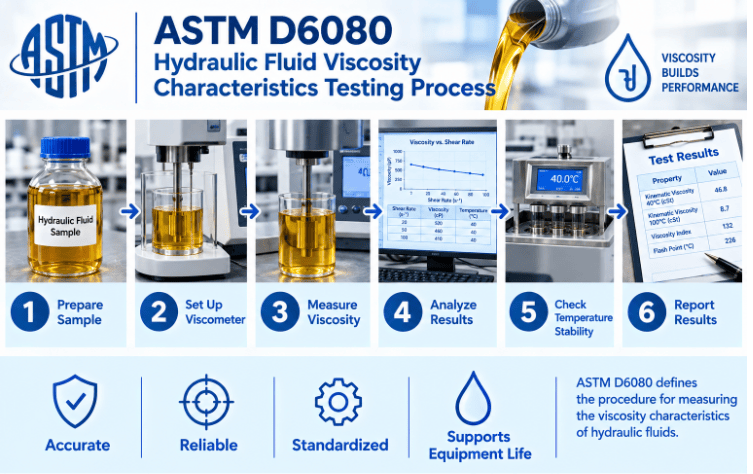
    Technicians identify the hydraulic fluid and prepare a representative sample for viscosity measurement. They verify the condition and calibration status of the viscosity-measurement equipment and establish the required temperature conditions. The technician measures the hydraulic fluid viscosity at the applicable temperatures and records each value with the corresponding temperature. Controlled temperature conditions are important because changes in temperature can significantly affect fluid viscosity. Analysts review the collected viscosity-temperature data and define the applicable viscosity characteristics of the hydraulic fluid. The results are reported with the relevant sample identification, viscosity values, temperatures, and test conditions.

    ASTM D6080 testing process showing hydraulic fluid sample identification, sample preparation, controlled temperature conditioning, viscosity measurement at applicable temperatures, analysis of viscosity-temperature data, and reporting of hydraulic fluid viscosity characteristics.
    ASTM D6080 Hydraulic Fluid Viscosity Characteristics Testing Process

    Common Challenges and Troubleshooting

    Sample contamination, incorrect temperature control, lack of proper temperature stabilization, incorrect viscosity readings, improper use of equipment, and incorrect calibration of equipment can influence ASTM D6080 outcomes. Technicians should prepare representative samples and avoid contamination of the fluid; they should allow the sample time to reach the specified test temperature before obtaining a viscosity reading. Analysts should ensure that all viscosity-measuring equipment is properly calibrated and functioning correctly, and if readings are anomalous, then the sample status, temperature stabilization, instrument operating procedures, equipment calibration, recorded readings and processing should be checked.

    Analysis Results and Interpretation

    The report contains a summary of the viscosity of the fluid tested. It displays the measured viscosity values along with the temperature of measurement, sample identification, test conditions, etc. required in the measurement.

    Read more

    • ASTM D6080 gives viscosity vs temperature properties, not a single material property value. 
    • The kinematic viscosity is typically reported in the SI-derived unit of mm²/s. Dynamic viscosity (if applicable) can be presented as mPa·s or Pa·s. 
    • The temperatures indicated for the test are in °C. The report contains details of the hydraulic fluid identification, relevant viscosity test, temperature range, and the relevant test conditions. 
    • Technicians and analysts can reliably and comparably produce results with accurate temperature control, representative sampling, calibrated viscosity-measurement equipment, and consistent measurement procedures. 

    Link to ASTM D6080 

    FAQ

    What does ASTM D6080 measure?
    ASTM D6080 provides a practice for defining the viscosity characteristics of applicable hydraulic fluids based on their viscosity behavior at different temperatures.
    The practice uses representative samples of applicable hydraulic fluids.
    Technicians use suitable calibrated viscosity-measurement equipment together with equipment for controlling and monitoring the required test temperatures.
    Kinematic viscosity may be reported in mm²/s, dynamic viscosity may be reported in mPa·s or Pa·s, and test temperature is reported in °C, as applicable to the selected procedure.
    Laraib Hashmi
    About Author
    Laraib Hashmi
    Laraib Hashmi is an aspiring research enthusiast and science content professional with a strong interdisciplinary skill set, holding a postgraduate degree in Applied Microbiology from KIIT Bhubaneshwar, Odisha.
    Testimonials
    Real results
    Engineers trust us with what matters most
    Start Your Testing
    Project Today
    Define your requirements and get access to
    specialized laboratories ready to deliver results
    Partners with us
    Clients
    Vendors
    Process for testing
    • STEP 01

      You share your testing requirements

    • STEP 02

      You share your sample(s)

    • STEP 03

      We deliver your test reports

    Get your testing done

    Let us known your testing requirements and we will be right back with a solution.

      Let us root for each other. Collaborate to grow, expand, and accelerate our businesses.

      Partner with us

        Contact Us

        Discover more from MaTestLab

        Subscribe now to keep reading and get access to the full archive.

        Continue reading