MaTestLab > Test Standards > ASTM D6068 Standard Test Method for Determining J-R Curves of Plastic Materials
Last updated 23rd November 2025
ASTM D6068 Standard Test Method for Determining J-R Curves of Plastic Materials
ASTM D6068 is used to determine J-R curves of plastic materials. J-R curves are crucial in characterizing the fracture toughness of materials, particularly plastics, used in various industries. It involves subjecting the plastic specimen to a constant load or displacement rate and measuring the corresponding crack opening displacement. The J-R curve obtained from the ASTM D6068 test provides valuable information about the material's resistance to crack propagation. This is an important test procedure used to determine the structural integrity and longevity of plastic materials under stress, enabling designers and engineers to anticipate performance, ensure failure-free operation, and guarantee product reliability across different applications.
Read More
GET STARTED
ASTM D6068 Introduction
ASTM D6068 involves determining the J-integral versus crack growth resistance (J-R) curves for polymeric materials. It describes a multiple-specimen method that requires optical measurement of crack extension from fracture surfaces. The values stated in SI units are to be regarded as the standard. ASTM D6068 provides a standardized method for evaluating the compatibility between lubricating oils and elastomeric materials, including seals and gaskets. The procedure involves exposing elastomers to lubricating oils and then evaluating changes in properties, such as hardness, tensile strength, elongation, and volume. These metrics indicate whether an oil will degrade or harm rubber components commonly used in engines and machinery. The reliable application of ASTM D6068 enables manufacturers to select the appropriate oil-elastomer pairings, thereby supporting the longevity and reliability of equipment by minimizing the risk of component failure or leakage.
ASTM D6068 is highly significant in terms of the applicability of the J-R curve produced by this method. The J-R curve identifies crack growth resistances in tough polymers and blends by enabling valid characterization using linear elastic fracture mechanics.
Service Name
Remarks
ASTM D6068 Testing
Expert Consultation
Get Certified ASTM D6068 for Reliable Fracture Toughness Evaluation
ASTM D6068 certification demonstrates that laboratories and manufacturers can accurately measure the crack resistance and J-R curves of plastics. Certified testing aids in product design, choices of materials used, and structural integrity testing by determining the resistance to crack propagation and initiation. Compliance produces greater confidence in long-term loading performance, the elimination of disastrous failures in critical parts, and increased model accuracy in finite element analysis. The use of ASTM D6068 can assist industries in streamlining the formulations, testing new materials, and testing the durability and safety of new materials in challenging applications.
ASTM D6068 Testing Procedure and Requirements
Specimen Selection
In testing, the largest specimens available are used to capture a greater portion of the J-R curve and achieve a more conservative estimation of crack growth resistance.
Test Setup and Execution
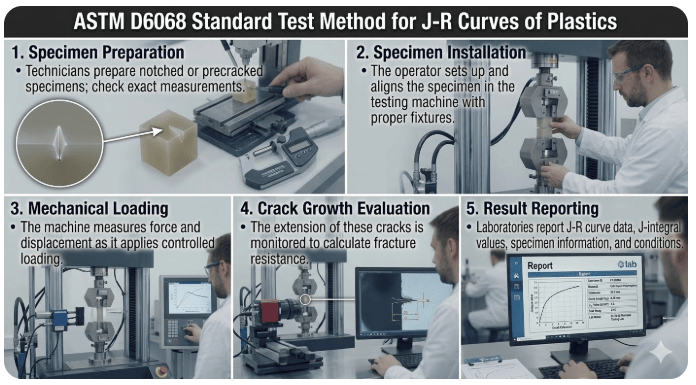
It involves preparing pre-cracked specimens according to specifications. Initial measurements are taken to ensure compliance. Loading conditions are applied, and load-displacement data is recorded. The test continues until the desired crack extension is achieved. Critical values for crack length, load, and displacement are recorded. J-R curves and crack growth resistance parameters are calculated.
Scope of ASTM D6068
Establishes standard procedures in the calculation of J-R curves and measurement of fracture toughness of plastic materials.
Applicable to thermoplastics, thermosets, reinforced plastics, polymer composites, and structural polymers.
Goes in favour of engineering design, product development, durability testing, and failure-analysis studies.
Gives the fracture-mechanics parameters required in structural modeling, safety testing, and qualification. Facilitates the recognition of crack-growth resistance that is stable in a variety of crack extensions.
ASTM D6068 Equipment and Sample Preparation
Specimen Details
Three-point bend and pin-loaded compact tension are the most reliable specimens that have constant proportionality in the in-plane dimensions.
Specimen dimensions
ASTM D6068 recommends specifying the dimensions of the specimens based on the material being tested and the desired objectives.
Use of ASTM D6068
Assessment of fracture toughness of engineering plastics in structural, automotive, aerospace, and pressure components.
Defining crack propagation resistance in polymer composites, fibre-reinforced materials, and advanced engineering plastics.
Defining durability modelling, life-prediction analysis, and finite-element simulation with J-integral parameters.
Evaluating the performance of slow crack growth in the long-term reliability of pipes, containers, housings, and load-bearing assemblies.
Fracture resistance is affected by validating the formulations and manufacturing process.
Common Challenges and Troubleshooting in ASTM D6068
These may include irregular pre-cracks, lack of quality notches, inaccurate measurement of crack extension, and unreliable loading to obtain non-representative fracture data. The presence of moisture affects retained stresses, or changes in temperature, which could affect the growth of the cracks. The troubleshooting is aimed at improving the preparation of the notches, sharpness of pre-cracks, other calibration of crack-measuring instruments, consistent loading rates, and running the test many times to verify the reliability of the data. The consistency in the development of J-R curves is achieved through clean specimen surfaces, proper fixture positioning, and stable environmental conditions.
ASTM D6068 Testing Technique, Process, and Data Collection
The testing method is the preparation of notched specimens, controlled growth of pre-cracks, quasi-static loading of the specimen, measurement of crack extension, and calculation of J-integral. Such data as specimen geometry, notch type, pre-crack length, material identification, test rate, load-displacement data, J-integral values, Δa measurements, and constructed J-R curves are involved.
Analysis Results and Interpretation for ASTM D6068
Findings are in the form of J-R curves, which are a graph of the J-integral versus the crack extension, which is the resistance of the material to stable crack propagation. An upward-sloping J-R curve means that toughness increases with the extension of cracks, which is typical of ductile materials. Interpretation is done by considering the initiation toughness (J 3), the slope of the resistance curve, and the maximum permissible range of crack extension. Abnormal behaviour can be reflected as a quality flaw in production, bad quality of polymers, deforestation, or a lack of good preparation of notches.
Problem & The Solution for ASTM D6068
Problem: Inaccurate J-R curves are caused by unreliable pre-cracking, poor notch quality, unstable loading, or some error in measuring crack length.
Solution: Use precise notch-machining techniques, reproducible pre-cracks, and stable loading conditions, and repeat tests for confirmation. Proper specimen conditioning and environmental control improve data consistency and fracture-toughness interpretation.
Factors to Consider for ASTM D6068
Speed Testing needs precise specimen preparation and crack-growth testing, making it relatively time-intensive but fundamental for high-accuracy fracture-mechanics data.
Expert To guarantee accurate development of the J-R curve, notch preparation, crack-extension measurement, and J-integral data reduction require the services of skilled technicians.
Cost ASTM D6068 test can help to predict the accurate duration, structural safety, and performance of the product and minimise long-term costs caused by premature fracture or failure.
Related
FAQ's
Where can I get the astm d6068 tested?
You can share your astm d6068 testing requirements with MaTestLab. MaTestLab has a vast network of material testing laboratories, spread across the USA and Canada. We support your all material testing needs ranging from specific astm d6068 test to various testing techniques.
How much do I need to pay for the astm d6068 test?
Please contact us for a detailed quote for your astm d6068 testing needs. Cost incurred to carry out different astm d6068 testing methodology depends on the type of raw material; number of samples, coupons, or specimens; test conditions, turn around time etc. Costs of some ASTM testing methods start from $100 and the final value depends upon the factors listed above. Please contact us for the best and latest prices.
How many samples are required for astm d6068?
The required number of samples or specimens should comply with the procedure given in the astm d6068 standard. However, the MaTestLab operations team can assist you for your special requirements once you share your testing details with us.
How much discount can I get on the astm d6068 test?
MaTestLab has a vast testing laboratory network, hence we bring you the best testing facilities in a cost-effective way. We offer considerable discounts (15-20%) to our returning customers based on test volume and frequency.
How many days will it take to complete the astm d6068 test?
The turnaround time for astm d6068 test methodology depends upon the test procedure mentioned in the standard test document. However, we at MaTestLab understand your research requirements and hence try to get your test completed within the least possible time.
Where can I get the astm d6068 tested?
You can share your astm d6068 testing requirements with MaTestLab. MaTestLab has a vast network of material testing laboratories, spread across the USA and Canada. We support your all material testing needs ranging from specific astm d6068 test to various testing techniques.
MaTestLab Inc. offers accessible, quick, and affordable material testing, product testing, and failure analysis services. We support your on-demand testing and expert consultation needs with the help of our extensive network of material testing laboratories situated in the US and other parts of the world.
MATERIAL TESTING
We offer destructive and non-destructive tests over a range of mechanical, electrical, chemical, thermal, optical, corrosion, radiation, and biological testing methodologies defined by ASTM, ISO and other organizations.
PRODUCT TESTING
We help you evaluate and ensure your product quality and performance with standard and custom-made testing solutions. All the tests are done at well-equipped testing laboratories using standard testing methods for best output and satisfaction.
FAILURE ANALYSIS
Failure analysis ensures high levels of quality in every manufacturing process. We help you with getting the best failure or root cause analysis to determine the cause of the failure. The results help you identify means to prevent failure recurrences.