
ASTM D6038 Standard Test Method for Determining the Compatibility of Resin/Solvent Mixtures by Precipitation Temperature (Cloud Point)

    What is ASTM D6038?

    ASTM D6038 defines a standard test method that uses the precipitation temperature (also known as cloud point) of a resin/solvent mixture to determine its compatibility. The method determines the temperature at which a previously clear mixture of resin/solvent turns cloudy due to phase separation or precipitation. Technicians make representative resin/solvent mixtures at the desired composition and subject them to controlled temperatures. They watch the mixture for cloudiness and take note of the temperature when precipitation is seen. ASTM D6038 (Standard Test Method for Determining the Compatibility of Resin/Solvent Mixtures by Precipitation Temperature (Cloud Point)) testing is useful for coating manufacturers, resin producers, resin formulators, engineers, and resin inspection and quality control personnel to compare resin/solvent combinations, to test the stability of the formulations, and to assess differences in material compatibility.

    Read more

    Get Certified ASTM D6038 Resin/Solvent Compatibility Testing

    ASTM D6038 testing helps resin manufacturers, coating formulators, solvent suppliers, engineers, and quality-control personnel assess the compatibility of resin/solvent mixtures. Technicians determine the resin and solvent composition and make representative mixtures at their proportions. They then expose the solution to controlled temperatures and record the changes in clarity as the temperature varies. Technicians note the appropriate temperature when cloudiness or precipitation occurs. Analysts review the recorded observations and precipitation-temperature data to evaluate the compatibility of the resin and solvent mixture. The results can be used to compare the properties of various solvent systems, test formulation changes, track material consistency, and aid in the development of resin and coating formulations.

    What is the scope of ASTM D6038?

    ASTM D6038 outlines test methods to assess compatibility, which involves measuring the precipitation temperature or cloud point of a resin/solvent mixture. The methods offer controlled procedures to observe the changes in the clarity of mixtures due to precipitation or phase separation. The standard covers:

    Read more

    • Resin/Solvent Mixtures: Assesses resin/solvent mixtures that can be used. 
    • Cloud-Point Determination: Measures the temperature at which the cloud or precipitation is visible. 
    • Compatibility Evaluation: Gives details of the relationship between the solubility of resin and the solvent.
    • Temperature Effects: Assesses appearance changes of mixtures at controlled temperatures. 
    • Material Comparison: Provides resin/solvent comparison. 
    • Formulation Evaluation: Assists in resin formulation and selection of solvents and in quality control. 

    What are the uses of ASTM D6038 testing?

    ASTM D6038 provides precipitation-temperature information that helps technical personnel evaluate resin/solvent compatibility. The test helps to:

    • Determine the cloud point of applicable resin/solvent mixtures. 
    • Evaluate compatibility between resins and solvents. 
    • Compare different solvent systems. 
    • Support solvent selection and formulation development. 
    • Identify changes in resin/solvent compatibility. 
    • Monitor consistency between material or production batches. 
    • Support quality control and product development activities. 

    Which materials can be tested according to ASTM D6038?

    The applicable resin/solvent mixtures for which precipitation-temperature or cloud-point determination is required are included in ASTM D6038. Before testing, technicians should confirm the type of resin, type of solvent system, mixture composition, and test condition. The methods apply to:

    • Resin Materials: Evaluates applicable resins that can be prepared in suitable solvent mixtures. 
    • Solvent Systems: Supports evaluation and comparison of suitable solvents and solvent blends. 
    • Resin/Solvent Formulations: Allows comparison of mixtures with different compositions. 
    • Coating Formulations: Supports evaluation of applicable resin-based coating systems. 
    • Production Samples: Supports testing of representative resin or solvent materials from production batches. 

    Why is ASTM D6038 Testing Important?

    Resin-solvent compatibility can affect a formulation’s stability, processing, storage, and the resin-based product’s performance. When the resin does not remain compatible in the solvent system it is used in, the resin/solvent mixture may become cloudy or precipitate when the temperature changes. ASTM D6038 is a standard method for determining the precipitation temperature or cloud point. The data assists manufacturers and formulators in comparing resin/solvent systems, observing compatibility differences, selecting appropriate solvent systems, and recording formulation consistency.

    ASTM D6038 Equipment and Sample Preparation Guide

    Sample IdentificationTechnicians identify the resin type, solvent or solvent blend, mixture composition, production batch, and other relevant material information before testing.
    Mixture PreparationTechnicians prepare representative resin/solvent mixtures at the required composition and ensure that the resin is properly dissolved before testing.
    Temperature-Control EquipmentTechnicians use suitable equipment capable of changing and maintaining the required temperature conditions during cloud-point determination.
    Observation and Measurement EquipmentTechnicians use suitable containers, temperature-measuring devices, and observation equipment to detect cloudiness or precipitation and record the applicable temperature.

    ASTM D6038 Testing Procedures and Requirements

    Technicians first identify the resin and solvent materials and prepare the required resin/solvent mixture. They ensure that the mixture is properly prepared and suitable for cloud-point observation. The technician subjects the mixture to the specified temperature conditions and observes changes in its appearance. When cloudiness or precipitation occurs, technicians record the applicable precipitation temperature and other required observations. The testing process includes the following steps.

    Read more

    Sample Identification and Mixture PreparationTechnicians identify the resin and solvent materials and prepare a representative mixture at the required composition.
    Initial Mixture InspectionTechnicians verify the appearance and condition of the prepared mixture before temperature testing.
    Controlled Temperature AdjustmentTechnicians heat or cool the mixture according to the applicable procedure while maintaining controlled test conditions.
    Cloud-Point Observation and Data RecordingTechnicians observe the mixture for the first visible appearance of cloudiness or precipitation and record the corresponding temperature.
    Result EvaluationAnalysts review the precipitation-temperature data and observations to determine the applicable cloud-point result and assess resin/solvent compatibility.

    ASTM D6038 Testing Process and Data Collection

    Technicians start testing by identifying the resin and solvent materials and preparing a representative mixture at the required composition. They ensure that the mixture is sufficiently homogeneous and record the relevant sample information. Technicians observe the appearance of the mixture during the temperature change. When visible cloudiness or precipitation first appears, technicians record the corresponding temperature. They also document the resin identification, solvent information, mixture composition, test conditions, and relevant observations. Analysts review the recorded cloud-point data to evaluate the compatibility of the resin/solvent mixture and compare the results with other applicable formulations or requirements.

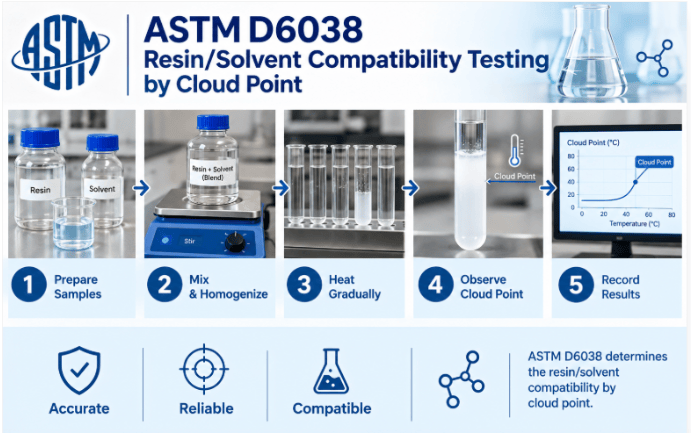
     The image shows the ASTM D6038 testing process, resin and solvent identification, preparation of a homogeneous resin/solvent mixture, controlled temperature adjustment, measurement of cloud-point temperature, and recording of compatibility results.
    ASTM D6038 Resin/Solvent Compatibility Testing by Cloud Point

    Common Challenges and Troubleshooting

    Incomplete resin dissolution, incorrect mixture composition, contamination, temperature-control variations, inaccurate temperature measurement, inconsistent heating or cooling rates, and difficulty identifying the first appearance of cloudiness can affect ASTM D6038 results. Technicians should make sure that they mix the resin/solvent mixture carefully and that the resin is completely dissolved before testing. They should test the temperature-measuring and temperature-control apparatus to see if they are in good working order. Technicians should check the following when results are not as expected: resin and solvent identification, make-up of the mixture, preparation of the sample, clarity of the mixture, temperature of the mixture, observation procedure, and equipment performance.

    Analysis Results and Interpretation

    The report provides a summary of the compatibility attributes of the resin/solvent mixture tested. It includes the measured precipitation temperature or cloud point with the corresponding resin/solvent identification, composition, specimen, test conditions, and observations. 

    Read more

    • ASTM D6038 will only generate cloud-point data or precipitation-temperature data, but not a single overall material-property value. 
    • Technicians record precipitation temperature as the value in °C (SI) units. The report provides the resin composition and solvent/solvent blend composition tested.
    • Observers make notes of the conditions of the temperature and notes on the appearance of cloudiness or precipitation. 
    • Technicians can make reliable and comparable results, provided there is consistency in the preparation of the mixtures, accurate control of the composition, control of the adjusting temperature, careful observation of the cloud point, and calibration of the temperature-measuring equipment. 

    Link to ASTM D6038 

    FAQ

    What does ASTM D6038 measure?
    ASTM D6038 is a test method that uses precipitation temperature or cloud point to determine the compatibility of applicable resin/solvent mixtures.
    Cloud point is the temperature at which a previously clear resin/solvent mixture becomes clearly cloudy through precipitation or phase separation.
    Consistent mixture composition and complete resin dissolution help ensure that the measured cloud point reflects the compatibility of the resin/solvent system rather than variations caused by improper sample preparation.

    Updated on September 17, 2026

    Davis Scott
    About Author
    Davis Scott is an Electrical and Electronics Engineer specializing in multidisciplinary validation, quality assurance, and comprehensive electro-mechanical testing.
    Know More
    Testimonials
    Real results
    Engineers trust us with what matters most
    Why Choose Matestlab?
    Matestlab is a unified testing services partner based in the USA. Matestlab offers raw material and product testing services through accredited, expert laboratories primarily based in the USA. Matestlab supports physical, thermal, chemical, electrical, mechanical, environmental, and characterization testing needs through its global network of 2200+ accredited testing laboratories. Matestlab's in-house materials science experts curate and design comprehensive testing programs matched to the sample material and specific testing need, with regulatory requirements and confidentiality in mind.

    If you are looking for a managed and trusted testing partner to achieve your research goals, feel free to schedule a meeting with us or send us a request at connect@matestlabs.com to learn more about our services. For a quick quote, call us at (302)244-7710. We are happy to serve you.
    Start Your Testing
    Project Today
    Define your requirements and get access to
    specialized laboratories ready to deliver results
    Partners with us
    Clients
    Vendors
    Process for testing
    • STEP 01

      You share your testing requirements

    • STEP 02

      You share your sample(s)

    • STEP 03

      We deliver your test reports

    Get your testing done

    Let us know your testing requirements and we will be right back with a solution.

      Let us root for each other. Collaborate to grow, expand, and accelerate our businesses.

      Partner with us