
ASTM D5994/D5994M Standard Test Method for Measuring the Thickness of Geomembranes

    What is ASTM D5994?

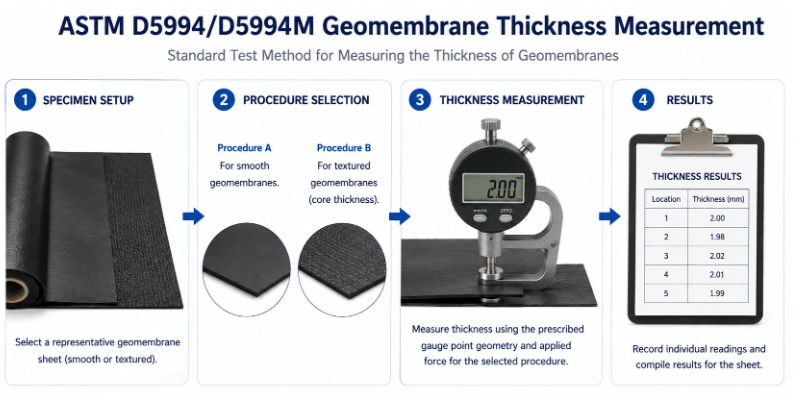
    ASTM D5994 is a standard test method that describes how to measure geomembrane thickness. This test method includes two procedures; procedure A specifies the thickness measurement for smooth geomembranes, whereas procedure B determines the core thickness of textured and non-smooth geomembrane sheets. ASTM D5994 (Standard Test Method for Measuring the Thickness of Geomembranes) prescribes a specific gauge-point geometry and force for each procedure to minimize measurement variability and avoid extremely low-pressure application that could produce unrealistically low thickness measurements. Technicians can use the procedure to control and monitor geomembrane sheet production because mechanical properties such as tensile yield strength and puncture parameters are related to core thickness. Geomembrane sheet thickness measurements can support tests that evaluate containment membranes and geotechnical barrier characteristics.

    Read more

    Get Certified ASTM D5994 Testing for Reliable Geomembrane Thickness Measurement

    Smooth geomembrane thickness and the core thickness of textured geomembranes are critical quality indicators since they define mechanical performance characteristics and are used to calculate other properties such as diffusion coefficients or tensile stresses. ASTM D5994 gives technicians a controlled measurement procedure that reduces the variation caused by inconsistent gauge geometry or applied pressure.
    What is the Scope of the ASTM D5994 Test Standard?

    ASTM D5994 describes a procedure for determining the thickness of smooth geomembranes and the core thickness of textured geomembranes. This test method is intended for geomembranes manufactured as sheets, including those typically available on the market. However, it does not apply to composite geomembranes, such as geomembranes laminated to a nonwoven fabric. The ASTM D5994 standard:

    Read more

    • Specifies procedure A for the determination of thickness of smooth geomembrane sheets.
    • Specifies procedure B for determination of core thickness of textured geomembrane sheets; the procedures may yield different results for a given geomembrane.
    • Prescribes a particular gauge point geometry and force to reduce variability due to excessive application force.
    • Applies to commonly available textured geomembranes deployed as manufactured sheets.
    • Excludes reliable use on composite geomembranes with a laminated nonwoven backing.

    What are the Uses of ASTM D5994 Testing?

    ASTM D5994 testing helps manufacturers and engineers control and monitor the quality of geomembrane sheet production using an important indicator property. In addition, the measurements obtained by using this test method can be used to carry out calculations and comparisons that require thickness information. This standard-

    • Helps provide quality control for geomembrane production.
    • Provides thickness information required to relate mechanical properties such as tensile yield strength and puncture resistance.
    • Provides core thickness values required to calculate other geomembrane properties such as diffusion coefficients or tensile stresses.
    • Allows differentiation between smooth and textured geomembranes.
    • Ensures measurement consistency through a prescribed gauge geometry and applied force

    Which Materials Can Be Tested Under ASTM D5994?

    ASTM D5994 test method applies to geomembranes produced in the form of sheets, such as smooth geomembranes and textured geomembranes. However, it does not apply to composite geomembranes such as geomembranes laminated to a nonwoven fabric.

    Why is ASTM D5994 Important?

    A geomembrane’s core thickness is often related to several mechanical properties, including tensile yield strength and puncture resistance. It is also an important indicator that must be measured to monitor and control geomembrane quality. The thickness of geomembranes can vary greatly depending on the applied pressure; therefore, a particular gauge geometry and force are required for reliable, consistent results.

    ASTM D5994 Equipment and Sample Preparation Guide

    ASTM D5994 requires a thickness gauge with the contact geometry specified in this standard and specimens representative of the geomembrane sheet type being tested. Technicians can use the following guide to prepare samples and operate the equipment:

    Read more

    Sample and Specimen DetailsTechnicians select representative geomembrane sheet samples based on whether the material is smooth or textured.
    Specimen PreparationTechnicians can identify measurement locations based on the procedures specified in ASTM D5994
    Procedure SelectionTechnicians apply Procedure A for smooth geomembranes or Procedure B for textured geomembranes.
    InstrumentationThe test uses a thickness gauge built to the prescribed gauge-point geometry and applied force for the selected procedure.

    ASTM D5994 Testing Procedure and Requirements

    ASTM D5994 specifies that geomembrane thickness is measured using a thickness gauge with a specified contact geometry and applied force. The procedure that must be used depends on whether the geomembrane sheet is smooth or textured. The ASTM D5994 testing procedure comprises the following steps:

    Read more

    Procedure SelectionTechnicians identify the geomembrane type and select Procedure A for smooth sheets or Procedure B for textured sheets.
    Gauge ApplicationTechnicians apply the thickness gauge to the specimen according to the gauge point geometry and applied force specified in the selected procedure.
    Thickness MeasurementTechnicians measure the geomembrane thickness according to the procedure.
    Result CompilationAnalysts compile the thickness results obtained for the tested geomembrane sheet.

    ASTM D5994 Testing Process and Data Collection

    Engineers start by identifying the geomembrane type and selecting a suitable procedure (A for smooth geomembranes and B for textured geomembranes). The technician then applies the thickness gauge according to the gauge point geometry and force specified in the procedure. The analyst takes thickness measurements at specified locations and compiles the results.

    The image shows a geomembrane sheet being measured for thickness using a gauge applied at the prescribed contact geometry and force according to ASTM D5994.
    ASTM D5994 Geomembrane Thickness Measurement 

    Common Challenges and Troubleshooting

    Accurate ASTM D5994 results depend on using the correct procedure for the sheet type and maintaining the prescribed gauge geometry and applied force. Excessive pressure during measurement can produce unrealistically low thickness readings, particularly on textured sheets. Technicians can avoid this error by using a reliable thickness gauge, applying consistent force, and confirming the procedure to use for smooth or textured geomembrane sheets prior to measurements.

    ASTM D5994 Analysis Results and Interpretation

    ASTM D5994 measures geomembrane thickness using a thickness gauge with a prescribed contact geometry and force. This test method provides a set of individual measurements for the thickness of the geomembrane sheet tested.

    Read more

    • The technician reports the thickness measured at each specified location in millimeters (mm) or inches (in.), as applicable.
    • The analyst identifies the procedure used, either Procedure A or Procedure B, with the corresponding thickness measurements.
    • The laboratory evaluates the variation among individual thickness measurements to identify differences in sheet thickness across the tested locations.
    • Engineers interpret thickness variation together with the specified material requirements and measurement conditions, rather than treating consistently low measurements alone as evidence of higher production quality.

    ASTM D5994 is used for determining the thickness of smooth geomembrane sheets and the core thickness of textured geomembrane sheets. The test method specifies two procedures for obtaining thickness measurements.

    What does ASTM D5994 testing evaluate? 

    ASTM D5994 testing evaluates the thickness of geomembrane sheets at specific measurement locations using a procedure applicable to smooth or textured geomembrane sheets.

    Link to ASTM D5994

    FAQ

    Why is ASTM D5994 important?
    ASTM D5994 is important because it provides a controlled procedure for thickness measurement of geomembranes, an indicator property for mechanical performance and quality control.
    Laraib Hashmi
    About Author
    Laraib Hashmi
    Laraib Hashmi is an aspiring research enthusiast and science content professional with a strong interdisciplinary skill set, holding a postgraduate degree in Applied Microbiology from KIIT Bhubaneshwar, Odisha.
    Testimonials
    Real results
    Engineers trust us with what matters most
    Start Your Testing
    Project Today
    Define your requirements and get access to
    specialized laboratories ready to deliver results
    Partners with us
    Clients
    Vendors
    Process for testing
    • STEP 01

      You share your testing requirements

    • STEP 02

      You share your sample(s)

    • STEP 03

      We deliver your test reports

    Get your testing done

    Let us known your testing requirements and we will be right back with a solution.

      Let us root for each other. Collaborate to grow, expand, and accelerate our businesses.

      Partner with us

        Contact Us

        Discover more from MaTestLab

        Subscribe now to keep reading and get access to the full archive.

        Continue reading