ASTM D5946 Corona-Treated Polymer Films

    What is ASTM D5946?

    ASTM D5946 is a standard laboratory test method developed to determine the effectiveness of corona treatment on polymer films by measuring the water contact angle. In a test, a measured amount of distilled water is dropped onto the surface of the treated film, and the contact angle between the liquid and the film is measured with a goniometer or contact angle analyzer. ASTM D5946 (Standard Test Method for Corona-Treated Polymer Films Using Water Contact Angle Measurements) differs from visual inspection because it provides objective, repeatable measurements of surface wettability and surface energy. Lower contact angles indicate better wettability and adhesion potential, helping manufacturers optimize surface treatment processes and confirm product quality before further processing.

    Read more

    Get Certified ASTM D5946 Testing for Reliable Surface Energy Evaluation

    Certified polymer film verifies corona treatment by testing it with standardized water contact angle measurement procedures. Laboratory tests confirm the surface wettability, treatment effectiveness, and adhesion properties under specific conditions. ASTM D5946 certified products provide quality assurance, material qualification, product development, manufacturing consistency, and regulatory compliance, and ensure reliable surface performance for printing, coating, laminating, and adhesive applications. 
    What is the Scope of ASTM D5946 Test Standard?

    ASTM D5946 provides standard methods for determining the surface wettability and surface energy of corona-treated polymer films by measuring the contact angle of water on these surfaces. The test standard-

    Read more

    • Tests the effectiveness of corona surface treatment.
    • Measures contact angles on polymer film surfaces.
    • Works well for adhesion, printing, coating, and laminating.
    • Used on polyethylene, polypropylene, PET, and other corona-treated polymer films.
    • Surface evaluation in line with standards for quality assurance and product qualification. 

    What are the Uses of ASTM D5946 Testing?

    This test method assesses the effectiveness of corona treatment and whether polymer films have adequate surface energy for subsequent manufacturing steps. Results help with the selection of materials, optimizing processes, quality assurance, and product development.

    • Packaging manufacturers use plastic treatment to test whether the treated film allows ink to adhere and to assess print quality.
    • In the printing industry, it is necessary to measure surface wettability before printing to ensure print quality and durability.
    • To achieve uniform coating adhesion and long-term performance, coating manufacturers assess treated film surfaces.
    • Polymer films are evaluated before lamination with the adhesive to ensure a strong, reliable bond.
    • Electronics manufacturers provide tested polymer substrates for flexible electronic components and specialty films.
    • ASTM D5946 is regularly performed in quality control laboratories to ensure the quality and compliance of the products to customer requirements and production standards. 

    What Materials Can Be Tested Under ASTM D5946?

    ASTM D5946 applies to polyethylene (PE), polypropylene (PP), polyethylene terephthalate (PET), polyolefin films, packaging films, industrial wrapping films, agricultural films, flexible electronic substrates, and other thin polymer films that require the surface wettability test. 

    Why is ASTM D5946 Important for Surface Energy Evaluation?

    The standard gives a reliable way to measure corona treatment effectiveness and surface wettability. Precise contact angle testing can aid manufacturers in optimizing all surface treatments, creating better adhesion performance, minimizing manufacturing defects, boosting product quality, and guaranteeing consistent performance for printing, coating, laminating, and bonding applications. 

    ASTM D5946 Equipment and Sample Preparation Guide

    To obtain accurate, repeatable wettability results, proper sample preparation and calibrated contact-angle measurement equipment are required. 

    Read more

    Specimen DetailsRepresentative samples are polymer films (polyethylene (PE), polypropylene (PP), polyethylene terephthalate (PET), etc) that need to be evaluated for surface energy and treated with corona. 
    Specimen PreparationTechnicians select film samples with a uniform corona-treated surface and inspect them to ensure they are clean, flat, and free from defects or contaminants that could affect contact angle measurement.
    Specimen DimensionsTechnicians prepare rectangular or circular samples of adequate size to allow multiple contact angle measurements without overlap.
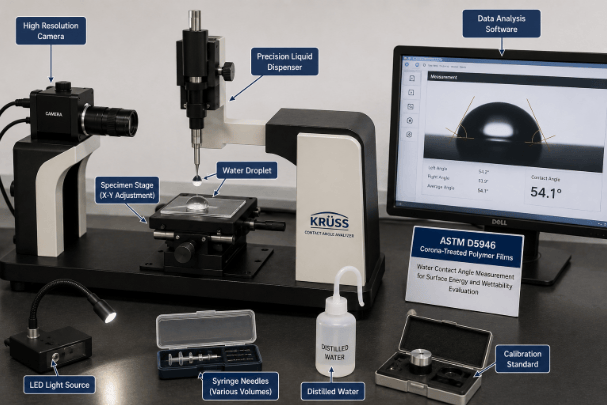
    InstrumentationCommonly used equipment includes a contact angle goniometer, contact angle analyzer, precision liquid dispenser, distilled water, specimen stage, image analysis software, and environmental controls if required.

    Testing Procedures and Requirements for Surface Wettability Evaluation

    Effectiveness of corona treatment is evaluated by measuring the contact angle of a water droplet placed on the film surface. To ensure wettability measurements are accurate, repeatable, and comparable, standardized laboratory procedures are used. The ASTM D5946 test procedure includes the following steps-

    Read more

    Specimen PreparationTechnicians cut representative samples to an appropriate size, clean them, and inspect the corona-treated surfaces to ensure they are free from contamination, dust, fingerprints, and defects.
    Instrument CalibrationTechnicians calibrate the contact angle measuring instrument before testing according to the manufacturer’s recommendations.
    Water Droplet ApplicationTechnicians use the precision dispensing system to carefully dispense a controlled droplet of distilled water onto the treated film surface.
    Contact Angle MeasurementTechnicians measure the angle between the water droplet and specimen surface using a goniometer or contact angle analyzer and take several measurements at different points on the specimen.
    Data CollectionTechnicians record each contact angle measurement and calculate the average to improve measurement accuracy and repeatability.
    Result AnalysisAnalysts calculate the average contact angle to assess surface wettability, surface energy, and the effectiveness of the corona treatment.
    Documentation and ReportingLaboratory personnel document specimen identification, testing conditions, average contact angle values, instrument information, environmental conditions, and conformance to ASTM D5946 in laboratory reports.

    ASTM D5946 Testing Process and Data Collection

    The testing process starts with the preparation of clean and representative film specimens that have been treated with corona and calibration of the instrument for measuring contact angles. A carefully dispensed drop of distilled water is placed on the specimen surface, and the contact angle between the liquid and the film is measured with the image analysis software. Several readings are taken at various points on the specimens to further ensure accuracy. The data are evaluated to calculate average contact angle values, surface wettability, and overall treatment effectiveness in accordance with ASTM D5946. 

     The image shows a laboratory contact angle analyzer for measuring the water contact angle on a corona-treated polymer film to evaluate surface wettability according to ASTM D5946
    ASTM D5946 Corona-Treated Polymer Film

    Common Challenges and Troubleshooting

    The accuracy of reliable contact angle measurements can be influenced by soil-fouled specimen surfaces, poor corona treatment, environmental changes, poor droplet size, instrument calibration errors, or operator technique. Accurate and repeatable results are obtained through proper specimen handling, routine instrument calibration, controlled test conditions of temperature and humidity, and standardized testing procedures. 

    Analysis Results and Interpretation

    • Typically, the water contact angle averaged over the specimen surface is reported.
    • The lower the contact angle, the greater the surface energy, and the better the wettability.
    • The larger the contact angle, the lower the surface energy and the less adhesion potential.
    • Product specifications and treatment requirements are used to measure material suitability.
    • Stable manufacturing quality and uniform corona treatment were confirmed by the consistent contact angle measurements.

    Link to ASTM D5946

    Read more

    FAQ

    Where can I get the astm d5946 tested?
    You can share your astm d5946 testing requirements with MaTestLab. MaTestLab has a vast network of material testing laboratories, spread across the USA and Canada. We support your all material testing needs ranging from specific astm d5946 test to various testing techniques.
    Please contact us for a detailed quote for your astm d5946 testing needs. Cost incurred to carry out different astm d5946 testing methodology depends on the type of raw material; number of samples, coupons, or specimens; test conditions, turn around time etc. Costs of some ASTM testing methods start from $100 and the final value depends upon the factors listed above. Please contact us for the best and latest prices.
    The required number of samples or specimens should comply with the procedure given in the astm d5946 standard. However, the MaTestLab operations team can assist you for your special requirements once you share your testing details with us.
    MaTestLab has a vast testing laboratory network, hence we bring you the best testing facilities in a cost-effective way. We offer considerable discounts (15-20%) to our returning customers based on test volume and frequency.
    The turnaround time for astm d5946 test methodology depends upon the test procedure mentioned in the standard test document. However, we at MaTestLab understand your research requirements and hence try to get your test completed within the least possible time.
    Suyog Kamble
    About Author
    Suyog Kamble
    Suyog Kamble is an Operations Associate at MaTestLab Inc. and holds a postgraduate degree in Organic Chemistry.
    Testimonials
    Real results
    Engineers trust us with what matters most
    Start Your Testing
    Project Today
    Define your requirements and get access to
    specialized laboratories ready to deliver results
    Partners with us
    Clients
    Vendors
    Process for testing
    • STEP 01

      You share your testing requirements

    • STEP 02

      You share your sample(s)

    • STEP 03

      We deliver your test reports

    Get your testing done

    Let us known your testing requirements and we will be right back with a solution.

      Let us root for each other. Collaborate to grow, expand, and accelerate our businesses.

      Partner with us

        Contact Us

        Discover more from MaTestLab

        Subscribe now to keep reading and get access to the full archive.

        Continue reading