
ASTM D5868 Lap Shear Adhesion for FRP Bonding

    What is ASTM D5868?

    ASTM D5868 provides a standardized method for determining the lap shear adhesion strength of bonded fiber-reinforced plastic (FRP) joints. The test quantifies an adhesive’s load-transfer capacity in a single-lap joint between FRP adherends. ASTM D5868 (Standard Test Method for Lap Shear Adhesion for Fiber-Reinforced Plastic (FRP) Bonding) is a useful standard for engineers and technicians to evaluate adhesive bonding performance under laboratory conditions. Engineers and technicians use the results for adhesive selection, joint design, quality control, process development, and comparing bonding systems. The method can also identify bond weaknesses and determine the effectiveness of various adhesive systems used to join FRP materials for structural or other critical uses.

    Read more

    Get Certified ASTM D5868 Testing for Reliable FRP Bonding Performance

    Adhesive joints in FRP structures are critical for transferring loads between bonded parts. Lap shear testing is therefore a useful tool for engineers to assess adhesive performance and determine whether a bonding system is suitable for a design. Adhesive-bonded FRP joints can be tested according to ASTM D5868. Results are used for adhesive selection, process optimization, quality control, and evaluation of bonded FRP assemblies.
    What is the Scope of the ASTM D5868 Test Standard?

    This standard measures the lap shear adhesion strength of joints formed between fiber-reinforced plastic adherends. This method involves bonded specimens subjected to shear loading in a single-lap configuration. The ASTM D5868 standard-

    Read more

    • Measures the lap shear adhesion strength.
    • Assesses the adhesion of FRP materials.
    • Produces specimens with single-lap joints.
    • Measures the force needed to cause failure of the joint.
    • Allows comparison of adhesives and bonding systems.
    • Assesses the quality of bonding processes.
    • Aids in the identification of adhesive or interface failure.
    • Facilitates FRP joint development and quality control.

    What are the Uses of ASTM D5868 Testing?

    ASTM D5868 testing helps laboratories assess the performance of adhesives bonding fiber-reinforced plastic materials. Engineers use the results for comparison and to determine the strength of bonded FRP joints. This standard-

    • Measures the strength between the adherends.
    • Assesses the strength of adhesive bonds.
    • Supports adhesive selection.
    • Assists in comparing FRP bonding systems.
    • Aids in the design and development of joints.
    • Assesses consistency of bonding processes.
    • Assists in the investigation of adhesive joint failures.
    • Helps to ensure quality control of bonded FRP parts.

    Which materials can be tested under ASTM D5868?

    ASTM D5868 is for adherends that are adhesive-bonded fiber-reinforced plastics. The type of fiber-reinforced polymer (FRP) materials may differ depending on the purpose of use and the bonding system. Before preparing specimens, technicians should determine the FRP composition, surface condition, type of adhesive, configuration, and the conditions under which the specimens are to be tested.

    Why is ASTM D5868 Important?

    ASTM D5868 is a standard procedure for determining the shear strength of adhesive-bonded FRP joints. Standardized testing allows for comparisons between bonding systems with controlled specimen configurations and loading. The results also enable manufacturers to check the bonding quality and choose the appropriate adhesive for FRP components and assemblies.

    ASTM D5868 Equipment and Sample Preparation Guide

    This ASTM D5868 test requires an appropriate universal testing machine and fixtures that can apply shear loading to the bonded lap joints. Technicians prepare the FRP adherends and bond them to the defined joint configuration.

    Read more

    Sample and Specimen DetailsTechnicians perform single-lap adhesive-bonded FRP specimen tests to applicable requirements.
    Specimen PreparationTechnicians prepare the FRP adherent surfaces, apply the adhesive, assemble the joint, and allow the bond to cure under specified conditions.
    Specimen DimensionsSpecimen size and bonded overlap will vary according to ASTM D5868 requirements and the selected material configuration.
    InstrumentationUniversal testing machines, shear loading fixtures, specimen alignment equipment, dimensional measurement tools, calipers, and micrometers facilitate testing.

    Testing Procedures and Requirements for ASTM D5868

    ASTM D5868 applies tensile loading to the bonded single-lap specimen, causing a shear stress to be applied to the adhesive joint. The FRP surfaces are prepared, bonded joints are made, and specimens are conditioned for testing. The procedure outlined in ASTM D5868 is as follows-

    Read more

    Surface PreparationTechnicians prepare the FRP adherend surfaces according to the selected bonding procedure before applying the adhesive.
    Bonded Joint PreparationThe operator applies the adhesive and joins the FRP adherends according to the overlap and alignment.
    Specimen ConditioningTechnicians cure and condition the bonded specimens according to the applicable adhesive and test requirements.
    Lap Shear TestingThe specimen is installed in the testing fixture, and a tensile force is applied until the bonded joint fails.
    Result ReportingLaboratories report maximum load, calculated lap shear strength, specimen information, and observed failure mode.

    ASTM D5868 Testing Process and Data Collection

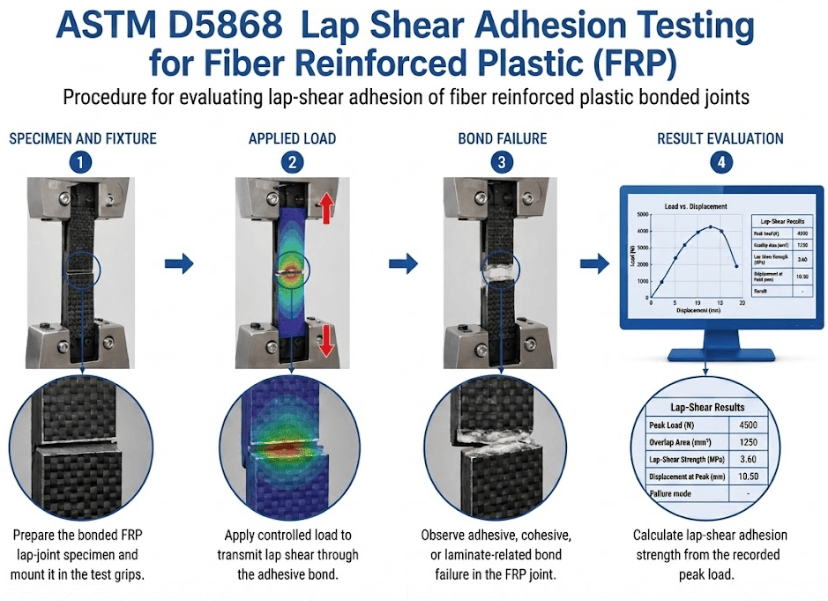
    Technicians select the FRP material(s) and adhesive system before preparing the bonded specimens. Next, they prepare the adherend surfaces for joining and form the single-lap joints as required. Then, operators mount cured samples in the testing fixture and load the sample at the desired rate. The testing machine records the load required to cause failure of the bonded joint. Lastly, engineers use the measured load and bonded area to determine the lap shear adhesion strength. The failed joint is also analyzed in the laboratory to determine the failure mode.

    This image shows a fiber-reinforced plastic bonded lap joint installed in a universal testing machine for ASTM D5868 lap-shear adhesion testing.
    ASTM D5868 Lap Shear Adhesion Testing of FRP

    Common Challenges and Troubleshooting

    Consistent surface preparation, adhesive application, joint alignment, and curing are important to obtaining an accurate ASTM D5868 result. Measured lap shear strength may be influenced by contamination or by variations in adhesive thickness. Technicians should ensure consistent specimen dimensions, consistent bond overlap, and no misalignment during assembly. Fixtures should also be aligned correctly, and test conditions should be controlled to ensure reliable results.

    ASTM D5868 Analysis Results and Interpretation

    A summary of the shear adhesion performance of the bonded FRP joint is provided. The laboratory reports the measured load, calculated lap shear strength, specimen information, and observed failure characteristics.

    Read more

    • The ASTM D5868 method generates lap shear adhesion values and not a general material property.
    • This lap shear strength is usually expressed in megapascals (MPa) or pounds per square inch (psi).
    • The maximum load can be given in N or lbf.
    • The bonded area is the basis for calculating lap shear strength.
    • The failure mode helps determine whether failure occurs in the adhesive, at the interface, or in the FRP adherend.
    • Laboratories can achieve reliable results through consistent surface preparation, adhesive application, and specimen alignment.

    Link to ASTM D5868

    FAQ

    Where can I get the astm d5868 tested?
    You can share your astm d5868 testing requirements with MaTestLab. MaTestLab has a vast network of material testing laboratories, spread across the USA and Canada. We support your all material testing needs ranging from specific astm d5868 test to various testing techniques.
    Please contact us for a detailed quote for your astm d5868 testing needs. Cost incurred to carry out different astm d5868 testing methodology depends on the type of raw material; number of samples, coupons, or specimens; test conditions, turn around time etc. Costs of some ASTM testing methods start from $100 and the final value depends upon the factors listed above. Please contact us for the best and latest prices.
    The required number of samples or specimens should comply with the procedure given in the astm d5868 standard. However, the MaTestLab operations team can assist you for your special requirements once you share your testing details with us.
    MaTestLab has a vast testing laboratory network, hence we bring you the best testing facilities in a cost-effective way. We offer considerable discounts (15-20%) to our returning customers based on test volume and frequency.
    The turnaround time for astm d5868 test methodology depends upon the test procedure mentioned in the standard test document. However, we at MaTestLab understand your research requirements and hence try to get your test completed within the least possible time.
    Laraib Hashmi
    About Author
    Laraib Hashmi
    Laraib Hashmi is an aspiring research enthusiast and science content professional with a strong interdisciplinary skill set, holding a postgraduate degree in Applied Microbiology from KIIT Bhubaneshwar, Odisha.
    Testimonials
    Real results
    Engineers trust us with what matters most
    Start Your Testing
    Project Today
    Define your requirements and get access to
    specialized laboratories ready to deliver results
    Partners with us
    Clients
    Vendors
    Process for testing
    • STEP 01

      You share your testing requirements

    • STEP 02

      You share your sample(s)

    • STEP 03

      We deliver your test reports

    Get your testing done

    Let us known your testing requirements and we will be right back with a solution.

      Let us root for each other. Collaborate to grow, expand, and accelerate our businesses.

      Partner with us

        Contact Us

        Discover more from MaTestLab

        Subscribe now to keep reading and get access to the full archive.

        Continue reading