ASTM D5649 Standard Test Method for Torque Strength of Adhesives Used on Threaded Fasteners
What is ASTM D5649?
ASTM D5649 is a standard test method for determining the torque strength of adhesives used on threaded fasteners. Technicians apply adhesive to a threaded fastener assembly, cure the adhesive under controlled conditions, and test the torque needed to break out the assembly. Engineers use these measurements to determine an adhesive’s effectiveness in securing or locking. The method also allows the laboratory to assess how curing time and environmental exposure affect the adhesive’s torque strength. Technicians use these steps to ensure fastener preparation, adhesive application, curing, conditioning, and torque measurement to achieve consistent comparative results. ASTM D5649 (ASTM D5649 Standard Test Method for Torque Strength of Adhesives Used on Threaded Fasteners ) is therefore applicable to the development of adhesives, material comparisons, quality control, and evaluation of the performance of threaded-fastener adhesives in controlled laboratory environments.
ASTM D5649 testing services help laboratories assess the torque strength of adhesives used with threaded fasteners. Qualified technicians make the threaded assemblies, apply the adhesive, control the curing conditions, and measure torque with suitable equipment. Manufacturers use these results to compare adhesive formulations, verify product performance, and aid quality-control programs. Professional laboratories also record the specimen data, testing conditions, measured torque, and final results.
What is the Scope of the ASTM D5649 Test Standard?
ASTM D5649 is a method for making comparative assessments of the securing or locking effect of adhesives used in threaded assemblies. The standard specifies how technicians should prepare test specimens, apply adhesives, cure them, and measure torque resistance. This standard-
Measures breakaway and prevailing torque of adhesive-bonded threaded fasteners.
Applies to threaded fasteners that technicians secure with adhesives and cure.
Measures locking performance using rotational torque.
Represents values in inch-pounds as standard.
Used to measure the level of cure and influence of the environment on torque strength.
Gives relatively reliable information for quality control, under conditions where safety is appropriately considered.
Helps laboratories assess the adhesive locking performance of threaded assemblies.
What are the Uses of ASTM D5649 Testing?
ASTM D5649 helps laboratories evaluate the torque strength of adhesives on threaded fasteners. Manufacturers and engineers use the results for quality control, product validation, and choosing the right glue. This standard-
Assesses the strength of thread-locking adhesive.
Measures breaking torque that is needed to start moving fasteners.
Calculates dominant torque when rotation is taking place.
Supports quality assurance in manufacturing processes.
Evaluates adhesion of automotive and aerospace assemblies.
Assesses vibration-damping joints in industrial equipment.
Helps with new adhesive development and research.
Which Materials Can Be Tested Under ASTM D5649?
ASTM D5649 is applicable to threaded fasteners that technicians can prepare for torque testing with adhesives. The method shows applicability to a variety of thread-locking adhesives used in threaded assemblies. The material should be appropriate for use on threaded fasteners, and technicians should cure it under certain conditions. The analyst should determine the adhesive type, fastener specifications, and thread clearance to obtain accurate results. The magnitude of the test results depends on the clearance between threads of test fasteners and the inclusion of air voids in the bond line.
Why is ASTM D5649 Important?
ASTM D5649 is a standard test method for determining the torque strength of adhesives for threaded fastenings. The reliability, safety, and resistance to vibration or dynamic loading forces of the joints are directly related to the locking capacity of the adhesive. Changes in either thread clearance or air bubbles in the bond line can affect test accuracy. Manufacturers and engineers use the results to verify adhesive locking performance, compare adhesive products, and ensure consistent assembly. Manufacturers and engineers also use these results as a quantified measure of torque strength to control the process, guarantee quality, and develop products.
ASTM D5649 Equipment and Sample Preparation Guide
ASTM D5649 requires appropriate adhesive-application equipment, torque-measuring equipment, conditioning facilities, and suitable threaded fasteners. Technicians prepare representative threaded assemblies and control the application and cure conditions of the adhesive before torque testing.
Sample and Specimen Details
Technicians apply adhesive to the threaded fasteners and allow the assembly to cure under specified conditions. Technicians maintain proper thread clearance for accurate results
Specimen Preparation
Technicians apply adhesive to threaded fasteners and allow the adhesive to cure under specified conditions.
Specimen Dimensions
Technicians select the fastener size, diameter, thread configuration, and substrate according to the applicable requirements or agreement. The interlaboratory study used 3/8 in. (9.525 mm) fasteners with 16 threads/in. (3/8 × 16 UNC) or 24 threads/in. (3/8 × 24 UNF).
Instrumentation
Technicians use a suitable torque-measuring device, fastener-holding fixtures, conditioning equipment, cleaning equipment, and adhesive-application tools.
Testing Procedures and Requirements for ASTM D5649
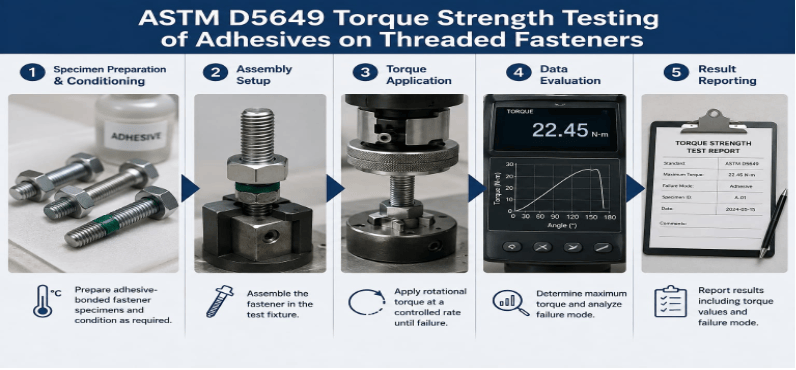
The laboratory makes representative fastener assemblies with adhesive and analyzes locking performance by applying controlled rotational torque. The laboratory records breakaway and prevailing torque values and compares them with the performance specifications. The ASTM D25649 test methods comprise the following test procedure-
Technicians apply adhesive to the threaded fasteners and allow the assembly to cure under specified conditions. Technicians maintain proper thread clearance for accurate results.
Assembly Setup
Technicians install the fastener assembly into a test fixture designed to measure rotational torque resistance.
Torque Application
Technicians apply controlled rotational torque to determine breakaway torque, the initial movement, and prevailing torque, the torque required to continue rotation.
Data Evaluation
Engineers record and analyze torque values to assess adhesive locking performance.
Result Reporting
Laboratories report breakaway and prevailing torque values in inch-pound units and include relevant test conditions and observations.
ASTM D5649 Testing Process and Data Collection
Technicians apply glue to threaded fasteners and dry it under set conditions. The technician uses a torque measurement test fixture to hold the fastener assembly. The technician applies torque until the load begins rotating and records the torque required to start the load moving. The technician keeps rotating to determine the torque that occurs. The lab is then able to record and analyze the torque values, evaluating the adhesive locking performance. Technicians make a report of the torque reading, the calculated torque, and the specimen and test conditions. This result is in inch-pounds of torque.
ASTM D5649 Torque Strength Testing of Adhesives on Threaded Fasteners
Common Challenges and Troubleshooting
Inaccurate results in ASTM D5649 testing are possible if technicians use improper thread clearance, install air bubbles in the bond line, and don’t provide adequate curing conditions. Alternatively, a variety of fastener types or incorrect torqueing could influence measurement accuracy. The technician always ensures that specimens have the correct thread clearance and that the adhesive is completely cured. The technician also maintains the torque measurement instrument in proper calibration. If there is any significant difference in the repeated measurements, then the laboratory has to check the validity of the specimen preparation, curing conditions, instrument calibration, or measurement setup before reporting the final measurement. If the laboratory uses the results of this test method to determine quality acceptance or rejection, it should apply appropriate safety factors for this purpose.
ASTM D5649 Analysis Results and Interpretation
The report summarizes the rotational torque analysis of adhesive locking performance for samples of threaded fasteners. The laboratory compares the measurement results to the specified performance requirements.
Laboratory reports breakaway torque as the torque required to initiate fastener movement after curing, typically in lbf·in or N·m, as applicable.
Technicians record prevailing torque as the torque required to maintain fastener rotation and report it in lbf·in or N·m.
Analysts evaluate measured breakaway and prevailing torque values to characterize the adhesive’s locking performance under the specified test conditions.
Engineers record relevant test conditions, including curing conditions, fastener information, and measurement data, to support interpretation and comparison of results.
Engineers compare the measured torque values with applicable specifications or performance requirements to evaluate adhesive locking effectiveness and joint reliability.
FAQs
What does ASTM D5649 measure?
ASTM D5649 is a test that determines the torque strength of adhesives applied to threaded fasteners. Engineers use the results to compare the performance of adhesives used for securing.
What equipment does ASTM D5649 require?
ASTM D5649 specifies the torque measuring equipment, fastener fixtures, and threaded fasteners, as well as appropriate equipment for application and conditioning of the adhesive.
Gokula Srinivasan Selvam is a Material Testing Associate at Matestlab Inc. and holds a postgraduate degree in Ceramic Engineering from IIT (BHU), Varanasi. His academic background and professional experience are centered on advanced ceramic materials, their processing, characterization, and performance evaluation. Know More
Testimonials
Real results
Engineers trust us with what matters most
“We had a great experience working with this company for our ASTM E84 testing. They were the first company to respond to our inquiry within just a few minutes of submitting it. From start to finish, the communication was excellent, and the entire process was swift, straightforward, and hassle-free.”
Ivars FancyWalls
United States
“Very good communication, testing associates were very patient with delays on our end. Reasonable turnaround time for results and nicely detailed report. Analysts were also quick to answer any follow-up questions. Happy with results.”
Skye Henderson
United States
“Matestlab connected us with an accredited lab within days, cutting weeks off our product validation timeline.”
Rebecca Kozodoy-Pins
United States
Start Your Testing Project Today
Define your requirements and get access to specialized laboratories ready to deliver results